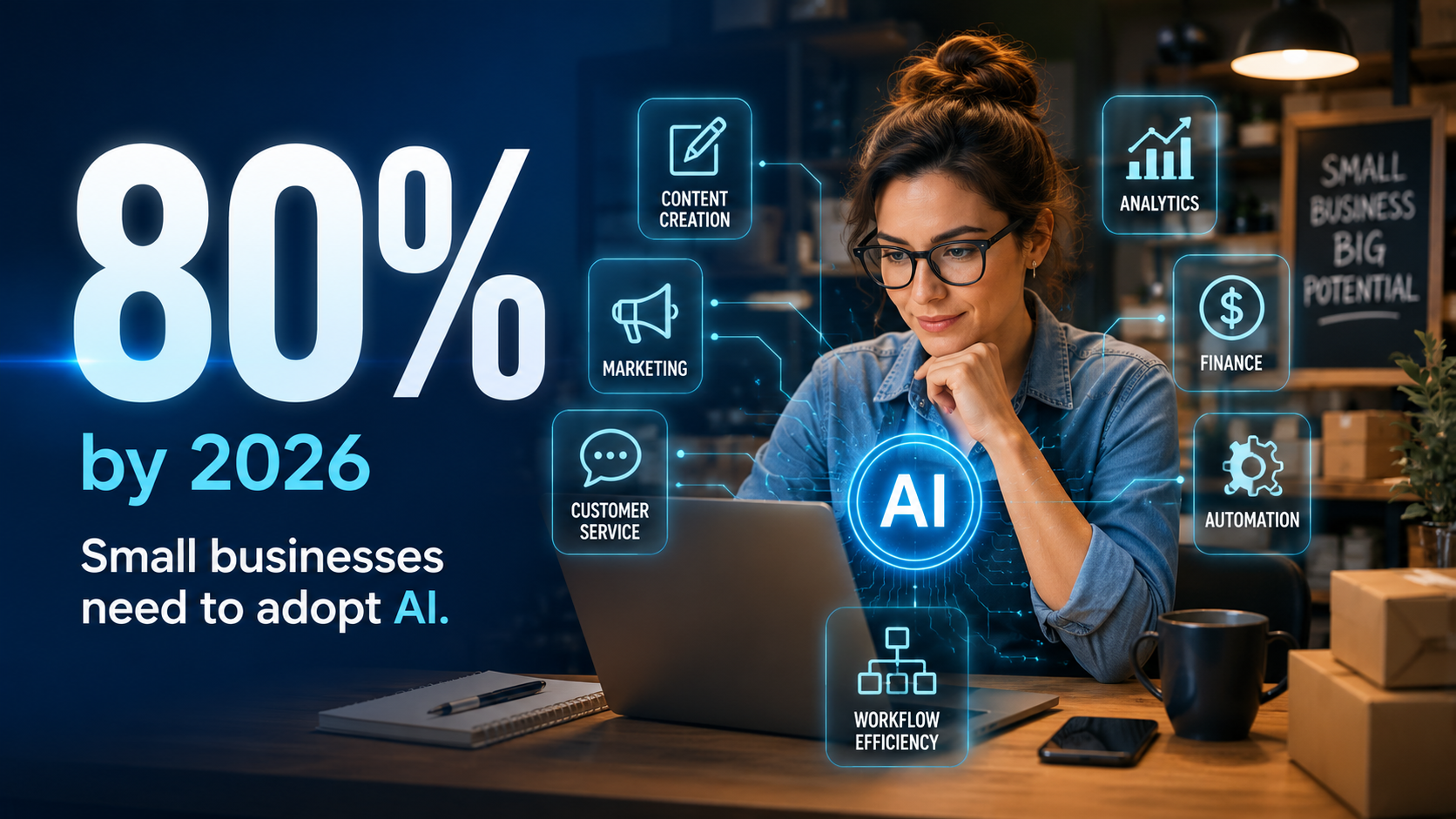
The Reality Check: 80% Adoption Isn't Optional Anymore
By 2026, nearly 80% of small businesses will use AI for marketing. That's not a prediction—it's a deadline. If you're a solopreneur or run a team under 50 people, this shift will determine whether you're competing or getting left behind. The question isn't whether to adopt AI; it's which AI tools solve your highest-friction problems right now.
The reason adoption is accelerating isn't hype. It's ROI. When five hours per week of manual work costs you $150 in labor, and an AI tool costs $20-50 per month, the math is undeniable. Most small business owners don't have the luxury of hiring specialists. AI fills that gap without requiring a developer or deep technical knowledge.
Where Small Businesses Are Winning With AI Today
Content Creation: The 99% Time Reduction That Actually Works
Sage Publishing cut content drafting time by 99% and marketing costs by 50% using Jasper AI for textbook marketing copy. That's not an outlier—that's the baseline for what AI content tools deliver.
Here's what you can automate immediately:
- Blog posts and social media content: ChatGPT Plus ($20/month) or Jasper ($49/month) can generate multiple variations of posts in minutes instead of hours.
- Email campaigns: AI generates personalized email sequences based on customer segments, increasing engagement without additional copywriting time.
- Product descriptions: For e-commerce, AI eliminates the bottleneck of manual product copy—critical if you're managing inventory at scale.
- A/B testing variations: Instead of writing two versions of ad copy, AI generates 5-10 variations for testing, accelerating optimization cycles.
The tangible benefit: One solopreneur can maintain a consistent content calendar that would normally require a part-time employee. That's $15,000-25,000 in annual labor you're not paying.
Visual Content & Design Without the Designer Budget
Canva Pro ($12.99/month) with AI features replaces hiring a graphic designer for social posts, email headers, and marketing materials. You're not building design skills—you're leveraging AI to produce professional-grade visuals in minutes.
For small businesses running on thin margins, this is a direct cost reduction. Design requests that would cost $50-150 per asset now cost under $13 monthly in tools.
Financial Management: Real-Time Insights Without an Accountant
QuickBooks' AI features automatically categorize transactions, detect anomalies, and generate financial reports. This solves two critical problems for small business owners:
- Reduced data entry errors: Manual categorization is error-prone and time-consuming. AI eliminates both.
- Real-time financial visibility: Instead of waiting for month-end reconciliation, you see cash flow trends and anomalies immediately. This matters when you're managing tight cash cycles.
For a solopreneur managing their own books, this reclaims 5-10 hours monthly—time you can spend on revenue-generating work.
Customer Service: Scaling Response Time Without Scaling Headcount
HubSpot's free chatbot or Jotform AI Agents ($9-29/month) handle first-response customer service at scale. Common use cases:
- Order status inquiries answered instantly
- FAQ handling without human intervention
- Lead qualification before they reach your inbox
- Support ticket routing to the right person
The impact: Average customer response time drops from hours to seconds. For small businesses competing against larger competitors, this is a significant advantage.
Inventory & Demand Forecasting: Stop Guessing on Stock
AI algorithms analyze sales patterns, seasonal trends, and external factors to predict when products will run low and automatically trigger reorders. This prevents two costly mistakes: stockouts (lost revenue) and excess inventory (tied-up cash).
For retailers and product-based businesses, this means better cash flow management and customer satisfaction—two metrics directly tied to profitability.
The 2026 Inflection Point: AI Agents and Automated Workflows
By 2026, AI agents—autonomous systems that complete multi-step business processes with minimal human intervention—will become the competitive standard. This is beyond chatbots or content generation.
What does this look like in practice?
- Finance: An AI agent manages invoices end-to-end: tracks payments, reconciles transactions, flags overdue accounts, and initiates collection processes. No accountant required for routine financial management.
- HR and Onboarding: A system schedules training, tracks employee progress through personalized learning programs, and flags performance issues without manual monitoring.
- Supply Chain: Automated reordering and inventory management based on predictive demand models, reducing manual oversight.
The small business advantage: These workflows compress processes that normally require 2-3 full-time employees into a system that costs 1/10th as much. You scale without scaling headcount.
Measuring AI ROI: The Math That Matters
To make investment decisions, track these metrics:
- Time saved per week: Measure hours recovered from automation tasks. At $30/hour average labor cost, five hours saved weekly = $150 in value. Most AI tools cost $20-50/month—that's a 3-7x ROI in the first month.
- Lead conversion improvement: AI-powered follow-up and personalization increase conversion rates. A 5-10% improvement in conversion directly adds revenue.
- Customer response time: Faster response = higher satisfaction and retention. Quantify this as reduced churn or increased repeat purchase rate.
- Operational cost reduction: Content creation, bookkeeping, and support are quantifiable labor costs. Measure cost-per-output before and after AI implementation.
The framework: Pick one high-friction process, measure baseline performance (time spent, cost, quality), implement an AI tool, and measure again after 30 days. If the tool doesn't deliver measurable value, move to the next priority.
The Competitive Urgency: Act in 2026, Not 2027
Small businesses that build agentic workflows and embed AI into customer-facing operations will scale more effectively and become more agile. Those that don't will find themselves competing against businesses that operate with 30-50% less overhead and faster execution cycles.
This isn't about being a tech company. It's about being efficient and competing on speed and scale. By 2026, that's non-negotiable.
Your next step: Identify your top three manual, repetitive processes. Audit how many hours they consume monthly. Then find an AI tool that solves for that specific problem. Start with one tool, measure the impact, and expand from there. The businesses that move first build sustainable operational advantages.