Agentic AI Business: How AI Agents Are Changing the Way Companies Work
For the past few years, most businesses have thought about artificial intelligence as a productivity tool. AI could write emails, summarize meetings, generate marketing copy, analyze spreadsheets, or help employees brainstorm ideas. That was useful, but it was still mostly assistant-style AI.
Agentic AI is different.
Instead of simply responding to a prompt, agentic AI systems can pursue a goal, make decisions, use tools, interact with software, and complete multi-step tasks. In business terms, this means AI is beginning to move from “help me do this” to “go do this, check the result, and tell me when it is done.”
That shift could become one of the most important business technology changes of the next decade.
What Is Agentic AI?
Agentic AI refers to artificial intelligence systems that can act with a degree of autonomy. A traditional chatbot answers questions. An AI agent can take a business objective and work through the steps needed to accomplish it.
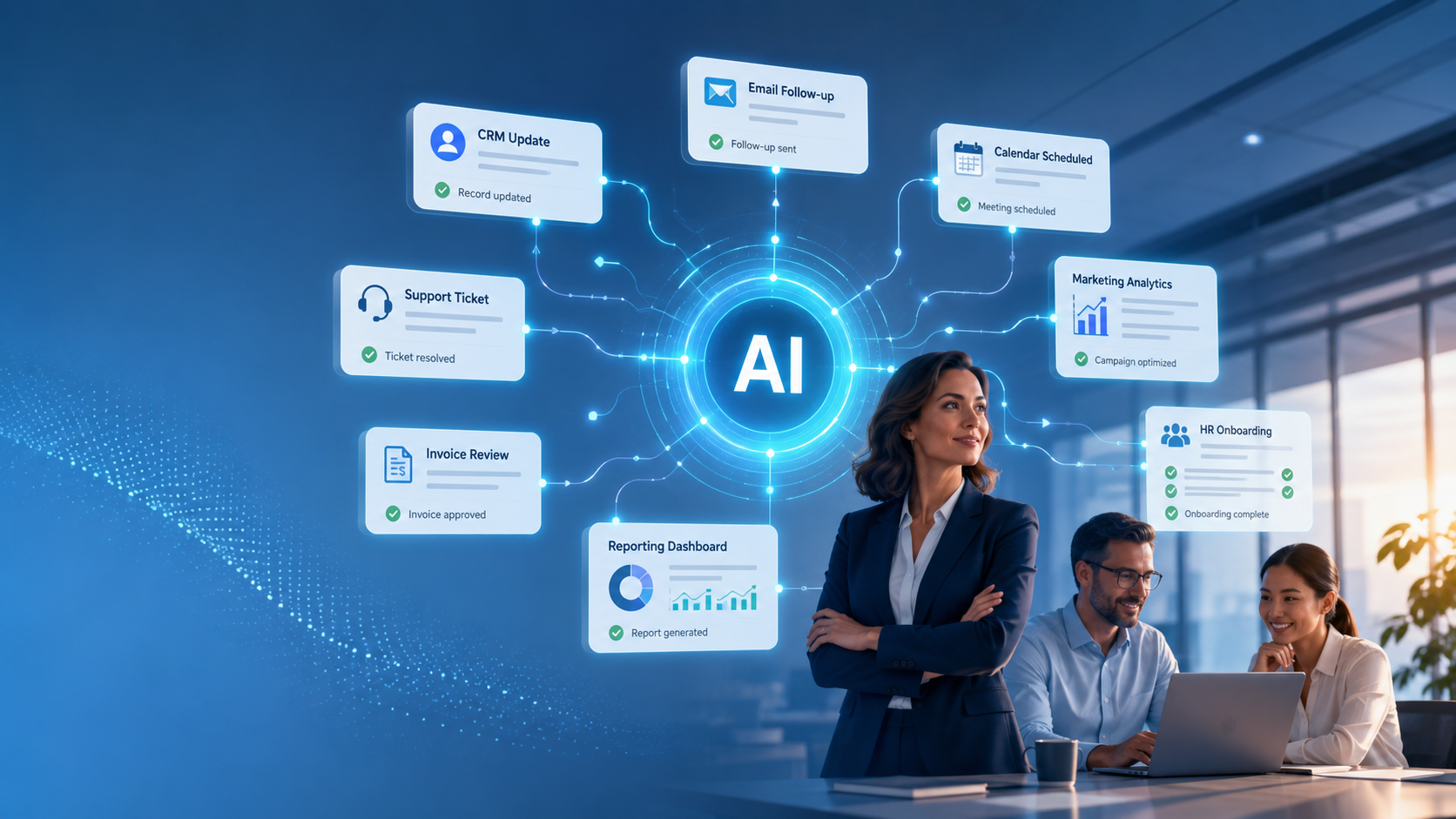
For example, a chatbot might explain how to follow up with a sales lead. An AI agent could review the CRM, identify inactive leads, draft personalized follow-up emails, schedule reminders, update records, and alert a sales manager when a promising prospect responds.
The key difference is action.
Agentic AI does not just generate information. It can participate in workflows.
Why Businesses Are Paying Attention
Businesses are interested in agentic AI because many office processes are repetitive, rule-based, and spread across multiple systems. Employees often spend large amounts of time moving information from one platform to another, checking statuses, preparing reports, sending reminders, and handling routine decisions.
AI agents are well-suited for this kind of work.
A business does not necessarily need one giant AI system. More likely, companies will use many specialized agents: one for customer support, one for sales operations, one for invoice review, one for HR onboarding, one for marketing reporting, and one for internal knowledge management.
This is why agentic AI may become less of a “tech department” issue and more of an operations strategy.
Practical Business Uses for Agentic AI
The most valuable uses of agentic AI are likely to appear in workflows where speed, consistency, and coordination matter.
In customer service, AI agents can classify tickets, pull customer history, suggest solutions, escalate complicated cases, and update support records. In sales, they can research prospects, prepare account briefs, monitor pipeline activity, and remind representatives when action is needed.
In finance, agentic AI can assist with invoice matching, expense review, fraud alerts, cash-flow monitoring, and routine reporting. In marketing, agents can track campaign performance, summarize trends, recommend content updates, and help repurpose material across channels.
Human resources departments can also use AI agents for onboarding checklists, policy questions, benefits reminders, training assignments, and internal communications.
The real business value comes when these agents connect separate steps into a smoother process.
The Big Opportunity: Workflow Automation
The most important phrase in agentic AI business is not “artificial intelligence.” It is “workflow.”
Companies do not make money simply because they have AI. They make money when work gets done faster, cheaper, better, or at larger scale.
That means the best agentic AI projects should start with a specific business process, not a vague desire to “use AI.” A company should ask:
- What process takes too long?
- Where do employees repeat the same steps every day?
- Where do errors happen?
- Where do customers wait?
- Where does information get stuck?
Agentic AI is most powerful when it is assigned to a defined workflow with clear goals, data access, permission limits, and measurable results.
The Risks Are Real
Agentic AI also creates new risks because agents do not merely produce text. They can take action.
If an AI agent has access to customer records, financial systems, email, or internal databases, companies need strong controls. A poorly governed agent could make mistakes, expose sensitive data, send incorrect messages, or take actions without enough oversight.
This is why businesses should avoid treating AI agents like ordinary software features. They are closer to digital workers with permissions, responsibilities, and audit trails.
Good governance should include human review for high-risk decisions, clear permission boundaries, strong data security, logging, monitoring, and regular performance checks.
The more autonomy an AI agent has, the more accountability a business needs.
Small Businesses Should Pay Attention Too
Agentic AI is not only for large corporations. Small businesses may eventually benefit even more because they often lack large administrative teams.
A local service business could use an AI agent to respond to inquiries, qualify leads, send estimates, schedule appointments, and follow up with customers. A small e-commerce company could use agents to monitor inventory, answer product questions, prepare social media posts, and flag unusual order patterns.
For small businesses, the advantage is leverage. Agentic AI can help a small team operate with the coordination of a much larger one.
However, small businesses should start carefully. The best first step is usually a low-risk workflow, such as drafting responses, organizing leads, summarizing customer requests, or preparing reports. Once the business trusts the process, it can gradually give the agent more responsibility.
The Human Role Will Change
Agentic AI does not eliminate the need for human judgment. In many cases, it makes judgment more important.
As AI agents handle routine steps, humans will spend more time setting goals, reviewing exceptions, managing relationships, making strategic decisions, and supervising automated workflows. The employee becomes less of a manual processor and more of a manager of systems.
This will require new skills. Workers will need to understand how to delegate to AI, check AI output, define good instructions, spot errors, and decide when human intervention is needed.
The businesses that benefit most will not simply replace people with agents. They will redesign work so people and agents each do what they do best.
How to Start With Agentic AI
A smart agentic AI strategy begins small.
First, identify a repetitive process with a clear outcome. Second, map the steps involved. Third, decide what data and tools the agent needs. Fourth, set boundaries around what the agent can and cannot do. Fifth, keep a human in the loop until the system proves reliable.
A good first project might be something like customer inquiry routing, weekly sales summaries, meeting follow-ups, invoice preparation, or content repurposing.
The goal is not to automate everything at once. The goal is to build confidence, learn what works, and expand gradually.
The Bottom Line
Agentic AI may become the next major phase of business automation. Chatbots made AI familiar. Agents may make AI operational.
The companies that succeed will not be the ones that chase hype. They will be the ones that identify real workflows, apply AI agents carefully, measure results, and build strong governance from the beginning.
Agentic AI is not just about smarter software. It is about changing how business work gets done.
https://join.glideapps.com/crguapkcem5h