AI Agents Move From Demos to Your Daily Operations
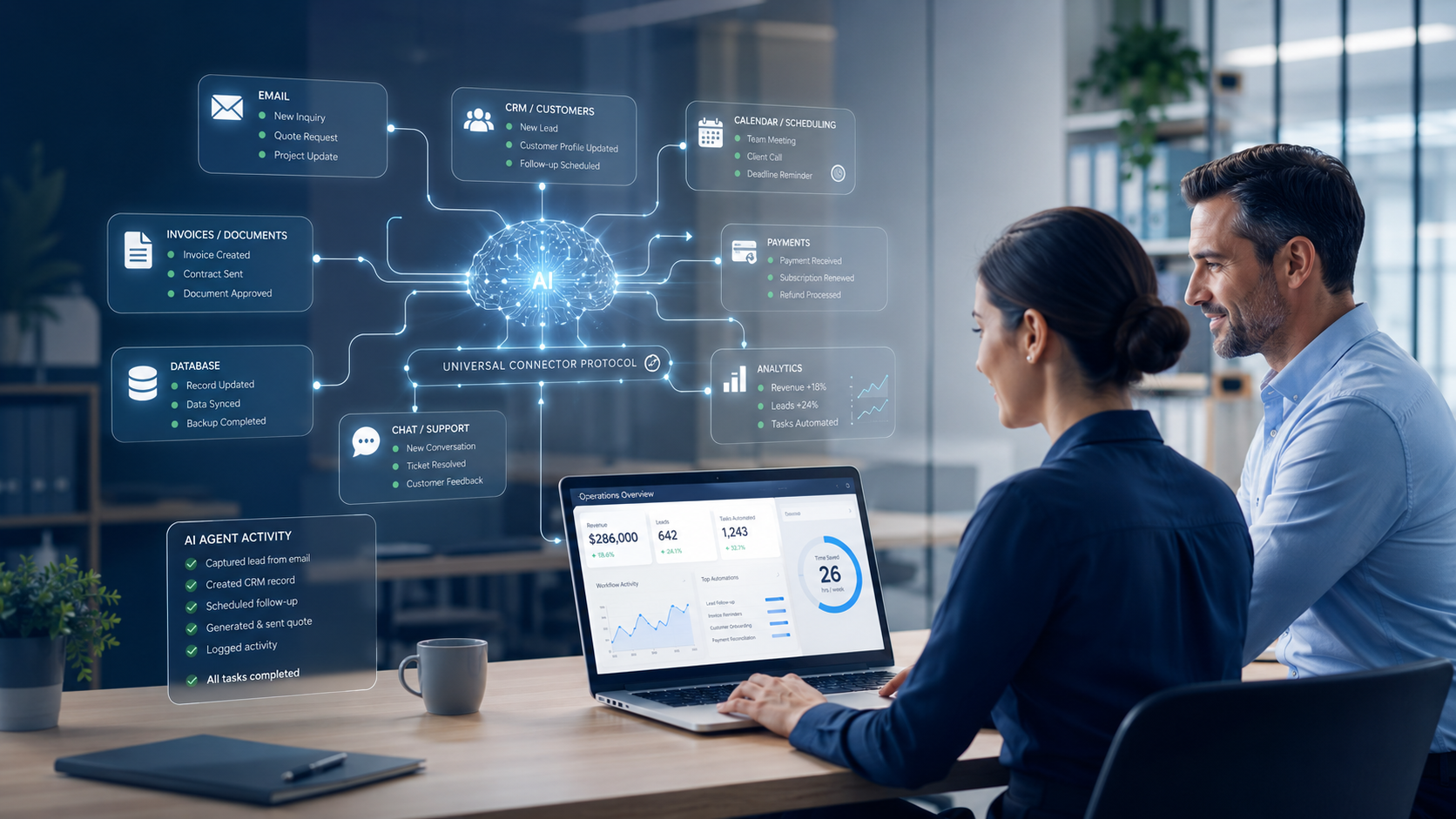
For three years, we've heard "AI agents are coming." In 2026, they're actually here—and small business owners need to pay attention. The difference between last year's hype and this year's reality? A technical standard called Model Context Protocol (MCP) that finally lets AI agents talk to your real business systems.
Here's what changed: AI agents couldn't reliably connect to your databases, customer records, payment systems, or APIs. They could talk about doing things, but couldn't actually do them. MCP solves this. Think of it as "USB-C for AI"—a standardized connector that lets agents access the tools you already use.
OpenAI, Microsoft, Anthropic, and Google have all embraced MCP. Anthropic even donated it to the Linux Foundation's Agentic AI Foundation. This isn't academic stuff. This is three of the four AI giants agreeing on how AI agents work. That signals the market has moved from fragmented experimentation to practical standardization.
What This Means for Your Bottom Line
Small businesses running on 1-50 employees typically waste 20-30% of their team's time on repetitive, non-strategic work. Customer service responses, order entry, invoice follow-ups, scheduling—these are the jobs AI agents can now handle reliably.
With MCP-enabled agents, you can:
- Automate customer service routing. An AI agent reads incoming emails, categorizes them, pulls relevant customer history from your CRM, drafts responses, and flags complex issues for humans. You handle the nuanced conversations; the agent handles the volume.
- Manage repetitive back-office work. Invoice processing, expense categorization, lead qualification—these agents run on your actual systems, not in sandboxes.
- Scale without hiring. Gartner predicts that by 2030, AI-native development platforms will enable organizations to shrink large software teams into smaller groups augmented by AI. For small businesses, this means one person can manage workflows that previously required two or three.
The ROI arrives because agents are now actually connected to your operations. Last year, an AI agent could theoretically help you manage a task. This year, it can complete the task end-to-end.
Two Practical Starting Points for 2026
Start with your most time-consuming repeatable process. Identify one workflow where a team member spends 5+ hours weekly on predictable, rule-based tasks. Customer inquiry triage. Invoice entry. Lead scoring. Pick one, define the rules, and test an AI agent on a subset of real data.
Tools like OpenAI's GPT agents with integrated actions, Microsoft's Copilot with MCP, or Claude agents can start this work within days, not months. You don't need a dedicated AI engineer—many small business owners are building their first agents using no-code platforms like Zapier's AI features or Make.com with agent capabilities.
Measure ROI in hours saved, not just cost reduction. If one agent handles 30 customer emails per day that previously took 3 hours of manual work, that's 15 hours per week freed up. At a $50/hour all-in cost for that labor, that's $750 weekly or $39,000 annually in reclaimed capacity. That's a year of tool costs for most small businesses in the first quarter.
Why 2026 Is Different From Previous "AI Will Automate Everything" Claims
In 2024-2025, AI automation promised more than it delivered because agents couldn't reliably interact with existing business systems. They could write code, but couldn't execute it. They could suggest actions, but couldn't trigger them. The gap between what AI recommended and what actually happened in your business was huge.
MCP closes that gap. When an AI agent writes an instruction to "update the customer record and send a confirmation email," it can now actually connect to your database and email system and do it. The agent isn't guessing or hoping—it's executing on your real infrastructure.
This is why major platforms are moving fast. Microsoft embedded MCP into Copilot. Google built managed MCP servers for its products. When the three largest AI companies decide to standardize on the same connector protocol, it's not a trend—it's the beginning of a platform shift.
The Realistic Timeline for Small Businesses
You don't need to hire an AI specialist or rebuild your entire tech stack. The realistic 2026 roadmap looks like:
- January-February: Audit your top 3 time-draining processes. Pick the most suitable for automation.
- February-March: Test an agent with a limited dataset. Use free or trial tools (OpenAI Playground, Claude API, Anthropic's free tier).
- March-June: If the pilot shows 20%+ time savings, deploy it to your full workflow. Costs typically start at $20-50/month for agent services.
- June+: Repeat with your next workflow.
Small businesses that move on this now—not next year, this year—will have agents handling 15-25% of their operational volume by Q4 2026. Competitors waiting for "more proven" solutions will still be planning in 2027.
One More Thing: You Don't Need Physical AI Yet
The research mentions physical AI (robots, autonomous vehicles, wearables) entering the market in 2026. This is real, but it's not relevant to most small businesses yet. Robotics and autonomous vehicles are still expensive. Focus on digital agents first—they deliver ROI in weeks, not years.
Wearables and edge AI will matter to certain industries (healthcare, field operations), but 90% of small businesses will see immediate value from agents that automate customer service, data entry, and back-office tasks. That's where to start.