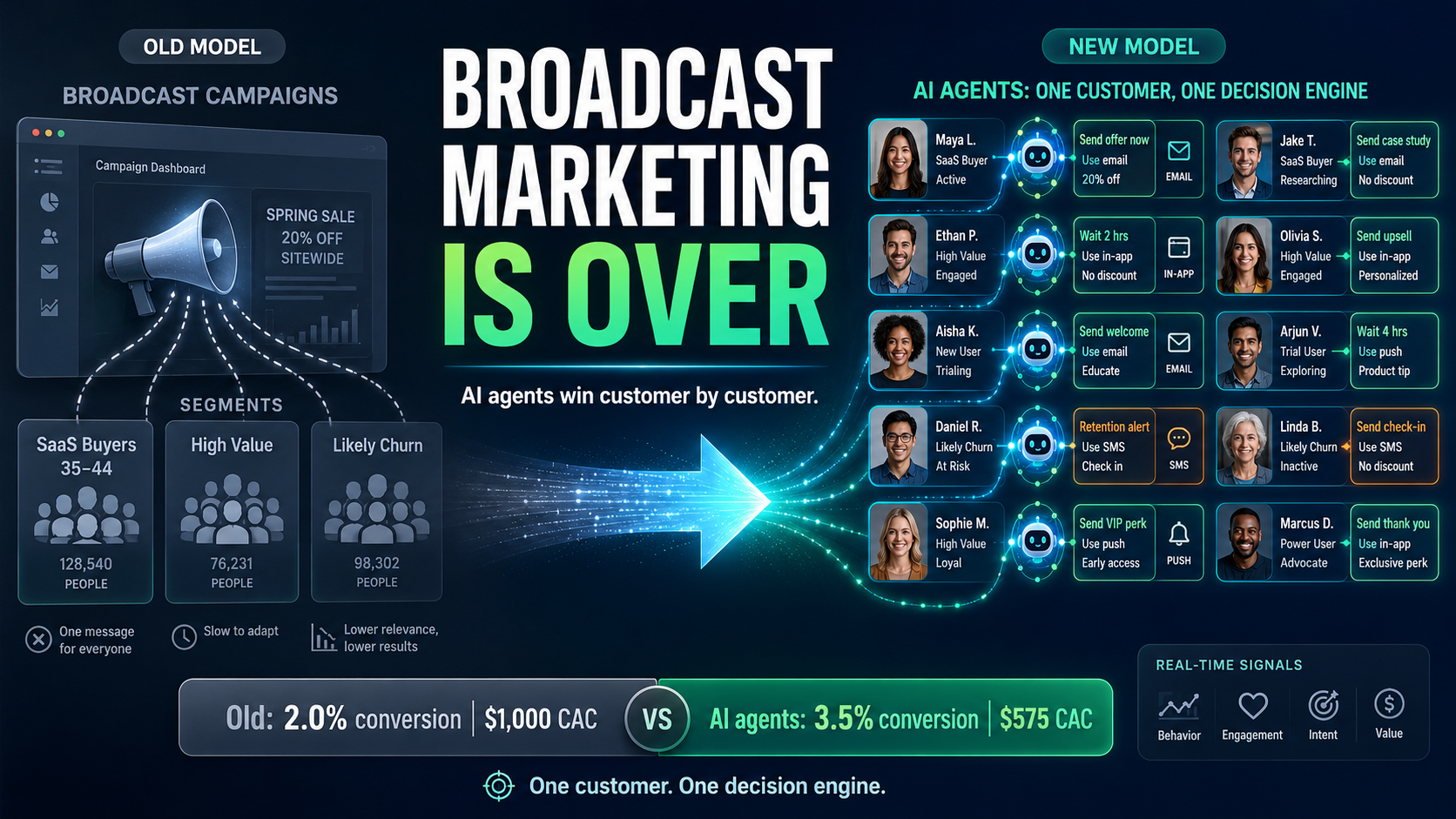
The Era of Broadcast Marketing Is Over
Your customer segments are lies. Well, not entirely—but they're increasingly useless. A segment called "mid-market SaaS buyers aged 35-44" tells you nothing about whether Sarah in accounting will actually buy your product in March, or whether she needs a discount, or whether she's seconds away from churning.
This is why AI agents are becoming the new unit of customer acquisition. Instead of one marketing campaign reaching thousands of people in a segment, brands are deploying individual AI agents—one per customer—that make real-time decisions about what to say, when to say it, and to whom.
The evidence is immediate and financial. MoEngage's 2026 acquisition of Aampe—an AI agent platform used by delivery giant Swiggy, ride-sharing platform Grab, and fintech Taxfix—came as the company signed "three to four multimillion-dollar annual contract value deals" with customers migrating directly from Salesforce and Adobe. Aampe itself grew annual recurring revenue by 150% over a single year. Enterprise software companies aren't investing tens of millions in acquisitions because the technology is neat. They're betting their growth on it because it works.
How Per-Customer AI Agents Actually Work
The mechanism is simpler than it sounds, but the implications are profound.
Traditional marketing uses rules-based campaigns: "If customer clicked email, then send discount. If customer is in segment 'high-value,' then prioritize retention." AI agents work differently. Each customer gets a dedicated AI that:
- Observes that customer's actual behavior in real time
- Predicts their likelihood to buy, churn, or respond to a specific message
- Autonomously decides which channel to use (email, SMS, in-app, push notification)
- Chooses the message content and timing without waiting for a human marketer to build a campaign
- Learns and adapts as that customer's behavior changes
This isn't personalization in the way most marketers use the term (dynamic first names in emails don't count). This is behavioral economics at scale. An AI agent assigned to one customer knows her purchase history, browsing patterns, response timing, sensitivity to discounts, and preferred communication method. It can infer that she's ready to buy—or that she's about to leave—before she consciously realizes it herself.
The result: higher conversion rates, lower acquisition costs, and reduced wasted spend on customers who were never going to convert anyway.
Why This Beats Salesforce and Adobe's Old Approach
Salesforce Marketing Cloud and Adobe Experience Cloud—the platforms companies are now leaving—are powerful tools. But they're built on centralized decision-making. A marketer or data analyst creates segments, builds campaigns, sets triggers, and launches. The system executes the decision, but a human made it.
Aampe and similar platforms invert this model. Decisions are decentralized. Each customer's AI agent makes millions of micro-decisions—too many, too fast, and too context-specific for any human to make manually. A human marketer might send 12 email variations across a year. An AI agent might test 1,000 message variations in the same timeframe, isolate which work best for that specific customer, and ship results weekly.
The migration data tells the story: enterprises switching from legacy platforms to AI-agent-first systems are doing so because the ROI gap is visible. If Salesforce's traditional segment-based approach generated a 2:1 return on ad spend, and an AI agent system generates a 3.5:1 return, the decision becomes financial, not philosophical.
What This Means for Small Businesses Right Now
If you're running a small business with 1-50 employees, you might assume this technology is out of reach. It isn't—but the adoption path looks different than for enterprise customers.
First, recognize what you already have: If you're using Shopify, HubSpot, Segment, or even a basic email platform, you have access to customer behavior data. You have purchase history, engagement patterns, and churn signals. Most small businesses are sitting on this data and not using it effectively.
Second, understand the gap: Running customer acquisition today using traditional segments is like navigating with a map from 1985. You're not wrong—you're just operating with less information than you could be. Every customer who doesn't hear from you until a broad campaign launches is a missed opportunity to catch them at their moment of highest intent.
Third, start with prediction, not full autonomy: You don't need full AI agents yet. You can start by using predictive analytics to identify which customers are most likely to respond to an offer this week, then manually reach out with higher-intent messaging. Tools like Segment or Mixpanel give you this data; you just need to act on it faster than you currently are.
Fourth, expect the tools to consolidate: Within 24-36 months, every major marketing platform—HubSpot, Klaviyo, even Mailchimp—will embed per-customer AI agent capabilities. When that happens, the cost to deploy will drop sharply. Early adopters who move now build institutional knowledge; later movers will simply flip a switch and match you at lower cost. But early movers will have 18+ months of learned optimization on their competition.
The Math of AI-Driven Acquisition
Here's a concrete scenario: assume you spend $10,000 monthly on customer acquisition across email and paid social. If your current approach reaches 500 prospects with a 2% conversion rate, you acquire 10 customers at a $1,000 CAC.
With AI agents personalizing outreach—better targeting, better timing, better message—you might see 3.5% conversion rates on that same spend. Now you acquire 17-18 customers at $550-600 CAC. On a $10K monthly budget, that's an extra $4,000-4,500 in monthly customer value. Annualized: $48,000-54,000 in additional revenue from identical spend.
That's why enterprises are migrating from Salesforce. That's why MoEngage's deal with Aampe matters. The margin improvement is real, measurable, and immediate.
What to Do This Month
1. Audit your current segments. List every customer segment you're targeting. Ask: "How many segments of one customer would I actually need to describe them?" The answer is revealing.
2. Identify your highest-intent signals. What does a customer do right before they buy? Spend time on your pricing page? Open three emails in a row? Browse for 10+ minutes? Document these signals.
3. Test micro-cohorts. Instead of targeting "SaaS founders," test targeting "SaaS founders who visited pricing page + opened last email + haven't purchased in 6+ months." Measure the conversion lift.
4. Map your tech stack for data flow. Can your email platform talk to your analytics tool? Can your CRM pull in behavioral data? If not, that's your first infrastructure project.
5. Plan your upgrade timeline. Which platforms in your stack will support AI agents in the next year? Which migrations make financial sense?
The future of customer acquisition isn't segments. It's decisions made at the individual level, at machine speed, grounded in behavioral reality. The companies winning now—Swiggy, Grab, Taxfix—are already operating this way. The question is whether you'll lead or follow.