Your Team Is Drowning in Repetitive Tasks. Here's How to Fix It.
If you're running a business with fewer than 50 employees, you already know the math: there are only so many hours in a day, and your team spends too many of them on work that doesn't require human judgment. Data entry. Email sorting. Invoice processing. Password management. These tasks pile up faster than you can delegate them.
The solution isn't hiring more people. It's automation.
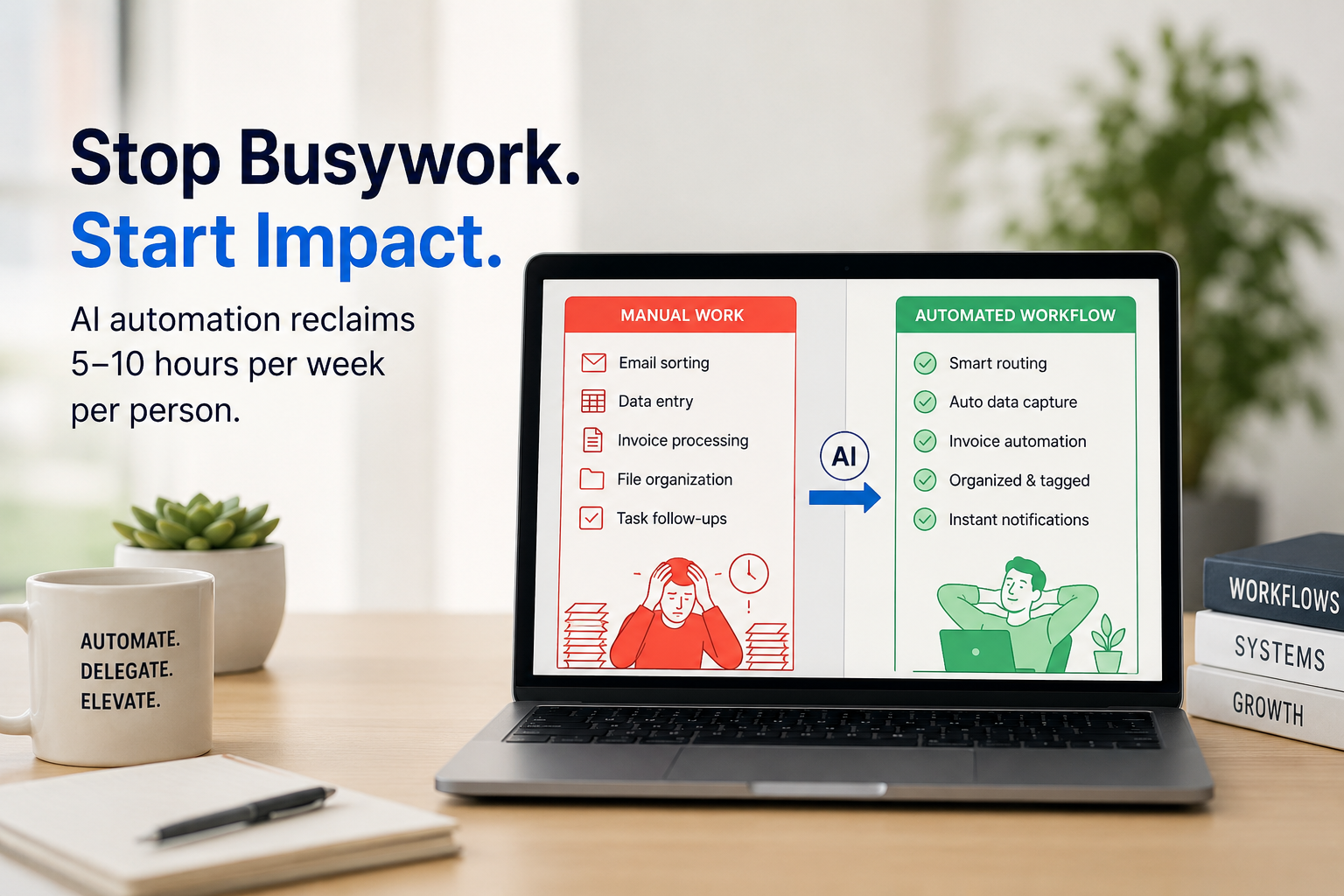
AI-powered workflow automation has matured past the "nice-to-have" stage. Tools like Levity and Box now make it possible for non-technical teams to automate complex processes without writing a single line of code. The result: your team reclaims 5-10 hours per week per person—time that goes toward revenue-generating work instead of busywork.
Here's what you need to know to implement it yourself.
Why Your Manual Workflows Are Costing You Real Money
Let's say one team member spends 2 hours daily on repetitive tasks. That's 10 hours per week, or roughly 520 hours annually. If that person earns $50,000/year, you're losing $12,500 in productive capacity to automation-preventable work.
Now multiply that across even a small team of five. That's $62,500 in annual opportunity cost.
Automation doesn't eliminate the need for oversight—it eliminates the need for mindless execution. The difference is significant.
Where to Start: The Five High-Impact Automation Opportunities
1. Email and Message Routing
Every email that lands in a shared inbox requires human sorting: Is this a customer complaint? A lead? A vendor invoice? An AI workflow can read incoming messages, classify them, and route them to the right team member or project—all before anyone manually touches the message.
Implementation reality: You can set this up in under an hour using tools like Zapier or native email filters. The payoff: eliminate the daily 15-minute email triage ritual across your team.
2. Form Submission Processing
When customers fill out a contact form, quote request, or service application, where does that data go? Into a spreadsheet? An email? A CRM you have to manually update?
AI automation can pull form data, validate it, enrich it (adding company information from public records), and push it directly into your CRM or database. Levity and similar tools specialize in this exact workflow and require no code knowledge.
Real impact: A service business processing 50 forms per month saves 8-10 hours monthly on data entry alone.
3. Invoice and Receipt Management
Your accountant spends time extracting invoice data, matching receipts to transactions, and categorizing expenses. AI can do this automatically. Tools can read PDFs and scanned documents, extract amounts and vendor names, and log them into your accounting system.
The math: Processing 100 invoices monthly by hand takes 5-6 hours. Automated, it takes 30 minutes of setup plus quality checks.
4. Document Organization and Naming
Chaos in your file systems costs time and invites mistakes. When a customer sends a contract, a proposal, or a project brief, it lands somewhere on your computer or cloud drive. Finding it again requires a search or scrolling through folders.
Workflow automation can rename files automatically based on content (using AI to read the document), move them to the correct folder, and tag them for easy retrieval. Box and similar enterprise platforms make this seamless.
5. Task Creation and Notifications
When a customer email arrives, does someone manually create a follow-up task? Does a sale in Stripe trigger a fulfillment checklist? These connections are prime automation targets.
Set up triggers: When X happens (new customer sign-up, invoice marked overdue, support ticket marked urgent), automatically create a task, send a notification, or launch a sequence of actions. This keeps workflows moving without manual intervention.
The Tools You Actually Need (No PhD Required)
For beginners: Start with Zapier or Make (formerly Integromat). These platforms connect your existing tools—Gmail, Slack, Stripe, Airtable, Google Sheets—without requiring code. They're visual: you point and click to build workflows.
For form-heavy processes: Levity adds AI intelligence to common business processes. It can read and understand emails, documents, and submissions in context, making smarter routing and categorization decisions than basic automation.
For enterprise-grade workflows: Box provides AI-powered content classification and workflow automation, useful if your business processes large volumes of documents or handle sensitive data.
For Google Workspace users: Google Apps Script lets you automate within Gmail, Sheets, and Drive. The learning curve is steeper, but it's free and deeply integrated with tools you already use.
The Implementation Reality: How Long This Actually Takes
You've heard about automation. You've thought about it. But implementation feels daunting. Here's the truth: a single workflow (email routing, form processing, or invoice capture) takes 1-3 hours to set up if you use no-code tools.
The process:
- Hour 1: Identify the process. Map out the steps. Note the trigger (when does this start?) and the actions (what happens next?).
- Hour 2: Build the workflow in your chosen tool. Test it with real data.
- Hour 3: Monitor it for a week. Refine as needed. Train your team on what changed (usually just "ignore this, the system handles it now").
After setup, the ongoing effort is minimal—a quick check-in weekly to ensure nothing broke.
The Steep Learning Curve Isn't Actually Steep Anymore
Earlier automation tools required coding or complex configuration. That meant hiring specialists. Today's no-code platforms have flattened the learning curve significantly. A non-technical founder or operations manager can build meaningful workflows without training.
What does require effort? Understanding your own workflows well enough to describe them clearly. Many small business owners haven't documented their processes. You'll spend time doing that.
It's worth it. Clear processes are automatable processes.
So What's the Play?
This week: Pick one process that wastes your team's time daily. Email sorting? Form data entry? Invoice management? Something clear and repeatable.
Next week: Spend an afternoon mapping out that process step-by-step. Write it down. Identify the trigger and the outcome.
The week after: Build the automation in Zapier or your tool of choice. Test it. Deploy it.
You'll reclaim 5-10 hours immediately. Your team will feel the difference. From there, the question isn't whether to automate more—it's how quickly you can identify the next workflow to tackle.
The businesses winning right now aren't hiring their way out of operational chaos. They're automating it away.