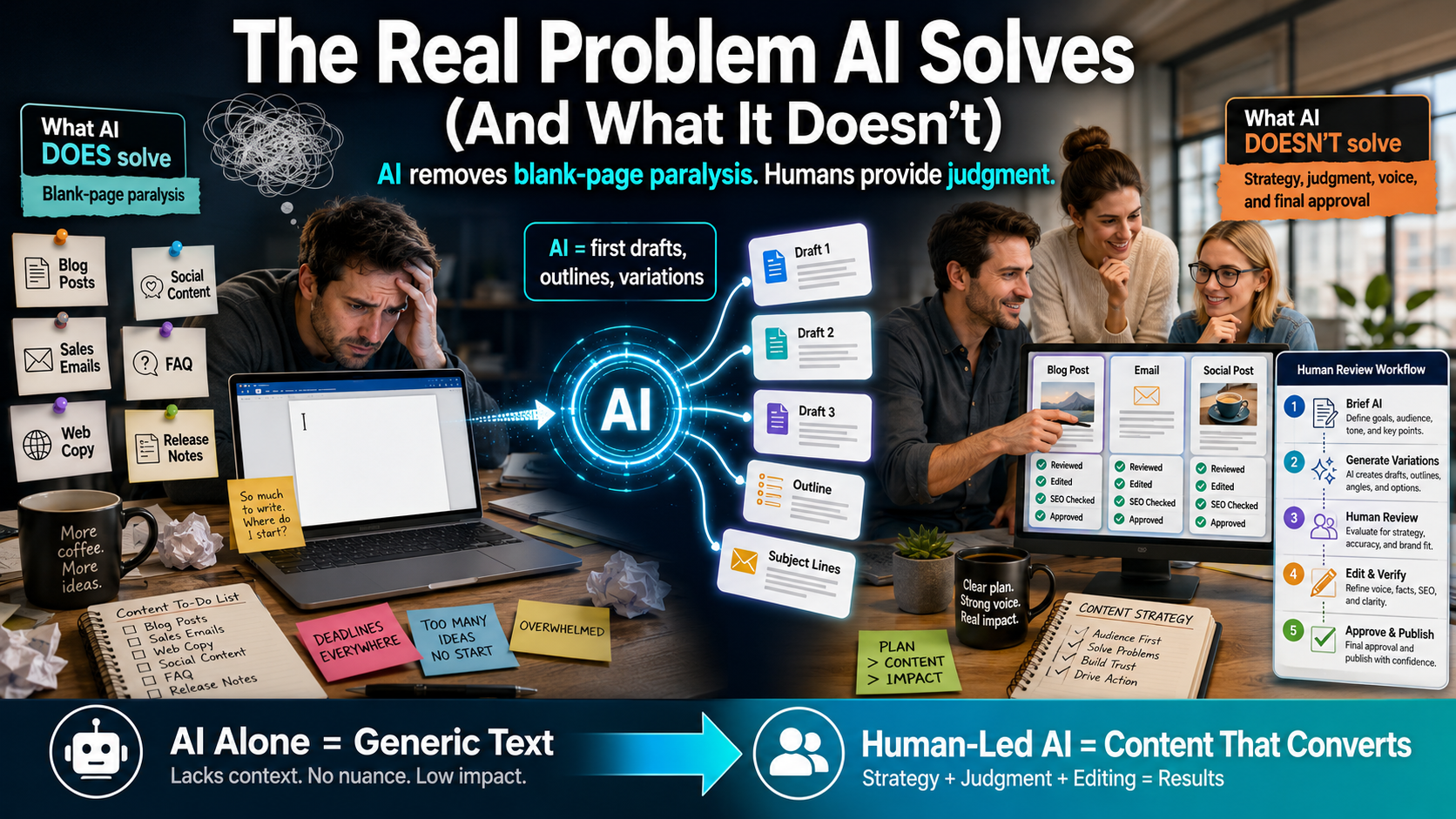
The Real Problem AI Solves (And What It Doesn't)
Your marketing team is drowning. You need blog posts, sales emails, web copy, social content—the list never ends. But hiring a full-time writer isn't in the budget for a 5-person shop. This is where AI content generation actually matters, but not for the reasons vendors pitch.
Generative AI doesn't replace your judgment. It replaces blank page paralysis. When Commvault repositioned their brand and launched a new product simultaneously, their CMO Anna Griffin faced a content avalanche: co-written blogs, prospecting emails, web pages, and more. They couldn't hire 10 writers. Instead, they trained an AI tool on their messaging strategy and SEO priorities, then had humans edit, refine, and approve every piece. The result: content velocity that matched their business velocity.
That's the playbook small teams need. Not AI that writes alone. AI that amplifies your existing writing capacity.
The Democratization Angle: Why This Matters to You
Here's what "democratizing content creation" actually means in practical terms: non-writers on your team can now generate rough drafts without being writers.
Your sales team can draft prospecting emails without waiting for marketing. Your product manager can spin up a first version of release notes. Your operations person can outline a FAQ. None of these people are professional writers—and with AI, they don't need to be. They generate something. A human (preferably someone with writing chops) refines it.
For solopreneurs and small business owners wearing 12 hats, this is the only way to produce the content volume your audience expects without burning out. You're not replacing yourself with AI. You're giving yourself permission to produce more without guilt about quality.
The Critical Requirement: Human-Led, Not AI-Led
This is where most small teams get it wrong.
The mistake: Generating a post with AI, running it through a plagiarism checker, and publishing it. That's not content creation. That's content roulette with your brand reputation.
The right approach: Human control at every stage. Griffin emphasized this directly: "It's critical that a human controls and supervises the process from start to finish."
Here's the step-by-step workflow for your team:
- Brief the AI: Feed it your messaging strategy, SEO keywords, and tone guidelines. If your AI tool doesn't let you train it on your voice, switch tools. Writer.com, Claude, and other enterprise-grade options allow custom training. Free tools like ChatGPT don't—use them for brainstorming only.
- Generate variations: Ask for multiple versions. AI first drafts are useful. AI first drafts as final output are brand suicide.
- Human review: One person (ideally your best writer or you) reviews for accuracy, brand voice, originality, and factual claims. AI hallucinates. This is non-negotiable.
- Edit and SEO-align: Match it to your keyword strategy. Check that internal links make sense. Verify any statistics or claims.
- Approve and publish: Only after human sign-off does it go live.
This sounds time-intensive. It's actually faster than starting from a blank page—because the AI handled the 30-minute staring-at-a-blank-screen phase.
Syncing AI With Your Actual Business Strategy
AI content generation fails when it's disconnected from strategy.
Commvault succeeded because they trained their AI on two things: their repositioning narrative and their SEO strategy. The AI wasn't guessing at what to write about. It was executing a plan.
Before you touch any AI tool, ask these questions:
- What are the 5-10 topics your ideal customer actually searches for?
- What's your unique angle on those topics?
- What messaging do you need to repeat across channels (brand positioning, value prop, proof points)?
- What's your content cadence? (Weekly blog? Monthly newsletter? Daily social?)
Then train your AI tool on these answers. Feed it your best previous content so it learns your voice. Instruct it to prioritize these topics and angles. Now when you hit "generate," you're not getting generic advice. You're getting drafts that align with your strategy.
Without this groundwork, AI generates noise. With it, AI becomes a force multiplier.
The Velocity Equation: What You Actually Gain
Let's do the math: A freelance writer costs $50–150 per blog post. A full-time content hire costs $45K–65K annually plus benefits. An AI subscription costs $20–300/month.
If your team of 5 currently publishes 2 blog posts monthly (1 hour each to write, edit, and publish = 2 hours/month), you're spending ~$4,200/year on external writers or avoiding content entirely.
With AI setup correctly, you can 3x that output with 1 extra hour monthly from one team member. Cost: ~$150/year in AI subscription. Time: same or less per piece, because AI removes the "what do I say?" phase.
This is why small businesses should care. Not because AI is magic. Because it's leverage.
The Real Risk: Quality Erosion If You Skip the Human Step
Here's what happens if you treat AI as a replacement instead of a tool:
- Your blog becomes indistinguishable from 500 other AI-generated blogs using the same prompts.
- You lose competitive advantage through voice and originality.
- Search engines increasingly penalize low-effort AI content without human review.
- Your audience can tell when you're not actually behind your content.
One venture-backed CMO described the tension: "AI will replace some jobs, because content has always been king, and this is a tool for content creation at a massive scale." But that's only true if humans guide it. Without human judgment, you're not creating content—you're generating text that looks like content.
Your competitive advantage is that you understand your customers better than generic AI training data ever will. Use AI to express that understanding faster, not to replace the thinking that created it.
How to Start This Week
Don't overthink this:
- Pick one content type you need more of (blogs, emails, social posts).
- Choose an AI tool that lets you train it or give detailed instructions (ChatGPT Plus, Claude, or a focused tool like Writer).
- Write 3–5 detailed examples of what you want in that format—your best previous work.
- Generate 5 versions of your next piece using those examples as reference.
- Spend 15 minutes editing the best version for accuracy, voice, and originality.
- Publish and track performance.
- Adjust your prompts based on what resonates.
You're not building an AI content factory. You're adding a productivity lever to your existing workflow. That's the whole point.