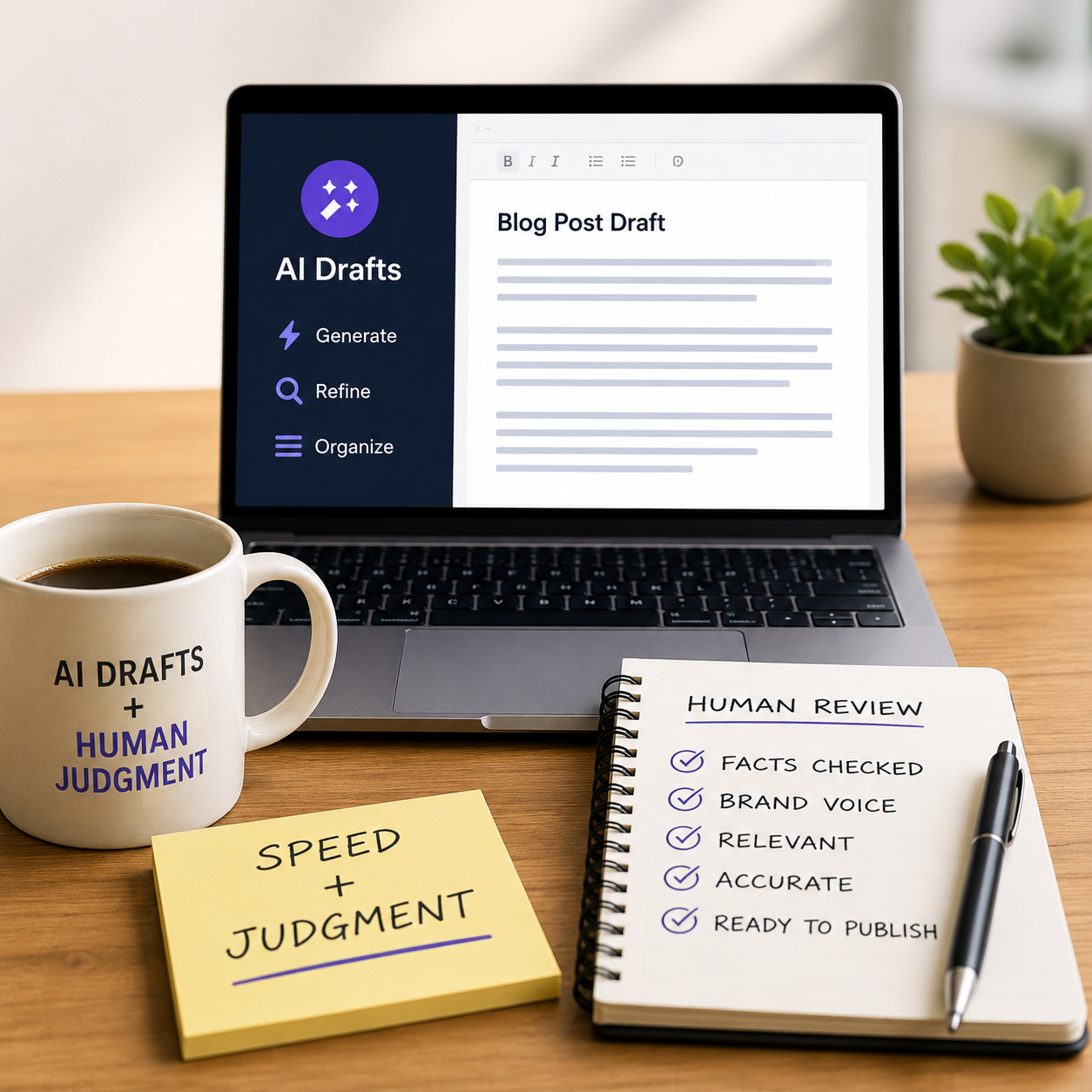
The Real Promise of AI Content Tools for Your Small Business
If you're running a business with fewer than 50 employees, you know the math: content creation takes time you don't have. AI content generators promise to fix this. And they partly do. But here's what matters: AI excels at speed and volume, not judgment. Tools like ChatGPT, Claude, and specialized platforms can produce blog drafts, email copy, and social media captions in seconds. That's the efficiency win you need. The catch is what comes next.
Where AI Actually Saves You Time (And Money)
Let's be concrete. A typical blog post takes a solo founder or small marketing team 4–6 hours from research to publication. Using AI to generate a first draft cuts that to 1–2 hours of refinement and fact-checking. Over a year, if you publish weekly, that's roughly 200 hours reclaimed. At $50/hour equivalent labor, that's $10,000 in capacity freed up.
The real wins happen in these specific areas:
- Ideation and outlining: Feed AI your target keywords and business angle; get 10 headline variations and structure options in 5 minutes instead of 45.
- First drafts: AI generates rough copy faster than you can type. You focus on making it true and strategic, not starting from a blank page.
- Repurposing at scale: Turn one long-form article into 5 social posts, 2 email sequences, and a LinkedIn article version—in under an hour.
- Rough email and ad copy: For promotional or exploratory messaging, AI beats the blank page. You refine, you personalize, you ship.
The Non-Negotiable: Human Judgment Still Rules
Here's where most founders stumble: publishing AI output directly without review is a business risk. Why? Because AI doesn't understand your customer's specific pain, your brand voice, or the competitive nuance of your market. It generates plausible-sounding text. That's not the same as right text.
Real problems occur when:
- AI fabricates statistics or sources (called "hallucination" in the industry).
- Tone misses your audience—too formal, too casual, or generically corporate.
- Content contradicts your existing positioning or makes claims you can't back up.
- Context gets lost—AI doesn't know that you pivoted your product last quarter or that a competitor just launched something similar.
Every piece of AI-generated content needs a human checkpoint. That person needs to verify facts, ensure brand alignment, and catch the moments where generic advice doesn't fit your specific business. This is non-negotiable.
The Practical Workflow That Works
If you're adding AI to your content process, structure it like this:
Step 1: Brief the AI (5 minutes)
Don't just ask "write a blog post about marketing." Be specific: "Write a 1,000-word post for solopreneurs who use HubSpot, explaining how to set up automation for cold email follow-ups. Tone: conversational but direct. Include 2 real case studies." The better your prompt, the closer the output gets to usable.
Step 2: Generate (2 minutes)
Use tools like ChatGPT Plus ($20/month), Claude (free or paid tiers), or industry-specific generators like Copy.ai for marketing copy. Run the prompt, get the draft.
Step 3: Fact-Check (15 minutes)
This is non-optional. Verify any statistic, quote, or specific claim. If AI mentioned a product feature, confirm it exists. If it cited a case study, check it's real. Spot-check 80% of factual assertions.
Step 4: Rewrite for Your Voice (20–40 minutes)
The draft is a skeleton. Now inject your perspective, your examples, your brand voice. This is where the content becomes yours. Remove generic phrases. Add specificity. Connect it to your actual customers' language and needs.
Step 5: Final Review (5 minutes)
Read it aloud. Does it sound like you? Does it serve your reader? Does every claim stand up? Hit publish only when you'd defend every sentence.
Common Pitfalls and How to Avoid Them
Pitfall: Over-relying on AI for strategic content. AI is bad at original research and deep thinking. If you need to take a position on industry trends or differentiate your product, do that thinking yourself first. Then use AI to articulate it.
Pitfall: Assuming one tool fits all content types. ChatGPT is versatile but not specialized. If you're writing sales copy, try Jasper or Copy.ai (trained on marketing). If you're creating technical documentation, Claude often outperforms. Test 2–3 tools for your specific use case before committing.
Pitfall: Publishing without a final human edit. This is how misinformation spreads. One founder published an AI-generated article claiming a competitor's product had a feature it didn't. It damaged trust. Review everything.
What This Means for Your Content Calendar
With AI in your workflow, realistic output changes like this:
- Solo founder: Move from 2 publishable pieces per month to 6–8, with the same effort.
- Small team (2–3 people): Maintain weekly publishing instead of every other week, and free those people for strategy and customer interviews.
That scalability matters. More content + consistent publishing = better SEO, more organic traffic, and more opportunities to convert prospects. But only if the content is accurate and genuinely useful.
The Bottom Line
AI content tools are force multipliers, not replacements. Use them to speed up the drafting phase, not to eliminate human thinking. Your judgment on what's true, what matters, and what resonates with your audience—that remains irreplaceable. Build AI into your process as a productivity layer, not as your final product. Do that, and you'll ship more, better content without burning out.