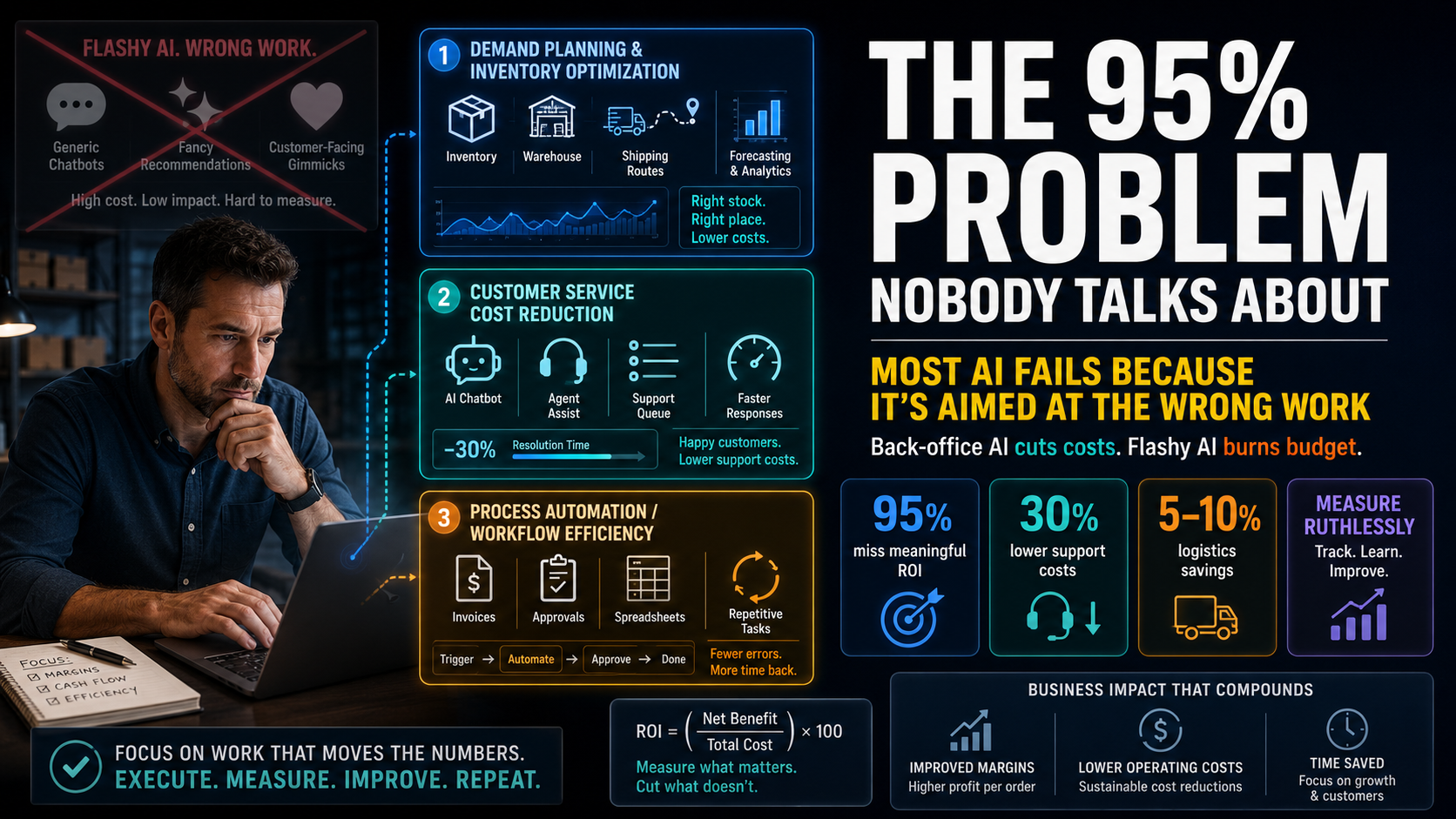
The 95% Problem Nobody Talks About
Here's what keeps most founders up at night: 95% of businesses implementing AI aren't seeing meaningful returns. Not because AI doesn't work. But because they're deploying it wrong.
The temptation is real. You see competitors launching flashy customer-facing AI features. ChatGPT chatbots. AI-powered recommendation engines. The pressure to "keep up" is intense. But the data tells a different story: the 5% of companies actually profiting from AI are using it on back-office tasks nobody sees—and that's exactly why they're winning financially.
So what? If you're a small business owner with limited capital, this distinction matters more than you think. It's the difference between burning cash on a vanity project and implementing AI that directly reduces your operating costs.
Three Proven Areas Where AI Cuts Real Costs
1. Demand Planning and Supply Chain Optimization
Most small businesses operate with siloed data. Your fulfillment team doesn't talk to your demand team. Customer behavior data sits in one department. Inventory lives somewhere else. This fragmentation wastes money—missed sales due to stockouts, late delivery penalties, inefficient shipping routes.
AI solves this by consolidating data across your entire operation. Imagine knowing exactly what to manufacture, when to manufacture it, what materials will cost, optimal pallet configurations, and the most fuel-efficient delivery routes. You're no longer guessing. You're optimizing.
The financial impact: Companies report avoiding inventory mistakes, eliminating late fees, and reducing fuel costs through optimized logistics. For a small business shipping products, this compounds fast. A 5-10% reduction in logistics costs moves directly to your bottom line.
The key is unifying your data first. Tools like Peak (mentioned in enterprise research) have small-business counterparts. Start there before you build custom solutions.
2. Customer Service Cost Reduction (Up to 30%)
Businesses spend over $1 trillion annually on customer service. Your phone lines, your labor costs—they add up quickly. AI-powered chatbots and conversational solutions are changing the math: companies report 30% reductions in customer service costs.
More importantly: for every second a chatbot shaves off average call handling time, call centers save roughly $1 million per year. Even a 10-person support team handling 100 calls per day feels this immediately.
By 2022, chatbots and natural language processing saved companies $8 billion annually in support costs. For small businesses, this means fewer support hires needed or redirecting existing staff to higher-value work—handling escalations, building relationships with key customers.
The ROI timeline: Businesses see returns within three years of implementation. For a solopreneur or small team drowning in support tickets, this is often faster.
The catch: customers increasingly prefer self-service anyway. They want to message, not call. AI solutions align with customer preference and reduce your costs. This is rare alignment.
3. Process Inefficiency Identification and Automation
CFOs across insurance, oil and gas, and other sectors report that AI excels at spotting inefficiencies humans miss. A manual data entry process. A sign-off workflow that bottlenecks. Redundant approval steps.
Once identified, AI automates these tasks. The financial benefit compounds: direct labor hour savings plus the value of reallocating your team to higher-leverage work. An employee spending 10 hours per week on data entry can now focus on strategy or customer relationships.
This is the "low-hanging fruit" finance teams attack first—and for good reason. It's measurable, trackable, and delivers immediate returns.
How to Actually Measure If AI Pays Off
Before you buy any tool, establish metrics. Sophisticated companies now use the formula:
ROI = (Net Benefit / Total Cost) × 100
Where net benefit includes direct financial savings (labor hours saved, costs reduced) plus indirect benefits (better decision quality, improved customer experience) minus total implementation costs.
For small businesses, this means tracking:
- Time-to-completion ratios: How long did manual Process X take before? How long does it take now?
- Cost-per-transaction: What did this process cost per unit before? After?
- Labor hour reallocation: How many hours per week is your team spending on manual work? Where could they spend that time instead?
If you can't quantify the benefit in 30 days, the AI tool isn't the right fit. Move on.
The Biggest Obstacles (And How to Avoid Them)
Gartner research shows why most AI implementations fail for small teams: 50% cite budget constraints, 48% cite integration difficulties.
Both are solvable if you approach systematically:
- Start small: Pick one back-office process causing measurable pain. Don't try to AI your entire operation on day one.
- Avoid integration nightmares: Use AI solutions designed to work with tools you already own (Slack, HubSpot, Stripe). Platform-specific integrations exist—use them.
- Budget realistically: AI tools range from $99/month SaaS solutions to 6-figure implementations. Small businesses thrive with the former. Be honest about what you can actually manage.
The Unsexy Truth
The companies winning with AI aren't building flashy customer experiences. They're automating invoice processing. They're optimizing inventory. They're reducing support queue times. It's "frumpy but functional," as Forrester describes it.
That's exactly why it works. And exactly why it matters for your bottom line.
If you're a small business owner evaluating AI, remember: ignore the hype. Focus on the back-office task that wastes the most time or money. Measure ruthlessly. Deploy only if the math works. Everything else is theater.