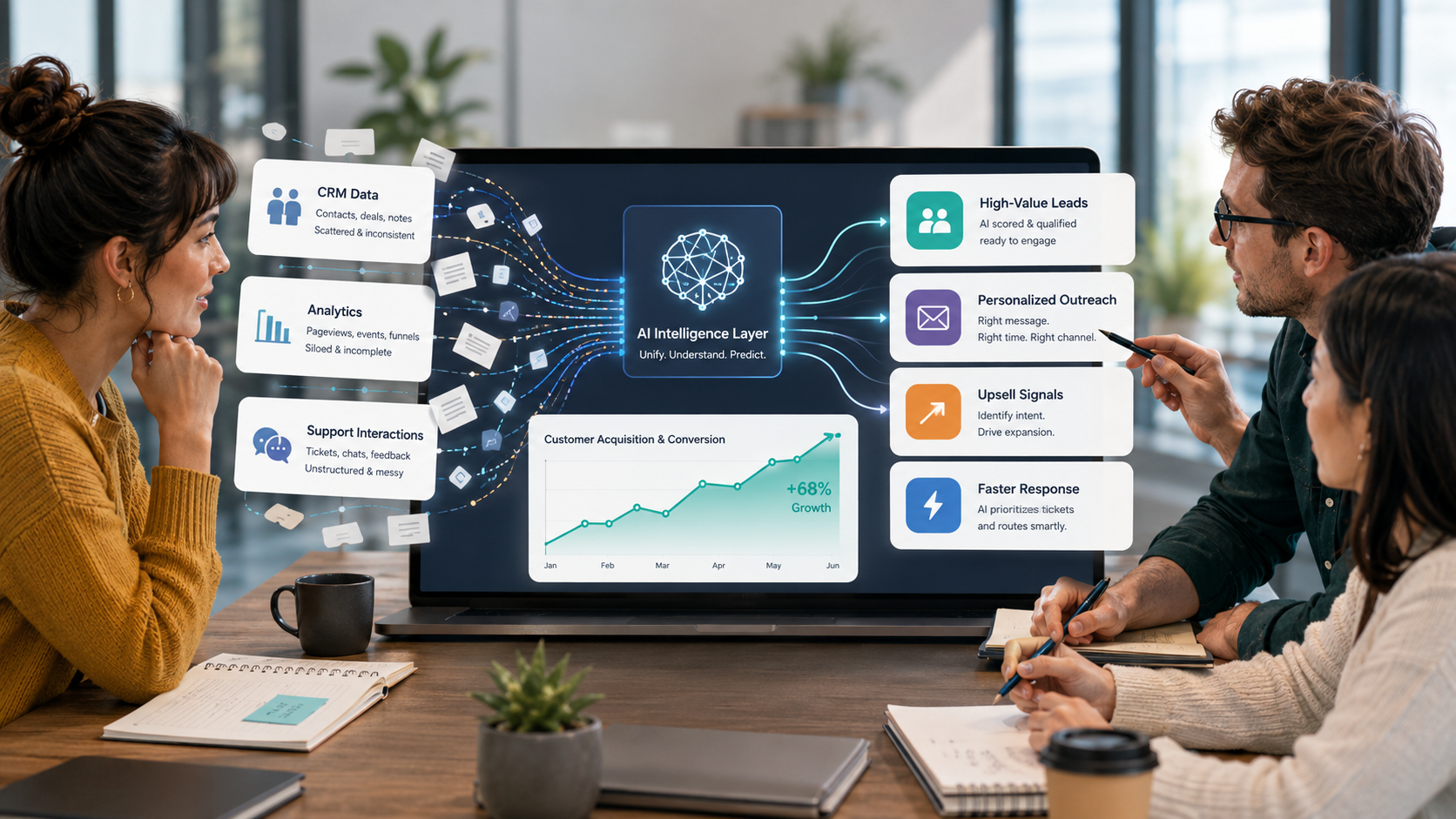
The Data Problem Killing Your Growth
You're drowning in customer data. Your CRM is full of interactions. Your analytics dashboard shows dozens of metrics. Yet you still can't reliably predict which prospects to target or when to upsell existing customers.
You're not alone. In a 2019 NewVantage Partners survey, over half of businesses admitted they're not competing on data and analytics—despite having more data than ever. The problem wasn't a lack of information; it was the inability to extract actionable insights from it.
So what? If your acquisition team doesn't have time or tools to leverage data effectively, you're leaving revenue on the table. Every day you operate without data-driven targeting is a day your competitors are stealing market share.
Why Traditional Customer Acquisition Falls Short
Most small businesses approach customer acquisition the same way:
- Cast a wide net with ads or outreach
- Hope qualified leads convert
- Track what happened after the fact
This reactive model wastes money. You're paying to reach people who may never buy. Your sales team spends hours on prospects with low conversion likelihood. Your customer service team reacts to issues instead of anticipating them.
The revenue optimization platform Coho AI exists because this problem was so widespread that a former Apple executive—Ariel Maislos, who sold semiconductor company Anobit to Apple for $400 million—decided to solve it. After building and exiting a hardware company, he recognized that SaaS businesses faced the same data bottleneck: teams with access to insights they couldn't actually use.
How AI Flips the Customer Acquisition Model
AI-powered customer acquisition works backward from the traditional approach:
- Identify high-value customer segments based on behavioral data, not demographic guesses
- Automate personalized outreach at scale to qualified prospects
- Predict upsell opportunities for existing customers before they consider competitors
- Optimize continuously as new data arrives
This isn't about replacing your sales team. It's about giving them intelligence so they spend their time on prospects actually worth pursuing.
The Acquisition Tooling Arms Race
Enterprise software companies understand the value of AI-driven acquisition so well that they're making billion-dollar bets on it. Salesforce acquired Fin, an AI customer service platform, for $3.6 billion—not because the platform was perfect, but because customer service interactions are the highest-leverage point in the customer acquisition and retention cycle.
Zendesk followed suit, acquiring Ultimate to integrate flexible AI agent capabilities into its customer service automation suite. Why? Because automating how you respond to inbound inquiries directly impacts:
- Conversion rates: Faster response times = more prospects who actually buy
- Sales efficiency: AI qualifies leads so sales reps only handle ready-to-buy prospects
- Upsell velocity: AI identifies and automatically surfaces upsell moments
If software giants are spending billions on this, what does that tell you about ROI?
What AI Customer Acquisition Actually Does (Concretely)
Here's what a data-driven, AI-powered acquisition system looks like for a small business:
1. Targeting Gets Smarter
Instead of guessing which industries or company sizes buy your product, AI analyzes your existing customer base and identifies hidden patterns. It might find that your best customers are mid-market companies in specific niches—not the enterprise segment you've been chasing. This shift alone can cut your customer acquisition cost (CAC) by 30-40%.
2. Outreach Gets Personal at Scale
AI doesn't just send the same email to everyone. It personalizes subject lines, messaging, and timing based on what works for that specific segment. The result: higher open rates, more replies, lower cost-per-qualified-lead.
3. Customer Service Becomes an Acquisition Tool
When a prospect reaches out with a question, how you respond matters. AI-powered customer service ensures every inquiry is answered quickly and accurately—turning support interactions into conversion opportunities. Slow or poor responses to early-stage inquiries kill deals before they start.
4. Upsell Revenue Happens Automatically
Rather than waiting for renewal conversations, AI identifies which existing customers are ready to expand. It spots usage patterns, feature adoption trends, and engagement signals that predict upsell opportunity. Your team acts on clear signals instead of guessing.
The Practical Reality for Small Teams
You don't need a dedicated data science team to make this work. The shift happening across the industry—from raw data to actionable intelligence—is democratizing these capabilities.
When tools like Coho AI emerged, the insight was simple: good acquisition data exists in every business, but most teams lack the tools to surface it. You're not failing because you don't have information. You're failing because it's buried in systems you don't have time to analyze.
AI addresses this by doing the analysis for you. It takes your customer data, identifies patterns humans miss, and tells your team exactly which prospects to target, when to reach out, and what message will resonate.
The Bottom Line: Data-Driven Acquisition Works
Over half of businesses still aren't competing on data and analytics. That's your advantage. While competitors rely on vanity metrics and gut feeling, you can use AI to systematically improve every part of your acquisition funnel.
The companies spending billions on AI customer service and revenue optimization aren't doing it for fun. They're doing it because AI-driven acquisition directly increases customer lifetime value and decreases CAC—the two metrics that determine if a business survives.
Your team doesn't have time to become data scientists. But your team does have time to use better tools. Start there. Implement AI that turns your existing data into acquisition intelligence. Watch your conversion rates climb and your sales efficiency improve.
That's not hype. That's why Salesforce paid $3.6 billion for this capability.