Your Onboarding Problem Is Costing You Revenue
Manual customer onboarding kills two things: your team's time and your customer retention. Consider this: Intelematics reduced its onboarding process from half a day to 15 minutes by automating what was previously manual registration and portal access work. That's not a nice-to-have improvement—that's a competitive advantage in a market where first impressions determine customer lifetime value.
For small business owners, the stakes are even higher. You don't have dedicated teams absorbing administrative burden. Every hour your founder or operations manager spends on repetitive onboarding tasks is an hour not spent on strategy, sales, or product improvement.
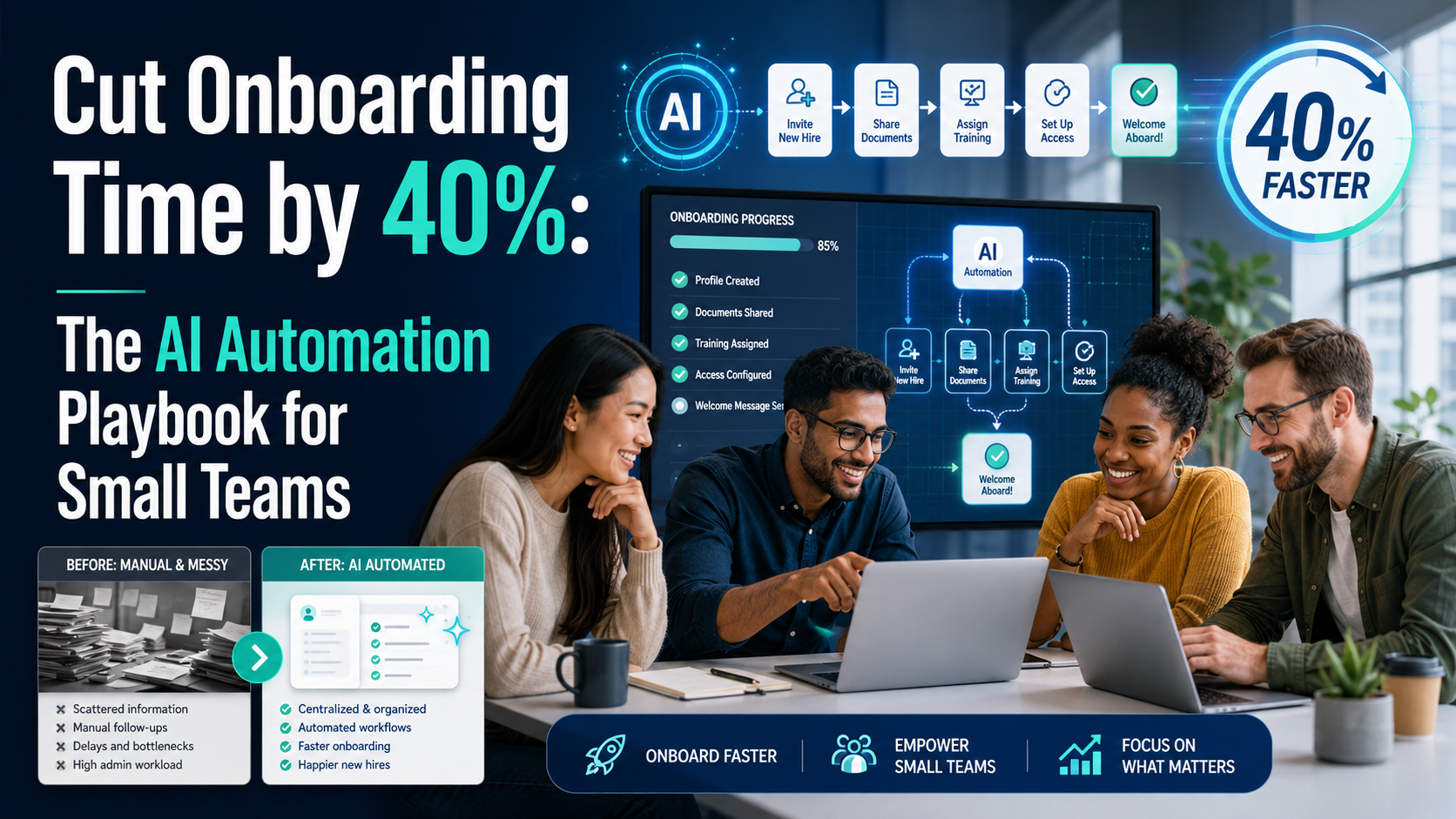
Here's the real number: Businessolver's AI-powered onboarding reduced implementation effort by 40% across organizations. If your team spends 10 hours per week on manual onboarding, that's 4 hours reclaimed immediately. Scale that across a year, and you're recovering 200+ hours of productive capacity.
What Can Actually Be Automated (And What Shouldn't Be)
Not all onboarding tasks are created equal. The winning strategy is automating the right things while preserving human judgment where it matters.
Automate These Immediately
- Document processing and data extraction: Intelligent Document Processing (IDP) uses AI algorithms to classify, extract, and validate data from emails, forms, and documents—eliminating manual data entry errors and the review cycles that follow.
- Chatbot-first customer interactions: AI chatbots handle initial questions, capture lead information, populate your CRM, and schedule follow-ups without human intervention. This includes FAQ deflection and routing complex questions to the right team member.
- Paperwork generation and compliance tracking: Digital form generation, automated compliance monitoring, and mandatory training verification happen in the background. Customers get confirmation emails; your team gets real-time visibility into bottlenecks.
- Personalized communication sequences: Automated nudges and targeted messages increase product adoption without feeling like spam because they're based on usage data and customer behavior patterns.
- Progress monitoring and reporting: AI analyzes onboarding completion rates, identifies customers stuck at specific steps, and surfaces issues before they become churn risk.
Keep the Human Element Here
The research is clear: customers don't want to change every interaction. Strategic decisions—resolving payment disputes, addressing complex use cases, handling objections that require domain expertise—should flow to your team. The AI handles the pipeline; humans handle the nuance.
The Two-Step Implementation Framework
Don't just pick a tool and hope. TechCrunch's analysis of fintech onboarding reveals a battle-tested structure that works for any vertical:
Step 1: Map Your Current Process (This Takes One Week)
Grab a process automation platform and visualize your entire onboarding workflow from first contact to activation. Document every step, every decision point, every system touchpoint. Identify bottlenecks—these are your automation targets.
For a SaaS company, this might look like: Website visit → Chatbot captures info → CRM entry → Email sent → Sales call scheduled → Contract signed → Credentials generated → Product training → First login recorded. Each step is a potential automation opportunity, but steps 2, 3, 4, and 7 will likely yield the biggest ROI.
Step 2: Unify Your Data (This Prevents Disaster)
AI is only as good as the data it consumes. You need a single source of truth—a unified data layer that every tool (your CRM, billing system, product platform, customer success tools) can read and write to securely.
Without this, you end up with customers in five different states across five different systems. AI makes those errors at scale.
This is why Businessolver emphasizes that automation should keep "human expertise at the center." Bad data amplified by AI is worse than bad data handled manually—at least humans catch some errors.
The Three Automation Architectures That Work
For Pre-Sale Automation: Deploy AI chatbots on your website. They answer questions, qualify leads, and schedule calls. Tools like this capture intent signals before your sales team ever touches the prospect.
For Post-Purchase Onboarding: Create an automated onboarding assistant that sequences your new customer through setup, training, and initial success metrics. Platforms like Truva AI personalize this journey based on customer goals—they generate a custom onboarding plan, not a generic one. The result: faster time-to-value and fewer support tickets.
For Retention and Expansion: Use AI to monitor usage data and automatically send targeted product recommendations and feature nudges. Over two-thirds of organizations already do this. It increases adoption rates, surfaces expansion opportunities before they're lost, and makes customers feel seen rather than automated.
The Real Numbers: What You'll Actually Get
Here's what the research shows for small teams that implement AI onboarding correctly:
- 40% reduction in implementation and onboarding effort (Businessolver)
- 75% faster onboarding cycles (Intelematics: half-day to 15 minutes)
- Higher engagement and retention for new customers (Forbes survey: 2/3 of organizations report improved engagement)
- Freed-up team capacity to focus on high-touch relationships and strategic work
- Fewer manual errors and compliance mistakes through consistent, rule-based automation
Your 30-Day Action Plan
Week 1: Document your current onboarding flow. Find the three most time-consuming steps. These are your targets.
Week 2-3: Evaluate two tools that match your industry (chatbot platform, workflow automation, document processing). Free trials exist for all of them.
Week 4: Implement on the lowest-friction step first. Success breeds momentum. A chatbot handling FAQs is easier to deploy than end-to-end automation.
The founders who win aren't the ones building fancy AI—they're the ones automating repetitive work and reinvesting that time into relationships and growth.
Your customers don't want to wait for manual processing. Your team doesn't want to spend Friday afternoons on data entry. AI onboarding automation solves both problems at once.