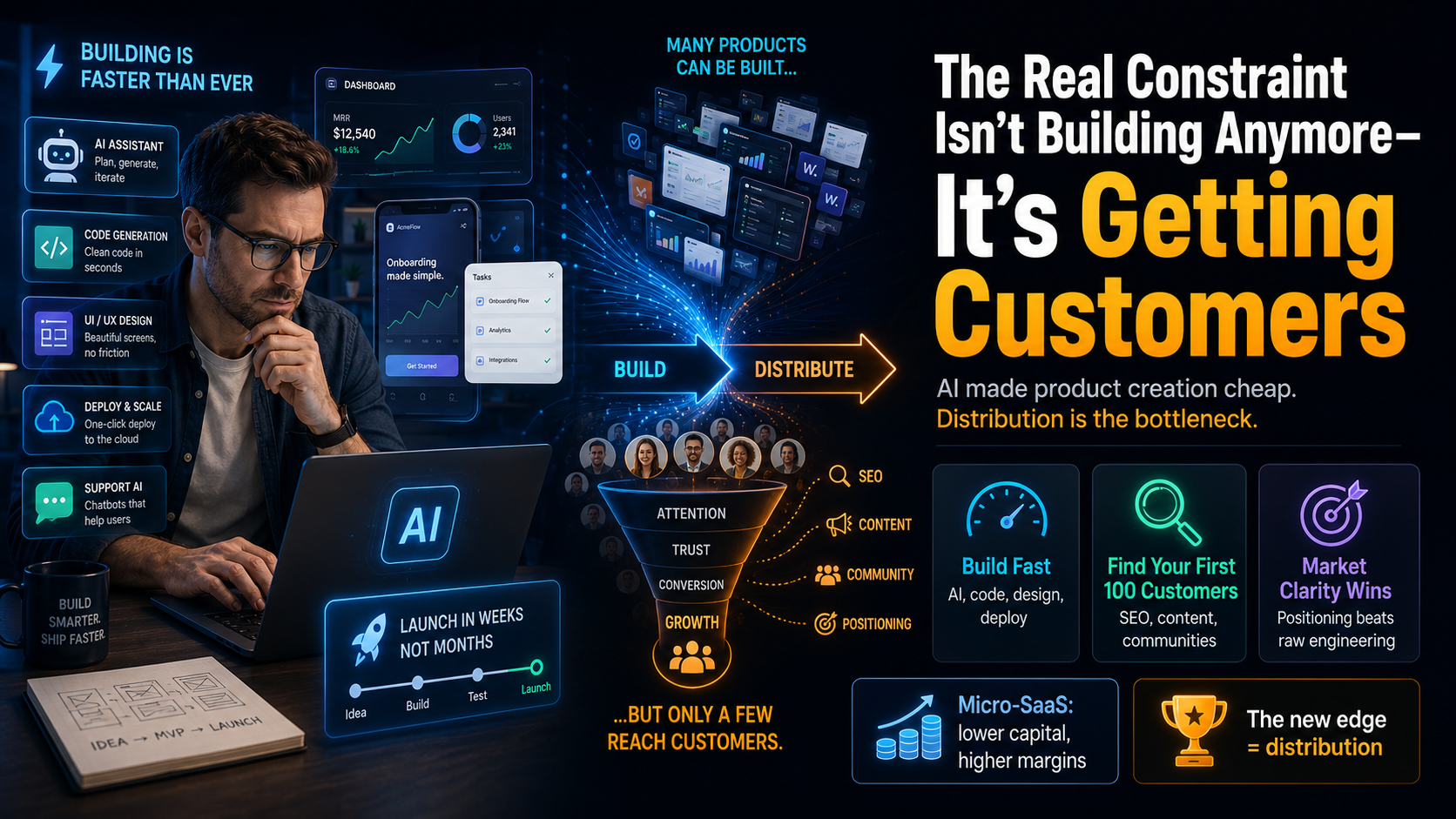
The Real Constraint Isn't Building Anymore—It's Getting Customers
For decades, the startup founder's roadblock was clear: you needed technical skills, a co-founder who could code, or venture capital to hire engineers. AI has obliterated that barrier. Solo developers are now launching profitable SaaS products in weeks.
Micro-SaaS founders are hitting $10,000–$50,000 in monthly recurring revenue with teams of one to three people. The development problem is solved.
But here's what matters for your bottom line: distribution is now the only constraint that matters. You can build a product. You can automate operations. You cannot automate finding your first 100 customers. That's your real work now.
How AI Actually Speeds Up Product Development
Let's be concrete about what's changed. Using tools like ChatGPT, Cursor, and design platforms, a non-technical founder can now execute this workflow:
- Generate product ideas using AI research tools and market validation frameworks
- Write backend logic using coding assistants—without knowing Python or JavaScript
- Design UI/UX layouts with generative design platforms, not Figma and hours of iteration
- Automate customer support using AI agents that handle common questions at 3 AM
- Deploy applications using low-code infrastructure and managed platforms
A solo founder building an AI-powered SEO optimizer or automated resume builder can move from "I have an idea" to "I have paying customers" in 4–6 weeks. This used to take 6 months and require $50,000 in salaries.
The reason? AI isn't just a tool—it's a strategic overhaul of your entire production process. As one enterprise architect put it: "AI is enhancing operational efficiency and revolutionizing customer experiences. We're talking about creating products, services, and business models that were unimaginable before AI came into the picture."
The New Economics: Lower Capital, Higher Margins
Here's what this means for your P&L:
- Reduced seed capital requirements: You don't need $25,000 to hire a developer for three months. You need $500/month for AI tools and your own time.
- No technical co-founder hunt: Stop wasting months on LinkedIn looking for a CTO. Use Claude or ChatGPT as your technical partner.
- Higher gross margins: Without payroll, a micro-SaaS product charging $99/month can hit 80%+ gross margin with just 200 customers.
- Faster iteration: A/B testing happens in days, not weeks. You validate features before they touch production.
The practical impact: independent developers are building niche tools that generate $10,000–$50,000 monthly revenue with minimal overhead. The venture capital path (raise $500K, hire 5 people, spend $50K/month) is no longer the only way to build a sustainable business.
Why Your Competitive Advantage Is Now Customer Acquisition
If everyone can build a product, the playing field isn't level—it's inverted. Your differentiator is no longer "we have better engineers." It's "we found customers before our competitors did."
Smart AI-native founders are winning through:
- SEO-driven positioning: Build products that rank for keywords customers actually search. A dashboard for freelancers beats a generic analytics tool.
- AI-generated content marketing: Use language models to create 50 blog posts about your target customer's pain points. Then optimize for search.
- Community-led growth: Find your customers on Reddit, Discord, and Slack communities. Help them solve problems before you pitch them your product.
- Product-led growth: Release a freemium version and let the product sell itself. Your free tier should show so much value that conversion feels inevitable.
Notice what's missing? You're not spending $5,000/month on Google Ads to get 50 conversations. You're doing the work of finding people who already want your solution.
AI Goes Further: Ideation as a Collaborative Process
Beyond execution, AI accelerates the thinking phase. Tools like MIT's Supermind Ideator don't just generate business ideas—they refine them. Think of generative AI as "an enthusiastic, highly capable intern: quick to engage but still learning the nuances of complex problems."
Here's what this means practically:
You have a vague idea: "Help freelancers manage invoices." You feed it into ChatGPT with context about your market. It generates 15 angles: invoicing for creative agencies, invoicing for contractors in emerging markets, invoicing with automated payment splits, etc. You test three of these on Reddit and Twitter. Two weeks later, you know which problem is most urgent. You build for that specific customer. Boom—you've compressed months of discovery into weeks.
The Operational Advantage: Automation Beyond Code
Even if you don't want to build a SaaS product, AI reduces your operational friction immediately. Using natural language processing, you can design processes, automate workflows, and scale operations without technical hiring.
This matters because AI handles the grunt work while you focus on what only humans do: understanding customers and making strategic bets. Your email sequence logic, your customer onboarding flow, your support ticket routing—these can all be automated. Your job is to make sure the automated path actually satisfies customers.
What Success Looks Like Now
The barrier to entry for starting a software business is now at its lowest point in 30 years. But this creates a paradox: easier to build means harder to differentiate.
Winners in 2024 will focus on:
- Speed: Launch in 4 weeks, not 4 months. Get real customer feedback before you overthink the product.
- Positioning: Pick a specific customer and specific problem. "AI-powered invoicing for freelance designers in the US" beats "invoicing software for everyone."
- Distribution discipline: Know exactly how you'll acquire your first 100 customers before you write line one of code.
- Responsible AI use: Use AI to accelerate your work, not to cut corners on quality or ethics. Customers notice.
The founders building successful micro-SaaS businesses right now aren't the ones with the best code. They're the ones who shipped fastest, talked to customers most, and positioned most clearly. AI gave them the time to do those things instead of debugging JavaScript.
Your competitive advantage isn't technical anymore. It's market clarity.