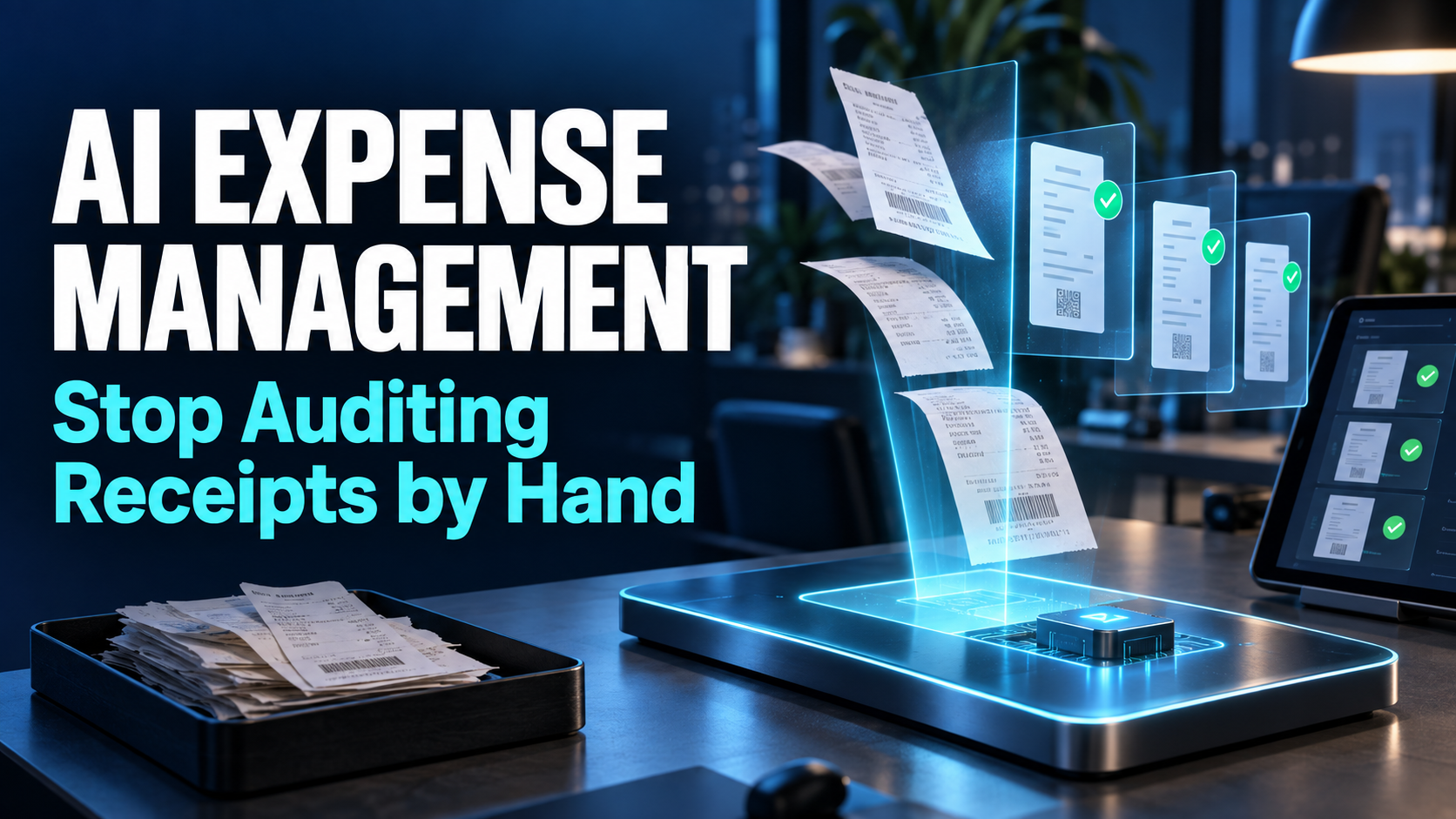
The Problem: Your Finance Team Is Still Doing Manual Work
Every month, your finance team spends hours categorizing receipts, hunting for duplicate submissions, and enforcing spending policies. If you're a 10-50 person company, that's real money leaving the table. A founder manually reviewing 200 expenses at 5 minutes each? That's 16+ hours of labor you're not getting back.
The old way: expense reports pile up, you catch violations after the money is gone, and your team argues about whether that meal was business or personal. The new way: AI catches problems the moment the card swipes.
How AI Expense Software Actually Works
Modern AI expense management tools do three things that matter:
- Automate receipt capture and coding. You forward a receipt via email. AI extracts the vendor, amount, date, and category in seconds. No manual data entry.
- Detect duplicates and flag suspicious spend. The system catches duplicate submissions, price anomalies, and out-of-policy transactions before they hit your accounting.
- Enforce policy in real time, not retroactively. Instead of auditing everything at month-end, AI reviews every transaction against your actual policy document as it happens. Ramp's Policy Agent catches 7x more out-of-policy spend than traditional rule-based systems, at 99%+ accuracy.
The shift is fundamental. You're moving from reactive cleanup to proactive enforcement. That matters because it means your team only handles genuine exceptions instead of auditing everything by hand.
What the Numbers Tell You
Modern AI agents can now autonomously audit up to 73% of routine expenses, ensuring 99.4% verification alignment with human standards. For a small team, that's the difference between someone spending 3 hours on expense review or 45 minutes.
The second metric that matters: duplicate detection. In most companies without AI, 2-5% of submissions are duplicates or errors that slip through. That's money you literally can't see walking out the door. An AI-powered system catches it immediately.
Third: policy compliance. Ramp users report that the platform automatically flags duplicate expenses, categorizes transactions, and suggests cost-cutting opportunities based on spending patterns. Reviewers specifically note that automatic receipt matching—where users forward an emailed receipt and the system pairs it with the correct transaction in seconds—eliminates one of the most tedious parts of expense management.
The Tools Worth Considering
For startups and lean teams: Ramp or BILL. Ramp offers $0/user/month pricing with corporate cards, AI policy enforcement, and AP automation. BILL Spend & Expense pairs smart cards with AI-powered expense management and budget controls at $0/user/month, with no per-user fees and no paid tiers to unlock features. Both tools have mobile-first interfaces that actually get employees to submit expenses on time.
For global or complex operations: SAP Concur. SAP Concur holds the number one worldwide market share in T&E management software with 49.6% share, serving more than 46,000 customers and 92 million end users. Its AI agents handle expense compliance end-to-end: an AI assistant auto-fills memos, fetches receipts, and files reimbursements; an audit agent monitors expenses and categorizes violations by risk level; a review agent auto-approves low-risk items and escalates exceptions. The trade-off: it's quote-based pricing and can feel complex if you don't need the full feature set.
For multi-currency spend: Airwallex. Airwallex handles the entire spending lifecycle natively across 23+ global currencies from a single account, eliminating forced conversion markups with $0 monthly maintenance fees on core card issuing.
The Real ROI Equation
Let's do the math for a 25-person company. Assume 500 expenses per month.
- Manual review at 5 minutes per receipt = 42 hours/month
- AI-powered audit handles 73% automatically = 11 hours/month
- Savings: 31 hours/month × your average finance salary
- Add in duplicate detection (2-3% of expenses caught), faster approval cycles, and fewer month-end reconciliation headaches
Most founders see payback in 2-4 months. The bigger win? Your finance team stops treating expense management like a compliance chore and actually uses the data to understand where money is going and whether spending aligns with budget.
What to Look For When Choosing
The best expense management software options provide the most robust combination of native multi-currency support, proactive spend controls, and enterprise-grade compliance. But that's enterprise language. For a small business, ask yourself:
- Does it integrate with the accounting software you already use? (QuickBooks, Xero, NetSuite—most tools do.)
- Can employees actually use it without a training session? (Mobile-first design matters.)
- Does it force you to pay per user, or does it charge a flat rate? (Flat-rate tools are cheaper for small teams.)
- Does it catch policy violations before the spend happens, or after?
The difference between a tool that catches exceptions and one that audits after the fact is the difference between a financial control and a compliance headache.
One More Thing: The Automation That Actually Saves Time
The feature founders always overlook until they use it: receipt email forwarding. You forward a receipt to an email address. The AI extracts it, matches it to the transaction, categorizes it, and files it. That single feature saves 30+ minutes per month per employee. Over a year, across a team of five, that's 30 hours of manual work gone.
Start there. Pick a tool, enable receipt forwarding, and watch how fast your month-end close gets.