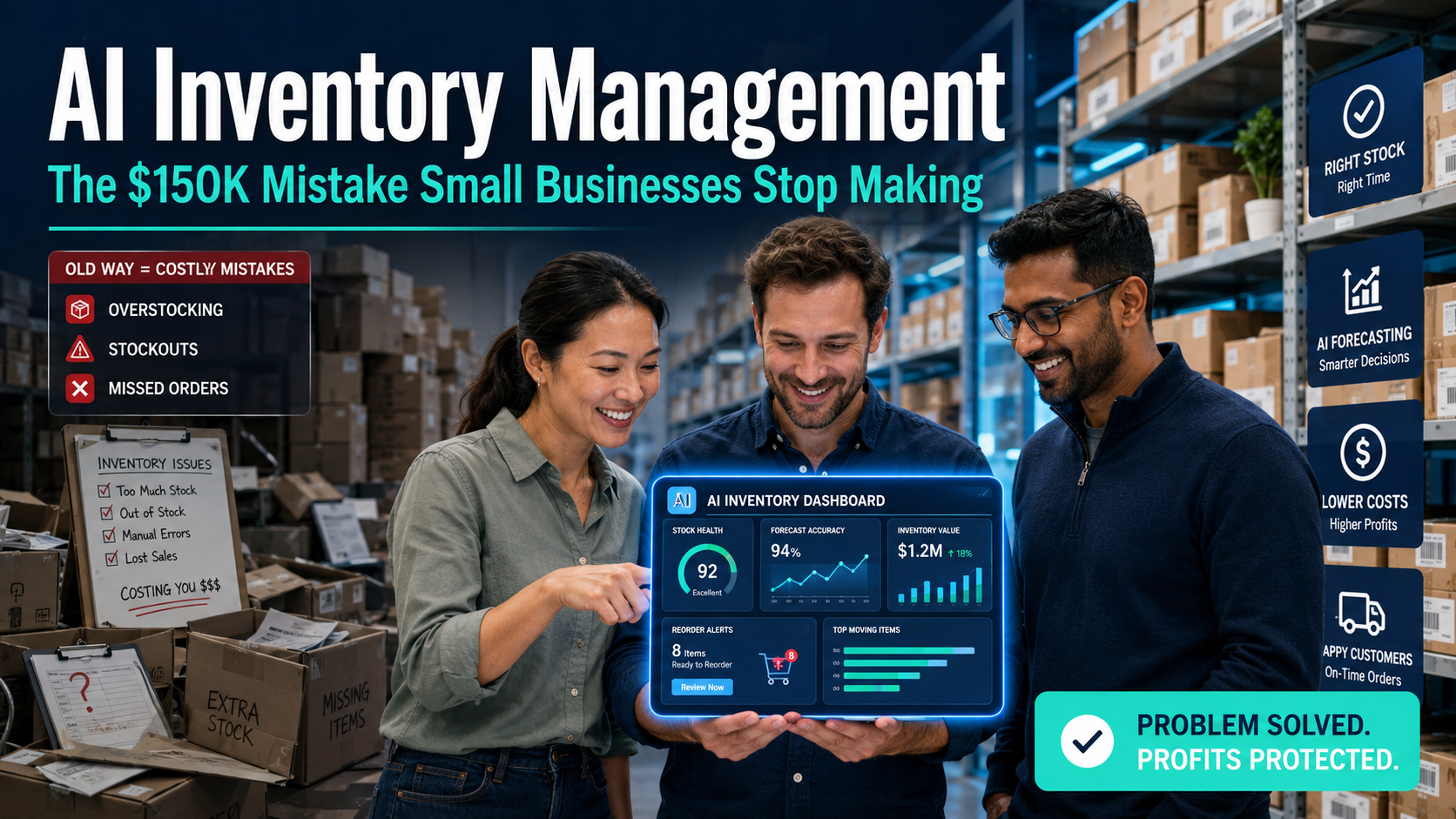
The Problem You're Probably Ignoring Right Now
You're bleeding money in inventory—overstock tying up capital, stockouts losing sales, manual spreadsheets causing decision paralysis. If you're managing inventory across multiple sales channels (your website, Amazon, Shopify, wholesale partners), you already know the pain. You're manually reconciling data, guessing on reorder quantities, and hoping your team doesn't miss a supply gap.
Here's what research from McKinsey confirms: companies using AI in supply chain operations cut logistics costs by 15% and improve inventory levels by up to 35%. For a small business with $500K in annual inventory spend, that's $75K in savings. Not theoretical. Real.
What AI Inventory Management Actually Does
Stop thinking of AI inventory tools as nice-to-haves. They're operational necessity now. Here's exactly what they handle:
1. Demand Prediction That Actually Works
AI analyzes your historical sales data, seasonal trends, and market conditions to forecast demand with accuracy traditional spreadsheets can't match. Instead of guessing whether you'll need 50 or 500 units next month, AI gives you a data-backed number. Steffy Lee Simms, founder of Guava Jammies, said AI tools eliminated the paralysis of inventory decisions: "It'll give me a very justified, quantifiable reason why I can just go ahead and move forward."
For a solopreneur or small team, this removes the cognitive load of complex calculations. You spend your mental energy on strategy, not spreadsheet math.
2. Real-Time Stock Level Optimization
AI continuously monitors what's selling, what's sitting, and what's incoming. It automatically adjusts your target stock levels so you're never overstocked (capital locked up, storage costs multiplying) or understocked (customers buying from competitors instead).
Target's AI-driven Inventory Ledger system predicts stock-outs "even before it's obvious to team members or systems." They've applied it to over 40% of their assortment. If Target—a $100B retailer—relies on this, your business with 20 SKUs will see even more dramatic impact.
3. Automated Reordering Based on Supplier Reality
Supply chain disruption is permanent now. Lead times that were 30 days are now 90+ days. AI tools instantly update ordering plans when supplier lead times change, preventing the domino effect of delayed orders cascading into stockouts.
ABC School Supplies, an AI early adopter, moved from manually copy-pasting orders and walking paper pick-lists to warehouses to fully automated reordering based on real-time supplier data. That's the difference between reactive chaos and proactive control.
4. Multi-Channel Inventory Synchronization
If you're selling on your website, Amazon, Shopify, and via wholesale partners simultaneously, you know the nightmare: a customer buys your last unit on Amazon, but your system still shows stock on your website. Then someone orders from your site and you're scrambling to fulfill from a supplier or cancel.
Jen Podany, founder of Bluestone Sunshields, was managing inventory across her website, Amazon, QuickBooks for wholesale, and Nordstrom drop-ship. "Lacking a single, cohesive place to understand sales and projections across disparate platforms, inventory management was one of my biggest challenges," she told Business Insider. AI dashboards pull data from all channels into one view, giving you immediate visibility across all sales streams.
The Numbers That Matter
Cost savings by the numbers:
- 15% reduction in logistics costs (McKinsey)
- 35% improvement in inventory levels (McKinsey)
- Eliminated time spent on manual data entry and reconciliation (hours per week reclaimed)
- Reduced overstock waste and carrying costs
- Prevented stockouts that cost an average of 1-2% of annual revenue per incident
For a 10-person business with $2M revenue and $400K in inventory, a 15% logistics reduction saves $60K annually. A 35% improvement in inventory efficiency frees up $140K in working capital that was previously locked in excess stock.
Choosing the Right Tool Without Breaking the Bank
You don't need enterprise software or a dedicated inventory manager. Start with these three criteria:
1. Identify Your Specific Pain Point
Don't buy a tool because it exists. Define the problem first:
- Are you losing sales to stockouts?
- Are you sitting on dead stock?
- Are you spending 5+ hours per week on manual inventory updates?
- Can't see inventory across multiple sales channels?
Different tools solve different problems. ABC School Supplies needed real-time visibility across suppliers and channels. Guava Jammies needed demand forecasting to avoid decision paralysis. Your answer drives tool selection.
2. Choose Tools That Scale With You
Pick solutions designed to grow from solo operation to 50 employees without forcing a platform migration. Look for integrations with your existing systems (Shopify, QuickBooks, Stripe, WooCommerce, Amazon Seller Central).
Tools like Katana, Cin7, and similar AI-powered inventory platforms handle businesses from 1 to 500+ employees. Start with core features (demand forecasting, automated reordering, multi-channel sync), then layer on advanced analytics as you grow.
3. Calculate Your ROI Before Signing Up
Most AI inventory tools cost $50-300/month depending on SKU volume and integrations. Over 12 months, that's $600-3,600. If you're saving 5 hours per week in manual work (5 × $25/hour = $125/week = $6,500/year) plus reducing overstock by 20% (potentially $10K+ depending on your inventory size), the math justifies itself in month two.
What Happens Next
The founders who've implemented AI inventory management report one unexpected benefit: reduced mental fatigue. When you stop manually crunching numbers and defending inventory decisions, you think clearer. Steffy Lee Simms said AI "helped me move past paralysis" and made "wiser business decisions."
That's not just efficiency—that's confidence. You're not guessing anymore.
For small businesses, that shift from reactive firefighting to proactive decision-making is the real win. You reclaim hours per week. You eliminate costly errors. You free up working capital. And you finally sleep without wondering if you'll run out of stock or get stuck with dead inventory.
The tools exist. The ROI is proven. The only question left: how much longer can you afford to manage inventory the old way?