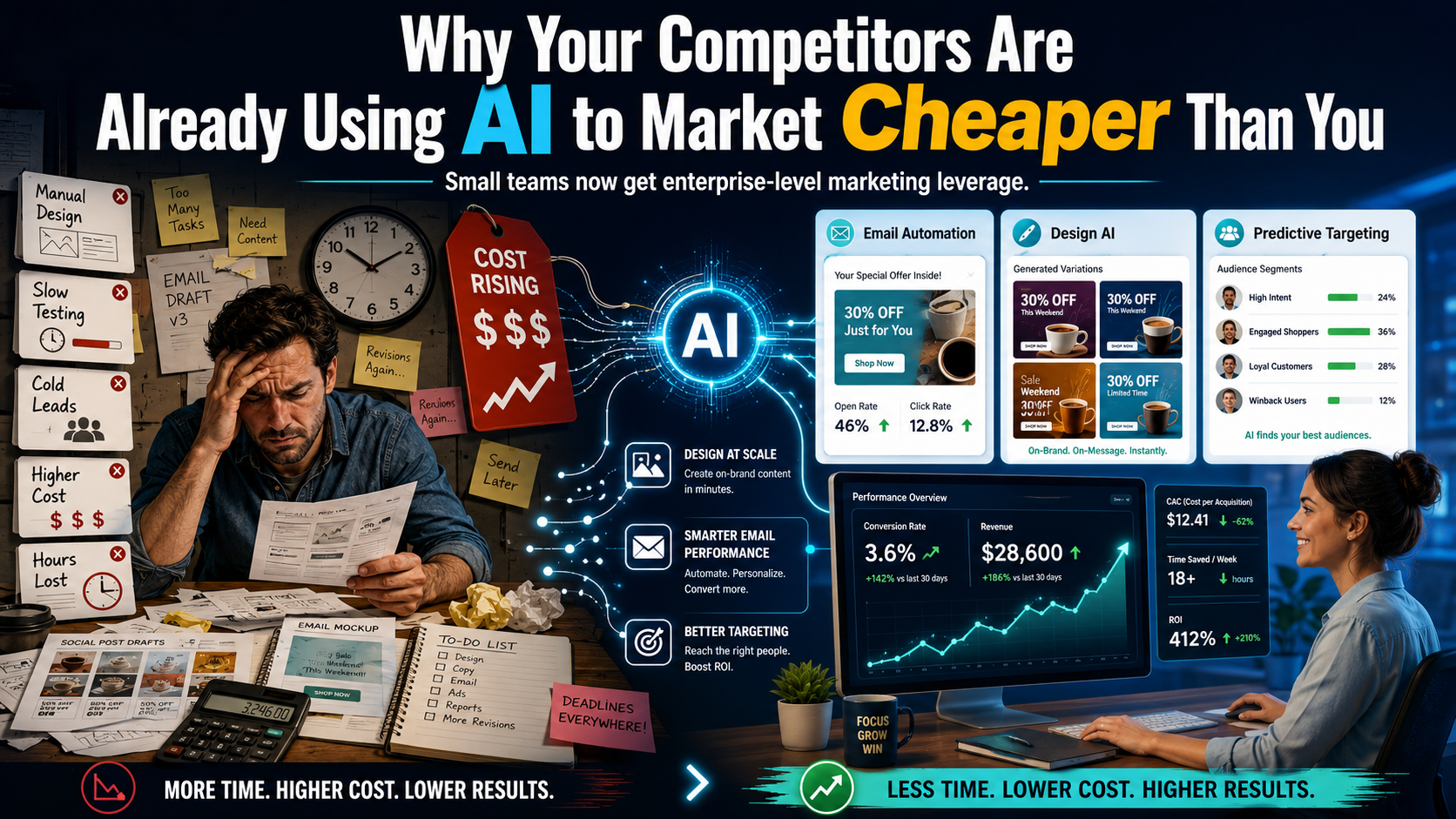
Why Your Competitors Are Already Using AI to Market Cheaper Than You
For decades, small businesses have watched larger competitors outspend them on marketing automation, personalization, and design. The gap felt insurmountable. A Fortune 500 company could afford dedicated data scientists and design teams. You couldn't.
That's changing. AI marketing tools have democratized capabilities that once cost tens of thousands per month. Mailchimp, Canva, and similar platforms now package enterprise-grade features into interfaces built for founders who don't have a marketing department.
The real question isn't whether to adopt AI marketing tools—it's which ones solve your immediate bottlenecks.
The Three Core Problems AI Tools Actually Solve
Before evaluating specific platforms, understand what AI marketing tools genuinely tackle:
- Design at scale without hiring a designer. Manual design work consumes 10-20 hours per week for many small teams. Canva's AI features compress that to minutes.
- Email performance through predictive insights. Subject line testing used to require weeks of A/B experiments. AI tools now predict winning subject lines before you send.
- Behavioral targeting based on purchase likelihood. Mailchimp's forecasting tools identify which customers are most likely to convert, letting you focus budget on warm leads instead of cold outreach.
Everything else—dashboards, analytics, integrations—matters only if these three fundamentals work.
Mailchimp: Email + Automation + Predictive Targeting
Mailchimp is the default choice for 1-20 person teams because it started as a simple email tool and evolved into a marketing automation platform without losing its simplicity.
The AI features that matter most:
- Smart subject line generator. Writes and scores subject lines for higher open rates. Most founders who test this see 15-25% lift within the first month.
- Behavioral forecasting. Analyzes your customer data (purchase history, email engagement, browsing patterns) to predict which users are most likely to buy. You can then segment campaigns around this—sending re-engagement emails to cold segments and aggressive upsells to hot ones.
- Personalized product recommendations. If you sell e-commerce, this automatically suggests products based on past purchases and browsing. Doesn't require separate tools or developer setup.
- AI-powered visual design assistance. Built from Mailchimp's acquisition of Sawa. Creates email templates, landing pages, and graphics without hiring a designer.
Pricing starts free (up to 500 contacts). Pay-as-you-grow structure means you're never overpaying early. Pro tier ($20/month) includes all AI features mentioned above.
Best for: E-commerce businesses, SaaS founders, and service providers sending regular customer emails. Weakest at: Complex multi-channel campaigns (ads, SMS, social) if you need them integrated.
Canva: Design Automation for Non-Designers
Most small business owners estimate they spend 8-12 hours weekly on design tasks: social graphics, email headers, landing page mockups, ads, presentations.
Canva's AI tools cut this in half through:
- Magic Design. Paste a product image or describe what you need; AI generates multiple design options in seconds. You edit, not create from scratch.
- Brand Kit automation. Once you set your colors, fonts, and logo, Canva applies them consistently across all designs. No manual resizing or color-matching.
- Background removal and enhancement. Professional-grade image editing without Photoshop expertise or $50/month subscriptions.
Most small teams see 6-10 hours of weekly time savings within the first month of Canva adoption. That's 24-40 hours per month—real capacity you can redeploy to sales calls or product work.
Pricing: Free tier covers basic designs. Pro ($120/year) unlocks AI features and brand kit. Teams pay $30/user/month.
Best for: Content creators, service businesses, and anyone managing social media. Weakest at: Highly custom branding or print-ready requirements.
What Mailchimp's Approach Reveals About Successful AI for Small Business
Mailchimp's evolution offers a blueprint for how to evaluate any AI marketing tool:
1. Data is the foundation. Mailchimp didn't invent AI-powered email subject lines overnight. It collected decades of marketing data across millions of small businesses and billions of customer interactions. The AI learned from that real-world baseline.
When you evaluate tools, ask: Where does the AI training data come from? Tools trained on millions of similar businesses (like yours) will outperform generic AI trained on random internet text.
2. Integration matters more than individual features. Mailchimp's AI tools work together. Subject line generator feeds into behavioral forecasting, which informs product recommendations. That compounding effect creates marketing velocity that point solutions can't match.
3. Ease of use is the real competitive advantage. Enterprise marketing platforms like HubSpot are more feature-rich. They're also overwhelming for a 3-person team. Mailchimp and Canva win because founders actually use them. Unused tools (no matter how powerful) generate zero ROI.
A Practical Implementation Framework
Don't try to adopt all AI marketing tools at once. Most small teams see the best returns by implementing in this order:
- Month 1: Email automation + subject line AI (Mailchimp or ConvertKit with AI features). This touches your highest-intent audience. 2-3 hours weekly to set up; 15-20% performance lift within 30 days.
- Month 2: Design automation (Canva). Frees up 8-10 hours weekly previously lost to manual graphics. Start with social media templates, expand to email headers.
- Month 3: Behavioral analytics and segmentation. Use Mailchimp's forecasting to identify your best customers. Double down on them instead of chasing cold leads.
This phased approach lets you measure ROI at each stage and avoid the trap of tool overwhelm.
The Economics: What You Actually Save
A realistic cost-benefit for a small team implementing Mailchimp + Canva:
- Monthly cost: $120/year Canva Pro + $20/month Mailchimp = ~$50/month fully loaded.
- Time savings: 10-15 hours weekly (design + email optimization) = 40-60 hours monthly.
- Performance lift: 15-25% improvement in email open rates and click-through rates is conservative (verified in Mailchimp case studies).
- Payback: At fully-loaded cost of $50/hour (salary + overhead), you're saving $2,000-3,000 monthly in labor. ROI breaks even in under 3 weeks.
The leverage compounds. Once these tools run on autopilot, that freed-up time isn't busywork—it's time for founders to focus on strategy, sales, or product improvements.
One Final Thought: The Audit You Need to Run
Before choosing tools, audit your current marketing spend and time allocation for 2 weeks:
- How many hours weekly on design and graphics?
- What's your current email open and click-through rate?
- Which customer segments convert best?
- Are you sending campaigns to cold audiences that should be ignored?
The tool that solves your biggest bottleneck (not the fanciest tool) is the one to start with. AI marketing tools are only worthwhile if they directly address your current constraints.