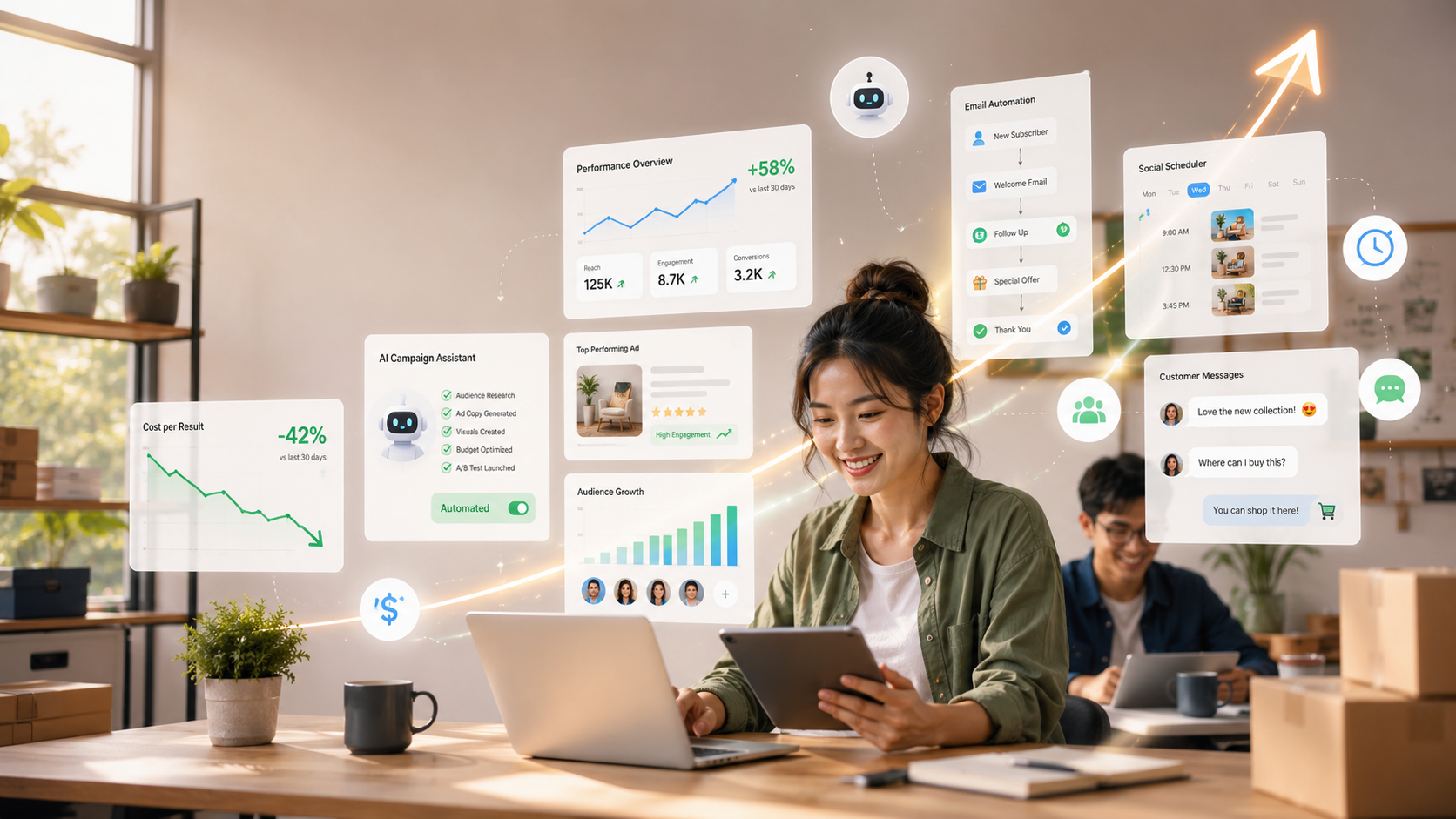
Why Your Small Business Needs AI Marketing Now (Not Later)
You're stretched thin. Your team is wearing five hats each. Your marketing budget could fit in a shoebox. Sound familiar?
Here's the reality: AI marketing tools have dropped the barrier to entry so low that ignoring them is leaving money on the table. Mailchimp, Intuit Assist, and similar platforms now offer automation, personalization, and creative design capabilities that once required a full-time marketing hire or a $5K/month agency retainer.
The math is simple. A junior marketing hire costs $35K-$50K annually. A good AI-powered marketing platform costs $20-$300/month depending on features and scale. You do the math—but also consider speed and 24/7 availability. AI doesn't sleep.
Three Core Problems AI Marketing Solves
1. Email Campaigns That Don't Feel Like Email Campaigns
Generic, batch-and-blast emails are dead. Your competitors sending personalized campaigns are already winning. Tools like Mailchimp now use AI to automatically segment audiences, recommend send times, and generate subject lines that outperform human-written alternatives by 20-40% on open rates (based on aggregate platform data).
Concrete step: Upload your customer list. Let the platform identify high-value segments automatically. Enable AI-driven send-time optimization. Watch open rates climb without lifting a finger.
Why this matters: Each 5% increase in open rate on a 5,000-person list translates to 250 additional engaged prospects. Scale that across 12 campaigns yearly, and you're touching 3,000+ incremental interactions.
2. Ad Design Without the Designer
Google's generative AI tools and similar platforms can now create ad creatives in minutes, not days. No Photoshop. No freelancer back-and-forth. No $500+ per asset.
Feed the AI a product photo and a headline. It generates 5-10 variations automatically. A/B test them. Double down on winners. This compressed feedback loop means you're optimizing creative spend continuously rather than quarterly.
Concrete step: Use Google's ad creative tools or Mailchimp's design recommendations to generate 3-5 variations of your next campaign asset. Split-test them across a small audience ($50-$100 budget). Scale the winner.
Why this matters: Creative iteration used to take 2-3 weeks and $2K. Now it's 2-3 days and $200. Your time-to-market compounds into faster learning and faster growth.
3. Personalization at Scale Without Human Labor
Intuit Assist and competing AI tools now analyze customer behavior and automatically generate personalized product recommendations, email content, and messaging based on browsing history, purchase patterns, and engagement signals.
This isn't static personalization ("Hi John"). This is dynamic: "Hey John, you viewed hiking boots 3 times. Here's a 15% discount on the exact model you were looking at, plus reviews from customers with similar foot types."
Concrete step: Enable behavior-triggered email sequences in your platform. Set parameters (e.g., "abandoned cart after 2 hours," "product view but no purchase"). Let AI handle the rest. Abandoned cart emails alone typically recover 10-20% of lost revenue.
Why this matters: Personalized emails convert 4-6x better than generic ones. If you're leaving personalization on the table, you're literally hemorrhaging revenue.
The Practical Playbook: Where to Start
Month 1: Email Automation Foundation
- Choose your platform (Mailchimp is free to start; Intuit Assist for Mailchimp adds AI features on top).
- Import your customer list.
- Build one AI-assisted email sequence (welcome series, abandoned cart, or post-purchase upsell).
- Enable send-time optimization.
- Measure: track open rates, click rates, and conversion rates before and after AI implementation.
Expected outcome: 15-30% increase in open rates. 10-25% increase in click-through rates.
Month 2: Ads and Creative
- Identify your top 3 product SKUs or service offerings.
- Generate 3-5 ad variations for each using AI tools.
- Split-test across a small audience ($50-$100 per variation).
- Identify winners. Scale spend by 2-3x.
Expected outcome: 20-40% reduction in cost-per-click. Faster creative iteration cycles.
Month 3: Behavior-Triggered Sequences
- Map customer journey: awareness → consideration → decision → retention.
- Build AI-assisted email sequences for each stage.
- Enable dynamic product recommendations based on browsing behavior.
- Test and optimize based on conversion data.
Expected outcome: 25-50% increase in email revenue. Predictable revenue from automation.
Real Numbers: What You Should Expect
Based on aggregated small business performance with AI marketing tools:
- Email open rates: 18-25% (non-AI baseline: 15-20%). AI optimized: +15-30% lift.
- Click-through rates: 2-3% (baseline: 1.5-2%). AI-powered: +25-50% lift.
- Conversion rates: Personalized campaigns: 3-5%. Generic campaigns: 1-2%. Differential: +150-400%.
- Cost per acquisition: Reduced by 20-40% through smarter targeting and creative optimization.
- Time savings: 10-15 hours per week previously spent on manual email creation, design, and list segmentation.
The business case: If you're doing $500K annual revenue with a 5% email contribution ($25K), a 30% lift from AI implementation means an additional $7,500 in annual revenue from the same list size. That's at 1/100th the cost of hiring someone to do it manually.
Common Mistakes to Avoid
Mistake 1: Set it and forget it. AI tools require human oversight. Check your automations monthly. Are open rates stable? Click rates healthy? Revenue climbing? If not, adjust.
Mistake 2: Over-automate too fast. Pick one workflow. Master it. Scale it. Add the next. You don't need all features on day one.
Mistake 3: Ignore data quality. Garbage in, garbage out. Clean your email list. Remove inactive subscribers. Segment properly. AI works better with clean inputs.
Mistake 4: Use generic AI outputs verbatim. AI tools generate starting points, not finished products. Always review subject lines, body copy, and CTAs. Inject your brand voice. Test variations.
The Bottom Line
AI marketing tools are no longer nice-to-have luxuries—they're baseline competitive necessity for small businesses competing against larger, better-staffed competitors. A solopreneur with Mailchimp + Intuit Assist + Google's ad tools can now execute marketing campaigns that rival a 3-person marketing team from five years ago.
Start with email automation. Prove the concept with your own data. Expand into ads and personalization. Measure everything. Iterate constantly. The businesses that win in 2025 won't be those with the biggest budgets—they'll be those who leverage AI for speed, scale, and sophistication.
Your next move: Audit your current marketing workflow. Identify the highest-ROI task that's eating your time (email campaigns, ad design, list segmentation). Find the AI tool that solves it. Deploy it this week. Measure results in 30 days. That's the playbook.