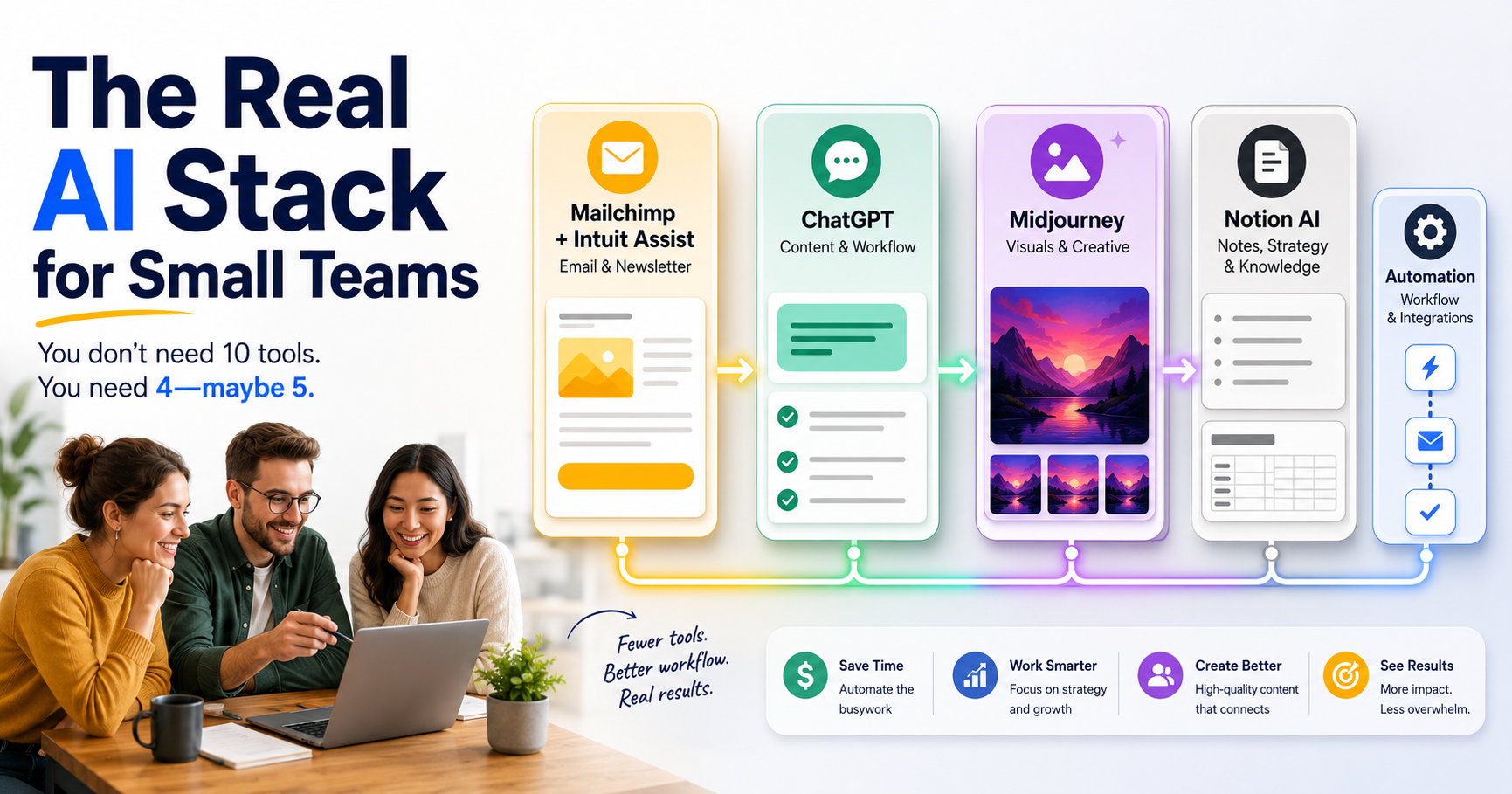
The Real AI Stack for Small Teams
You don't need 10 tools. You need 4—maybe 5. And you definitely don't need to pay for annual subscriptions you'll abandon in March.
The AI marketing landscape for small business owners has shifted. Instead of sprawling SaaS stacks, smart operators are consolidating around a core set of tools that actually move revenue metrics. The signal is clear: depth over breadth. One tool used daily beats five tools collecting dust.
Here's what's actually working for small businesses right now, and why each one matters.
1. Mailchimp + Intuit Assist: Personalized Email at Scale
Email remains the highest ROI channel for small businesses. The problem: most founders hate writing email copy, let alone personalizing it for different customer segments.
Enter Intuit Assist, Intuit's generative AI assistant embedded directly into Mailchimp. This isn't theoretical anymore. Real small business owners are using this right now to:
- Generate draft email content automatically from product data in QuickBooks
- Adjust tone, text, and images in seconds without touching design software
- Schedule campaigns and add them to marketing calendars automatically
- Segment customers into sales pipelines for follow-up nurture sequences
The math: A typical 3-person marketing team spends 2-3 hours per week on email copy alone. Intuit Assist cuts that to 30 minutes. That's 2-2.5 hours back per week to focus on strategy, not grunt work.
Mailchimp itself costs $20-$350/month depending on list size and features. If you're already paying for email, the AI layer costs nothing extra. If you're not, start here before anywhere else.
2. ChatGPT: Your Content Operations Engine
ChatGPT (both free and $20/month Pro) has become the backbone of content systems for small businesses doing real volume. Not for viral tweets—for systems.
Real-world example: A solopreneur running a niche content site used ChatGPT agents to build automated workflows that would have required a full-time hire six years ago:
- Daily news summaries fed to websites automatically
- Full article analysis for topic extraction and SEO tagging
- Affiliate product recommendations embedded contextually into published content
- Report generation that synthesizes data into actionable insights
The time savings are staggering. One founder reduced 20+ hours per week of manual content operations to less than 5.
That's not hyperbole—that's what happens when you build systematic processes instead of using AI casually.
Pro tip: Don't prepay for annual plans. Buy one month of ChatGPT Pro ($200 upfront) to stress-test the tool for your specific workflow. If you find yourself opening it daily, drop to the $20/month plan. If you don't, you've only burned $200 instead of $240.
3. Midjourney: Visual Content Without the Freelancer Budget
You need custom visuals. Hiring a designer costs $500-2,000 per project. Midjourney costs $10-30/month.
The calculation is simple: If you produce more than 2-3 pieces of visual content per month (blog headers, social graphics, thumbnail experiments), Midjourney pays for itself immediately.
Where small businesses use Midjourney:
- Blog post header images (faster than stock photography searches)
- Social media graphics for LinkedIn, Twitter, Instagram
- Product mockups and demo visuals
- Landing page hero images
- Case study graphics and data visualizations
The key: Midjourney is not a replacement for professional design. It's a replacement for either hiring a designer or spending $600/year on premium stock photos. Use it for that purpose, and it's clearly ROI-positive.
4. Notion AI: The Thinking Partner for Strategy
Notion AI is the least obvious tool on this list, but small business owners keeping notes in Notion should consider it ($10/user/month on top of Notion subscription).
It's useful for:
- Expanding rough outline notes into full strategic documents
- Summarizing customer feedback into actionable themes
- Drafting SOPs and internal processes from conversation notes
- Analyzing market research and competitor data you've collected
It's not mandatory. Many founders skip it. But if your entire business documentation and knowledge base lives in Notion already (which it should), adding AI-assisted thinking is a small friction reducer that compounds.
The Wrong Way to Buy AI Tools
Most small business owners make the same mistake: They buy too many tools, pay for annual subscriptions, and use 2 features from each.
The correct approach:
- Start with one tool. Master it for 30 days. Know where the friction is.
- Buy monthly, not yearly. Unless you've used a tool daily for 60+ days, don't commit annually.
- Measure output time. If a tool doesn't save you 5+ hours per week, drop it.
- Build workflows, not tool collections. The value is in chaining tools together (Mailchimp → ChatGPT → Notion → Midjourney) to create systems that work while you sleep.
The Real Opportunity: Systems, Not Features
Here's what separates founders winning with AI from those wasting money: they build systems.
A system is what happens when you connect tools to do work autonomously. Examples:
- A Mailchimp workflow that automatically generates personalized emails based on customer behavior data, pulls templates from brand guidelines, and schedules sends without human intervention.
- A content pipeline where ChatGPT agents automatically summarize industry news, feed it to your website, extract topics, and populate an internal Notion database for future content planning.
- A visual asset workflow where a product launch triggers Midjourney image generation, which feeds into Canva templates, which post automatically to social channels.
This is where AI delivers real ROI for small businesses. Not in individual features. In the automation of entire workflows that would otherwise require a full-time hire.
Start narrow. Pick your biggest time drain. Choose one tool that directly addresses it. Give it 30 days. Then expand if it works.
That's the AI stack that actually matters.