What Just Happened (And Why You Should Care)
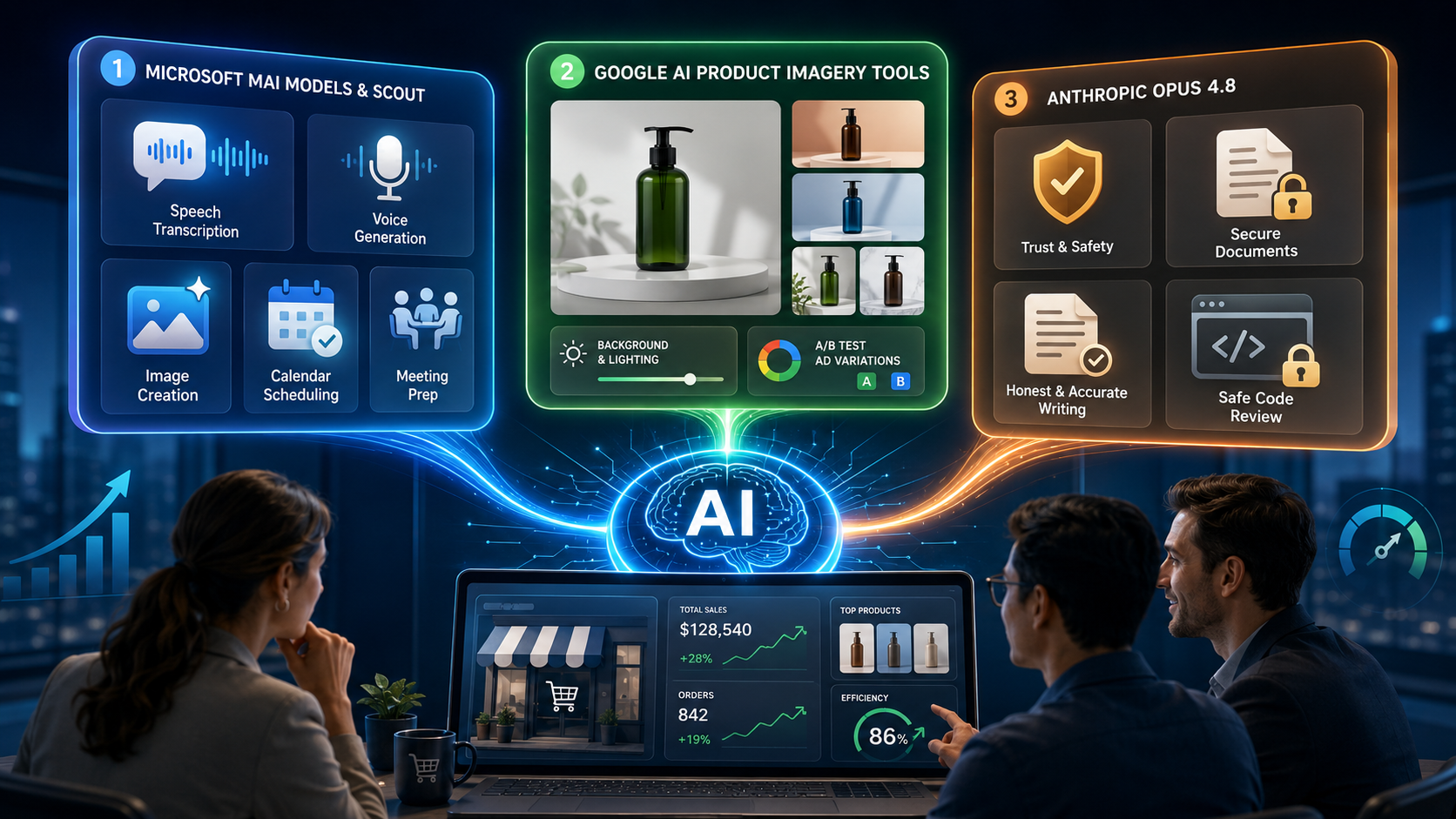
In June 2026, three major AI announcements landed within days of each other. Microsoft dropped a new family of proprietary models (MAI) targeting speech, voice, and images. Google rolled out generative AI for product photography aimed at U.S. advertisers. Anthropic released Opus 4.8, emphasizing honesty and cybersecurity. For small business owners, this matters because these aren't incremental updates—they're tools solving specific business problems that previously required hiring specialists or piecing together expensive third-party solutions.
Microsoft's MAI Models: The Shift to Built-In AI
Microsoft announced its MAI (Microsoft AI) family of models at Build 2026, specifically targeting three workflow bottlenecks: speech transcription, voice generation, and image creation. Here's why this is actionable for your business:
- Vertical integration matters. Microsoft is building these directly into its stack rather than relying on third-party APIs. For solopreneurs and small teams, that means fewer vendor dependencies, potentially lower costs per transaction, and tighter integration with tools you already use daily (Teams, Outlook, Office).
- Local compute is becoming practical. The Surface RTX Spark Dev Box—shipping later in 2026—can run models up to 120 billion parameters locally with 128 gigabytes of unified memory. Translation: You can process sensitive customer data without sending it to the cloud. For industries dealing with HIPAA, PCI compliance, or confidential client work, this is a game-changer.
- Scout agent handles the routine. Microsoft Scout, rolling out to Frontier customers now, handles scheduling, meeting prep, and administrative tasks without prompting. For a 5-person agency, this means one person's manual scheduling work gets automated immediately upon launch in your environment.
Google's Advertiser Play: AI-Generated Product Images
Google's generative AI tools for product imagery target a specific pain point: e-commerce businesses without professional photography budgets. Here's what this unlocks:
- Faster product iteration. If you're testing new product variations, SKU colors, or seasonal packaging, AI-generated imagery collapses the time from concept to listing from days (hiring photographer, scheduling shoot) to hours (prompt generation).
- Lower upfront costs. Small brands testing whether a red vs. blue packaging variant converts better no longer need a 3-hour photo shoot. Generate 50 variants, run A/B tests, pick the winner.
- Geography-specific targeting. The tool is U.S.-focused initially, but the pattern suggests regional expansion. This means localizing product photography for different markets without location-specific shoots.
So what? If you run a Shopify store, Etsy shop, or sell on Amazon, AI product imagery tools reduce the friction between product idea and market validation by 60-70%.
Anthropic's Opus 4.8: The Trust and Security Layer
Anthropic released Opus 4.8 with explicit emphasis on honesty and cybersecurity. This is less flashy than image generation but critically important for B2B work:
- Reduced hallucination in high-stakes contexts. If you use AI to draft legal memos, client proposals, or technical documentation, Opus 4.8's focus on accuracy means fewer embarrassing rewrites. It won't fabricate case law or invent technical specs.
- Cybersecurity-aware reasoning. The model flags security vulnerabilities in code reviews and documentation, making it useful for founders who've hired junior devs or outsourced development. It's a second pair of eyes on your security posture.
- Compatible with existing Claude integrations. If you've already built workflows around Claude (via API, web interface, or third-party tools), Opus 4.8 is a drop-in upgrade with no restructuring required.
How to Prioritize These Three Tools for Your Business
Use Microsoft MAI + Scout If:
You're already in the Microsoft ecosystem (Office 365, Teams, OneDrive). Your immediate win is eliminating 3-5 hours per week of calendar management and meeting prep through Scout. Transcription via MAI models replaces expensive tools like Otter.ai for call recording and meeting notes.
Implement Google's Product Imagery Tool If:
You sell physical products online (Shopify, Amazon, Etsy, your own site). Budget 4-8 hours to learn the interface, then allocate 15-20 minutes per new product variant for AI image generation. ROI appears within the first product refresh cycle.
Adopt Opus 4.8 If:
You're writing anything customer-facing or security-sensitive: client emails, proposals, code reviews, documentation. Start with a two-week trial. If your current AI tool (GPT-4, other Claude versions) requires multiple revision rounds, Opus 4.8 will cut that by 25-40%.
The Larger Pattern: From Horizontal Tools to Vertical Integration
These three launches signal a shift in AI's maturity curve. The gold-rush phase of general-purpose chatbots is ending. Instead, major players are embedding AI deeper into industry-specific workflows: productivity (Microsoft Scout), e-commerce (Google imagery), and professional services (Anthropic). For small business owners, this is favorable because it means:
- Better cost efficiency. Specialized tools optimized for one job beat generalist tools requiring workarounds.
- Reduced setup friction. Scout integrates with Teams automatically; you don't build custom integrations. Google's imagery tool hooks into your existing ad stack. Opus 4.8 drops into Claude's existing interface.
- Lower switching costs once deployed. Once embedded in your workflow, these tools become sticky—which means better long-term productivity gains.
What to Do Next Week
Priority 1 (2 hours): Audit which of these three categories applies to your business (admin overhead, product imagery, or content accuracy). Prioritize the one causing the most friction.
Priority 2 (4 hours): If you chose Scout, request Frontier access to your Microsoft Account. If you chose product imagery, test Google's tool with 3-5 product variants. If you chose Opus 4.8, start a free trial on Claude's web interface and draft one high-stakes document (proposal, memo, code review) to compare output quality against your current tool.
Priority 3 (ongoing): Track time savings for four weeks. If any of these tools saves more than 5 hours weekly per person, budget it into your 2026 software spend. If less, flag for Q3 reassessment.
The window for adopting these tools early is narrow. By Q4 2026, competitors will have normalized them, and the competitive advantage will flatten. Move now.