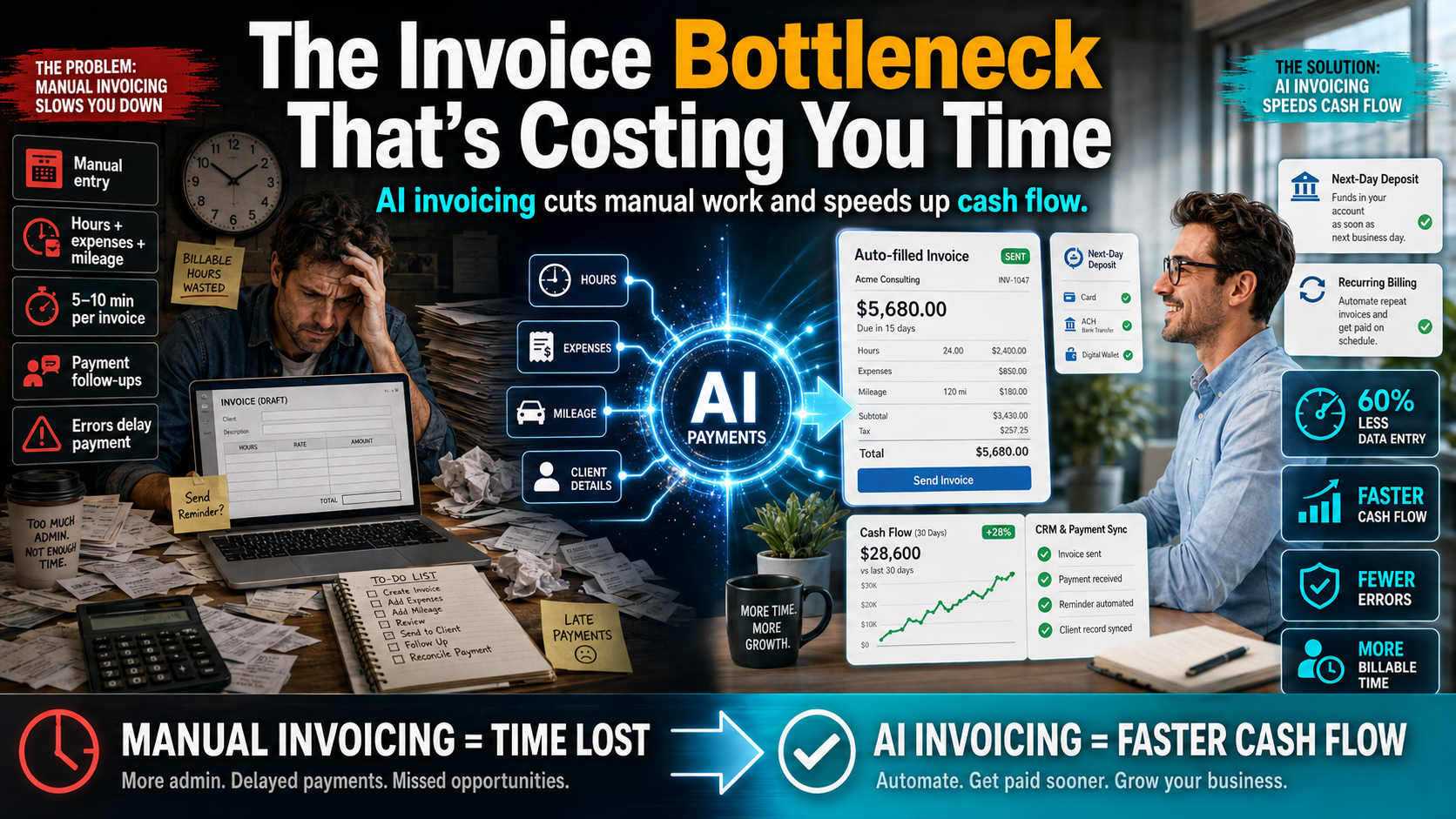
The Invoice Bottleneck That's Costing You Time
If you're still manually building invoices, you're losing money. A solo consultant or small team can spend 5-10 minutes per invoice entering hours, expenses, mileage, and client details. Multiply that by 50 invoices a month, and you've burned through 4-8 hours of billable time.
That's where AI-powered payment platforms enter the picture. In 2026, payment software like QuickBooks Payments now automatically populate invoices with hours worked, expenses incurred, and mileage tracked—cutting manual data entry by up to 60%. The result: faster cash flow and fewer errors that delay payment.
What AI-Powered Invoicing Actually Does
Modern payment automation isn't just about templates. Here's the concrete workflow:
- Auto-population of financial data: Hours, expenses, and mileage are automatically pulled from your tracking system and inserted into the invoice. No copy-paste required.
- Flexible payment structures: You can collect deposits upfront, structure installment plans, or offer multiple payment methods (card, ACH, digital wallet) in one invoice link.
- Next-day deposits: Payment hits your account the next business day—or instantly in some cases. Compare this to traditional invoicing where you wait 3-7 days for ACH clearance.
- Team-level payment permissions: With tools like GoPayment (QuickBooks' mobile POS), you can set role-based permissions so employees can accept payments on-site without access to your full payment system.
The Real Impact: Cash Flow Acceleration
Here's the math for a 20-person team sending 100 invoices monthly:
- Time saved: 8-10 hours per month (500+ hours annually)
- Cash flow improvement: With next-day deposits instead of 5-day waits, you're holding $20K-$50K more cash at any given time. That's working capital you can reinvest immediately.
- Error reduction: Manual invoicing mistakes (wrong rates, duplicate line items, miscalculated totals) drop by 80%+. Fewer follow-ups with clients = faster payment cycles.
- Customer experience: Clients receive polished, detailed invoices faster. Multiple payment options reduce friction. Studies show payment variety increases on-time payment rates by 15-25%.
Why CRM Integration Matters
Standalone invoicing tools are table stakes. The competitive advantage comes from integration with your broader business systems. Platforms like HubSpot CRM and Zoho CRM now embed payment functionality directly into customer records.
Real-world scenario: A client payment is due. Your CRM automatically triggers an invoice using stored hours data, sends it via your customer's preferred channel, and tracks payment status in real-time. No context-switching between apps. No manual follow-up needed until day 30+.
The CRM + Payment Advantage for Small Teams
- All customer financial history lives in one place (CRM record)
- Payment reminders trigger automatically based on invoice age
- Recurring invoices for retainer clients need zero manual refresh
- Reporting shows customer payment patterns—helping you spot at-risk accounts early
Beyond Invoicing: Business Planning AI
If you're serious about scaling, invoice automation is just the beginning. AI-powered business planning tools like LivePlan and Upmetrics handle forecasting, cash flow projections, and scenario planning.
Why this matters to small teams: You can build a 3-year financial projection in 20 minutes instead of 4 hours. The AI uses industry benchmarks and your historical data to flag unrealistic assumptions. For lenders and investors, a data-backed plan dramatically improves your odds of getting funded or approved for credit lines.
Implementation Path for Your Business
Month 1: Audit your current invoicing
- Track how long invoice creation actually takes (include data entry, sending, follow-up)
- Count payment touchpoints (how many emails, reminder calls, etc. per invoice)
- Identify your most common invoice mistakes
Month 1-2: Choose your stack
- If you use QuickBooks, QuickBooks Payments is the fastest integration (same platform)
- If you're in CRM-first workflow (HubSpot, Zoho), implement their payment layer
- For mobile/field teams, prioritize mobile POS with permission controls
Month 2-3: Set up automations
- Link time-tracking and expense tools to your invoicing system
- Enable automatic recurring invoices for retainer clients
- Customize payment reminder sequences (day 5, day 15, day 25 post-invoice)
- Test deposit and installment payment workflows with 5-10 invoices first
Ongoing: Monitor and refine
- Track days-to-payment before and after implementation
- Measure payment method usage (cards vs. ACH vs. wallets)
- Review error rates quarterly—AI systems learn from corrections you make
The Bottom Line
AI-powered payment and invoicing tools aren't luxuries in 2026—they're table stakes for any small business handling recurring billing. The cumulative benefit is significant: 60% faster invoice creation, next-day cash deposits instead of week-long waits, and dramatically fewer payment follow-ups.
For a 10-person team, that translates to approximately 500+ recovered billable hours per year and $10K-$20K in accelerated working capital. Start with the tool your business already uses (QuickBooks, HubSpot, Zoho), flip on payment automation, and measure the improvement in your cash conversion cycle within 30 days. You'll have hard data on ROI before deciding to expand to business planning AI.