Why Enterprise Giants Are Betting Billions on AI Acquisition Tools
Salesforce, Zendesk, and Nice Systems didn't spend hundreds of millions acquiring AI platforms for novelty. They recognized a hard truth: traditional customer acquisition funnels are broken for modern buyers. AI-driven personalization now directly impacts customer lifetime value, conversion rates, and acquisition costs. The question isn't whether to use AI for customer acquisition—it's whether your competitors are already doing it.
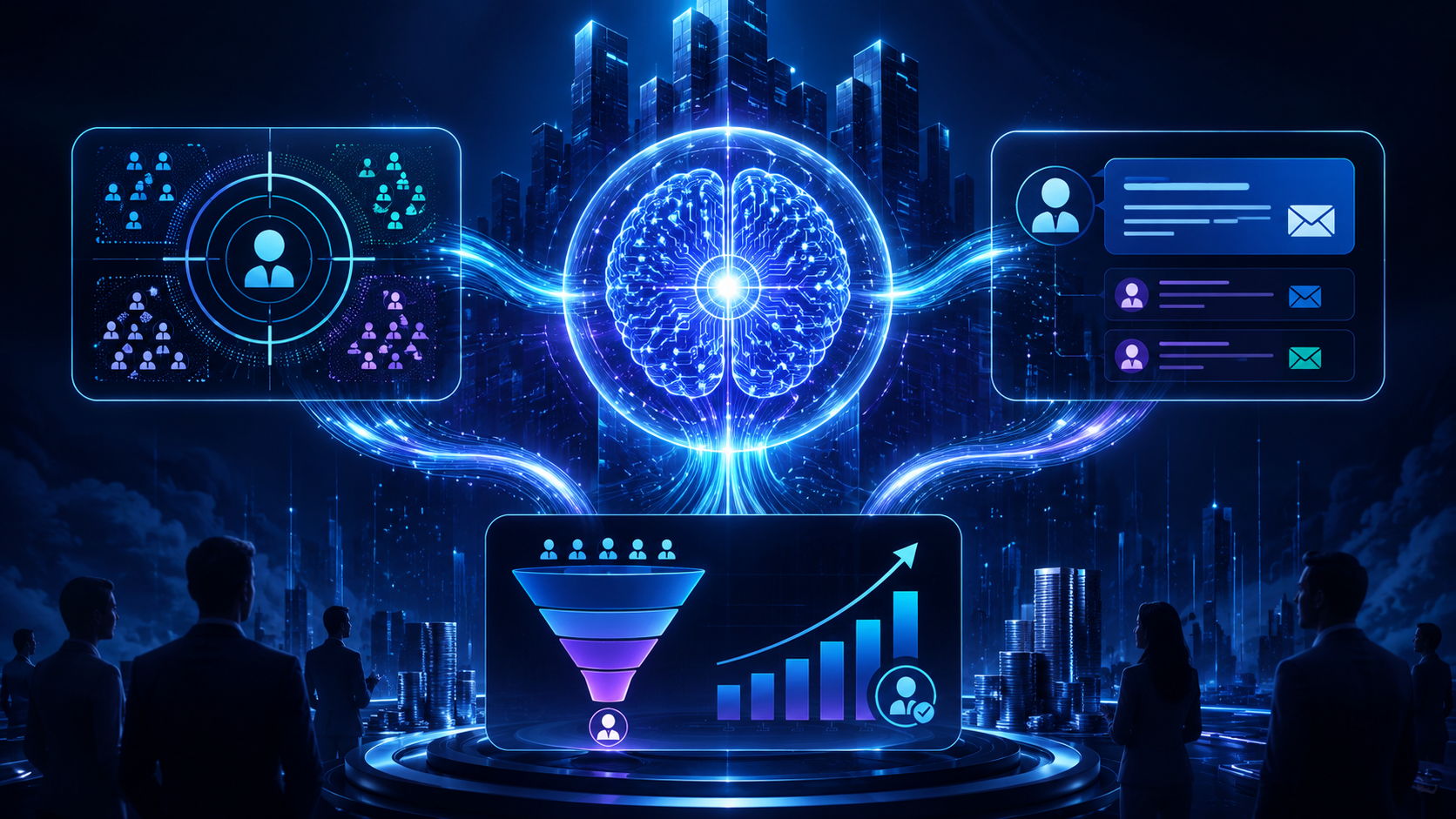
Here's the business reality: companies using AI-powered personalization report 25-30% higher customer retention rates and significantly improved conversion metrics. But this isn't magic. It's systematic application of machine learning to three repeatable processes: audience targeting, message customization, and conversion optimization.
The Three Levers AI Pulls in Customer Acquisition
1. Hyper-Targeted Audience Discovery
Traditional customer acquisition starts with guesswork. You create an ideal customer profile, run ads, and hope. AI flips this approach.
Modern AI platforms analyze your existing customer base—their industry, company size, job title, pain points, and buying signals—then identify lookalike audiences with statistical precision. Instead of targeting "marketing managers at SaaS companies," your AI system identifies which specific roles, company characteristics, and behavioral signals correlate with your highest-value customers.
Practical step: If you're using LinkedIn, HubSpot, or Salesforce, your platform already includes basic AI targeting. Start by uploading your top 100 customers (by LTV) into your ad platform's lookalike audience builder. This single step typically improves cost-per-acquisition by 15-40% within 30 days.
2. Dynamic Message Personalization
The same pitch doesn't work for a startup founder and a Fortune 500 procurement manager. AI personalizes messaging at scale—something humans can't do manually above 100 prospects.
AI systems now generate personalized cold emails, landing pages, and ad copy based on prospect characteristics. Tools like Jasper, Copy.ai, and ChatGPT (via prompt templates) can draft dozens of customized outreach sequences in minutes. The lift is significant: personalized email campaigns see 50% higher open rates and 2x higher click-through rates compared to generic messaging.
Practical step: Map your top customer segments (e.g., "mid-market SaaS vs. enterprise healthcare"). Create 3-5 core value props for each. Use an AI copywriting tool to generate 10 variations of an outreach email for each segment. A/B test these variations for 2 weeks. Measure open rate, click rate, and reply rate. Redirect budget toward the winning segments and messages.
3. Lead Scoring and Conversion Optimization
Not all leads are equal. AI-powered lead scoring identifies which prospects are actually ready to buy, preventing wasted sales effort and enabling sales teams to focus on high-probability deals.
Machine learning models trained on your historical sales data predict which leads will close based on behavioral signals: website activity, email engagement, content downloads, and company characteristics. This isn't guesswork—it's statistical prediction. Companies using AI lead scoring typically improve sales efficiency by 30-50% because reps spend time on qualified prospects rather than cold calling every lead.
Practical step: Export your last 12 months of closed deals and lost deals from your CRM. Tag deals as "won" or "lost." Feed this data into Salesforce Einstein, HubSpot AI, or Zendesk's AI lead scorer. The system will identify which early-stage signals correlate with closed deals. Use these signals to automatically prioritize leads for your sales team.
The Real Bottleneck: Data Quality, Not AI Sophistication
Enterprise AI acquisitions work because these companies have clean, structured customer data. Your bottleneck isn't intelligence—it's information quality.
Before implementing AI for customer acquisition, audit your data:
- CRM completeness: Are lead records 80%+ filled out? If your database has blank fields for company size, industry, or job title, AI will struggle.
- Conversion tracking: Can you connect web activity to specific leads? If you can't track which prospect clicked which link, AI can't learn patterns.
- Historical accuracy: Are past closed deals accurately marked in your system? Garbage data in = garbage predictions out.
Spend 2-4 weeks cleaning your CRM before deploying any AI tool. This directly impacts ROI.
Three AI Tools for Immediate Implementation
HubSpot AI (Free-$3,200/month)
If you're already on HubSpot, enable AI features within your existing account. AI email subject line suggestions, chat support automation, and predictive lead scoring are built-in. Minimal setup required.
Salesforce Einstein (Included in most Salesforce tiers)
Predictive lead scoring, opportunity scoring, and Einstein Activity Capture automatically log prospect interactions and predict close probability. Works best if you're already on Salesforce.
Copy.ai or Jasper ($36-125/month)
For generating personalized outreach at scale. Train these tools on your best customers and sales messaging. Output: dozens of personalized cold email variations in 30 minutes.
The Bottleneck Most Founders Miss: Attribution
You've deployed AI for customer acquisition. Now what? The critical next step is measuring impact.
Set up UTM parameters for every AI-driven campaign. Track which AI-generated messages, segments, and channels drive actual revenue. Without this attribution layer, you won't know whether AI is actually improving acquisition or just changing which channels you're wasting money on.
Practical step: Use Google Analytics 4 or your CRM's attribution reporting. Compare CAC (customer acquisition cost) and conversion rates for AI-driven campaigns vs. traditional campaigns. Run this test for 30-60 days before scaling investment.
What Not to Do
Don't assume AI will fix a broken funnel. AI is a multiplier. If your landing pages convert at 1%, AI targeting will help you reach more relevant prospects—but won't fix the 1% conversion problem. Fix fundamentals first.
Don't deploy AI without defining success metrics upfront. Decide: Are you optimizing for CAC, pipeline generated, or conversion rate? Different goals require different AI implementations.
Don't set it and forget it. AI models degrade over time as market conditions change. Review and retrain your models quarterly.
The Bottom Line
AI-powered customer acquisition isn't a future technology—it's a competitive advantage today. Enterprise software companies spent billions acquiring AI platforms because they recognized the math: AI-driven personalization and targeting improve acquisition efficiency by 20-40% on average. For a 10-person startup, that's the difference between profitability and burnout.
Start with data quality. Then pick one lever—audience targeting, message personalization, or lead scoring. Measure impact over 30 days. Scale what works. Repeat.