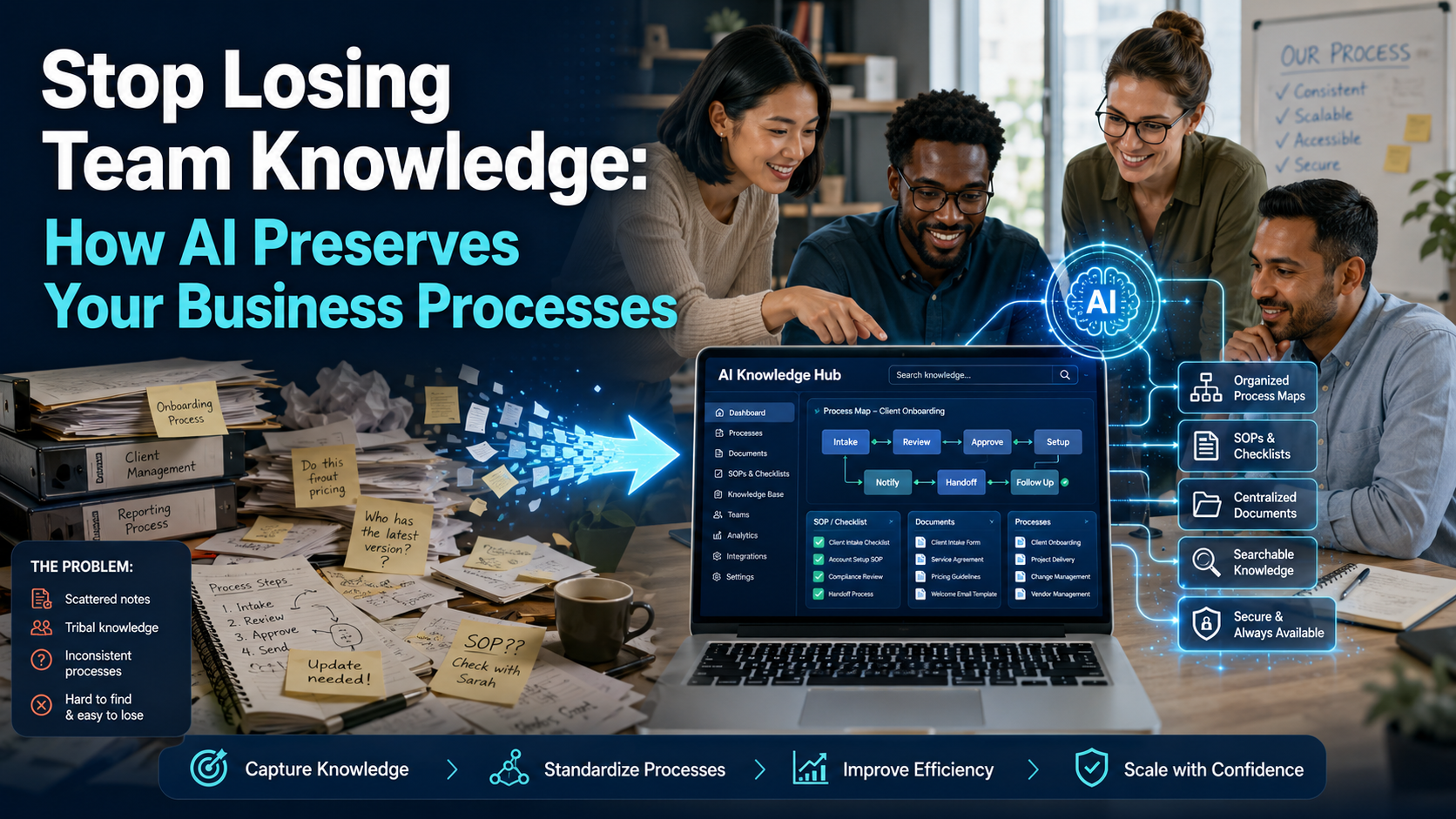
The Hidden Cost of Employee Turnover Nobody Talks About
When your operations manager quits, you don't just lose a person—you lose an invisible asset worth thousands. That manager knew exactly which processes worked under pressure, which vendors were reliable during crises, how your team performed under specific conditions, and what external factors tanked productivity last quarter. All that institutional knowledge walks out the door.
For small teams especially, this knowledge drain is catastrophic. You can't afford to rehire and retrain. But here's what's changed: AI now has permanent memory. It can capture what your best operators know, embed it into your systems, and make it available to whoever comes next.
Predictive AI as Your Process Archive
Traditional business process automation focuses on repetitive tasks—invoice processing, email routing, scheduling. Useful, but limited. Predictive AI goes deeper. It analyzes your historical data to understand why your processes work the way they do, then forecasts future patterns before they happen.
Think of it this way: Your team has collectively run 500+ projects, handled 10,000+ customer interactions, and navigated multiple crises. That's data. Predictive AI ingests all of it—dates, outcomes, team composition, external factors, bottlenecks—and builds a model of what makes your operation tick.
The practical outcome? When your lead developer leaves or your operations person takes a new job, the next person inherits not just a handbook, but a AI system that understands your exact environment.
Three Concrete Ways This Solves Real Problems
1. Automatic Goal-Setting Based on Your Reality
Most small businesses set goals by guesswork: "We'll increase output 15% next quarter." Wrong. Your actual capacity, team dynamics, and market conditions are unique. Predictive AI analyzes your historical performance data—velocity, quality metrics, time-to-completion—and recommends realistic targets automatically.
This isn't just accurate forecasting. It's forecasting that remembers your specific constraints. If your team historically underperforms in summer because two people take vacation, the AI knows that. It won't recommend aggressive targets for July.
2. Real-Time Performance Diagnostics
When productivity drops, you waste time asking: Was it that client project? Did we hire poorly? Is everyone burned out? External market shift?
Predictive AI processes far more information than you can manually track. It cross-references team performance data with calendar events, project assignments, external factors, and historical patterns. Within days, not weeks, it identifies the actual root cause and suggests interventions that worked before in similar situations.
This is the difference between "our numbers are down" and "your numbers are down because of X, and last time this happened, strategy Y improved things by 18%."
3. Succession Planning That Actually Works
When a key person leaves, their replacement inherits an AI that has documented the exact conditions under which that person performed best. What time of day were they most productive? Which types of tasks yielded their best work? What management style resonated with them?
This sounds trivial until you're a 12-person team and your head of sales quits. Now your new hire gets onboarded not just with a folder of old emails, but with an AI system that knows your sales process inside out—which leads converted historically, which stages cause bottlenecks, and what the previous person did that actually worked.
Why This Matters More for Small Teams
Enterprise companies can absorb knowledge loss. They have documentation teams, HR systems, and 500 other people who know how things work. You don't.
When your team is 5-20 people, one person's departure can crater operations for months while the replacement gets up to speed. Predictive AI compresses that timeline dramatically. The new person isn't starting from zero—they're starting with a full institutional memory of how your business actually operates.
Think about the ROI: If hiring someone new typically causes a 2-3 month productivity dip, and AI cuts that to 3-4 weeks, you've paid for years of the tool in a single transition.
The Technical Side (You Don't Need to Understand All of It)
Predictive AI works by ingesting structured data: timestamps, metrics, project outcomes, team composition, external events. It identifies patterns humans miss—correlations between seemingly unrelated variables—and builds models of "when X happens, Y tends to follow."
You don't need to be a data scientist to use this. Tools are increasingly plug-and-play. Connect your project management software, CRM, calendar, and spreadsheets. Let the AI run. Get insights back as recommendations, not raw data.
Where to Start
You don't need to overhaul everything tomorrow. Start with your highest-impact process. For most small businesses, that's either sales pipeline management, project delivery, or customer support. Pick one. Audit what data you already have about that process. That's your starting point.
The data you've probably already collected—email timestamps, project completion dates, revenue figures, team member assignments—is exactly what predictive AI needs to work.
The shift from art to science in how you manage operations isn't coming. It's here. The question is whether you capture your team's knowledge before the next person leaves.