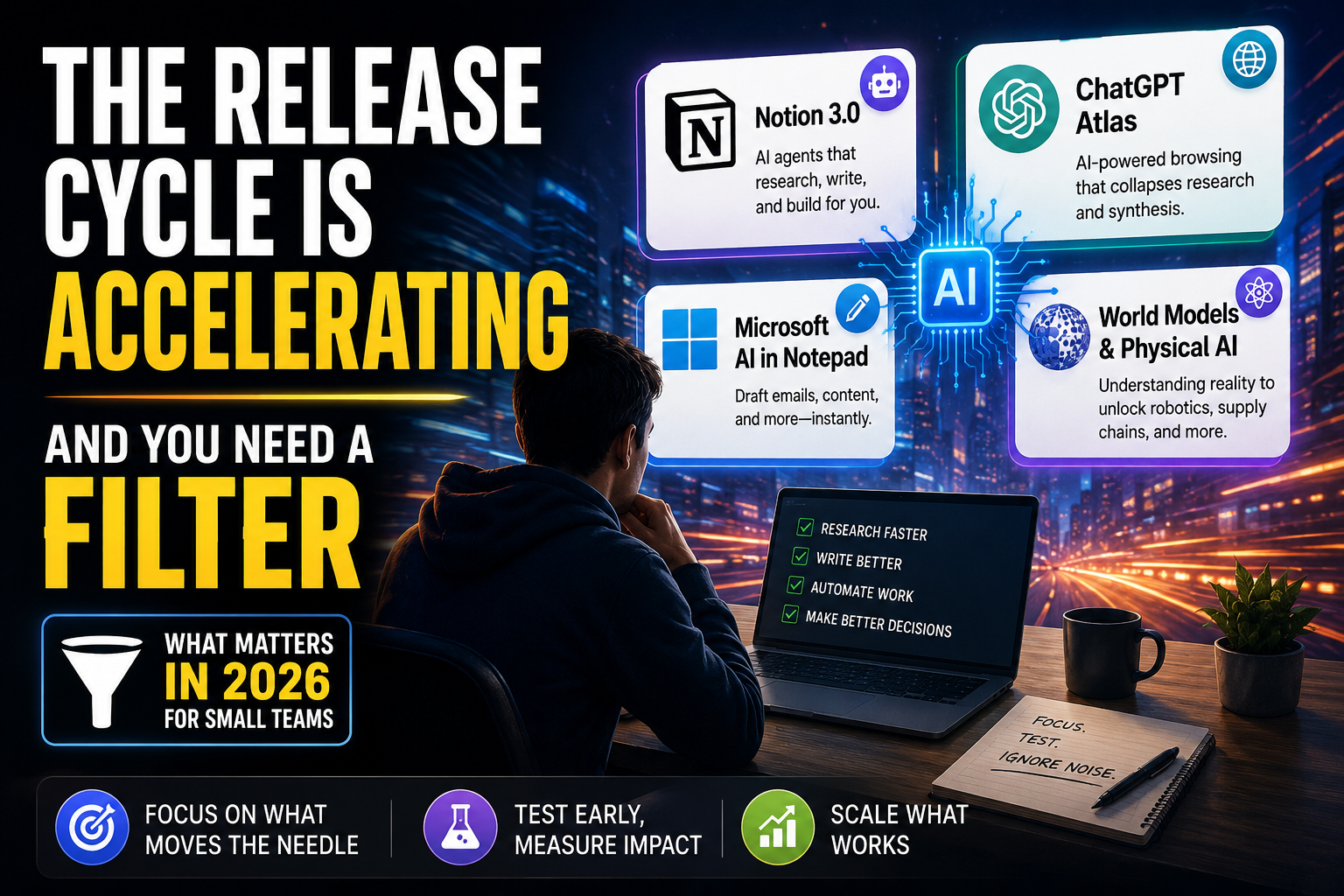
The Release Cycle Is Accelerating—And You Need a Filter
In the last 18 months, we've watched OpenAI release GPT-5, Google ship Gemini 2.5 Pro and Flash variants, Microsoft embed AI into Windows Notepad, and a dozen other major players launch competing tools. The pace isn't slowing down. 2026 will bring Notion 3.0 with native AI agents, OpenAI's ChatGPT Atlas browser (potentially reaching 500-700 million users), and refinements to DeepSeek and Claude that challenge established players.
So what? Every new launch promises productivity gains. But for a 5-person agency or solo founder, the real question is: which tools actually move your business forward, and which are just noise?
The Big Four Launches You Should Track
1. Notion 3.0: The All-In-One Bet
Notion announced version 3.0 in September 2025, and the headline feature is AI agents—autonomous systems that can research, take notes, search the web, and even build basic websites without step-by-step prompts. If you're already using Notion to organize client work, proposals, or knowledge bases, native AI agents could cut your manual research and documentation time by 30-40%.
Action: If you rely on Notion today, test the beta as soon as it's available. If you don't, evaluate whether bundled AI agents justify switching from your current workflow tool.
2. ChatGPT Atlas Browser: A Search Engine Alternative
OpenAI's upcoming browser integrates ChatGPT directly with internet search. This matters because it collapses the gap between research and synthesis. Instead of opening three tabs to find vendor comparisons, client case studies, or market data, you'll get AI-powered answers in one place. With 500-700 million active ChatGPT users, adoption will be rapid.
Action: Plan to test this for competitive research and customer discovery. Monitor whether it reduces your dependency on Google or specialized research tools.
3. Microsoft AI in Notepad: Writer's Block Becomes Someone Else's Problem
Microsoft is rolling out generative AI directly into Windows Notepad. Give it a prompt like "write a professional email offering a discount to a churning customer," and it drafts the content instantly. The rollout is currently in Windows Insider testing but will go global soon.
Action: For founders who draft proposals, emails, or social content, this removes friction. Start thinking about how to brief an AI on your brand voice now—generic AI writing won't cut it.
4. World Models and Physical AI: The Longer Play
Fei-Fei Li's World Labs launched Marble in November 2025—the first commercially available world model product. Unlike language models that predict text, world models learn the causal structure and physics of reality. This sounds abstract, but it unlocks applications in robotics, supply chain optimization, and manufacturing.
Action: If you operate a hardware business, manage inventory, or optimize logistics, monitor this space. 2026 will likely bring use cases you can deploy, but we're still 6-18 months away from tangible small-business applications.
What's Actually New vs. Marketing Noise
Every major AI company is releasing something in 2026. OpenAI, Google, and Microsoft are locked in a feature-parity race. Grok 5, Gemini 3, and GPT-6 are coming, but they'll likely be incremental improvements—faster, cheaper, or slightly smarter versions of existing tools.
The meaningful innovation is happening in three places:
- Agentic AI: Tools that can autonomously complete tasks (booking meetings, generating reports, managing workflows). Notion 3.0 and OpenAI's new models are bets here.
- New architectures: Former AI lab executives (including Ilya Sutskever, who founded SSI after leaving OpenAI) are betting that token-prediction models have hit a plateau. They're working on novel training regimes and system-level intelligence. This is real innovation—but impact for small businesses is 2-3 years out.
- Hardware enablement: Nvidia's Rubin architecture arrives in 2026, alongside new BCI (brain-computer interface) startups and infrastructure plays. These unlock faster, cheaper AI inference—which makes AI tools more accessible to smaller teams.
The Enterprise AI Moment Is Here—But It Starts Small
2026 is being called "the year of enterprise AI," but that doesn't mean Fortune 500 only. It means AI is moving from consumer novelty to business infrastructure. AWS, Google Cloud, and Microsoft Azure are embedding AI deeper into their platforms. Bedrock (AWS's foundational model service) now supports healthcare, finance, and logistics workloads. SageMaker (AWS's ML platform) powers fraud detection and customer chatbots at scale.
For a 10-person team, this translates to:
- Cheaper access to fine-tuned AI models for your specific business
- Legitimate alternatives to OpenAI and Google if you need data privacy or custom training
- Faster time-to-value for AI projects (no need to hire a PhD in machine learning)
Your 2026 AI Strategy: Three Questions
1. What manual, repetitive task costs you the most time each week?
If it's research, use ChatGPT Atlas or Notion 3.0 agents. If it's writing, test Windows Notepad AI or ChatGPT. If it's decision-making (analyzing options, comparing vendors), world models and agentic AI will matter soon, but aren't quite ready for small teams yet.
2. Can you switch tools without disrupting your team?
If you're on Google Workspace, Gemini integration is native. If you're on Windows, Notepad AI is built-in. If you're on Notion, 3.0 is a natural upgrade. Lock-in is real—don't switch just because something new dropped.
3. What's your data protection requirement?
Consumer tools like ChatGPT and Gemini are improving privacy, but they're not HIPAA or SOC 2 compliant. If you handle sensitive customer data, AWS Bedrock or Google Cloud's enterprise AI offerings are worth the learning curve. Microsoft's enterprise AI is solid if you're already in their ecosystem.
The Bottom Line
2026 will bring a flood of new AI products. Most will be incremental. A few—Notion 3.0, ChatGPT Atlas, and agentic AI in general—will genuinely shift how small teams work. The worst move is treating every launch as urgent. The best move is identifying the one or two tools that align with your biggest bottleneck, testing them early, and ignoring the rest.
Nvidia's next GPU architecture, new world models, and novel training techniques matter for long-term strategy. But for today? Start with Notion 3.0 if you're a research-heavy business, or ChatGPT Atlas if you spend too much time synthesizing web information. Everything else can wait until it's proven on your team.