Why Your Small Business Can't Ignore AI Anymore
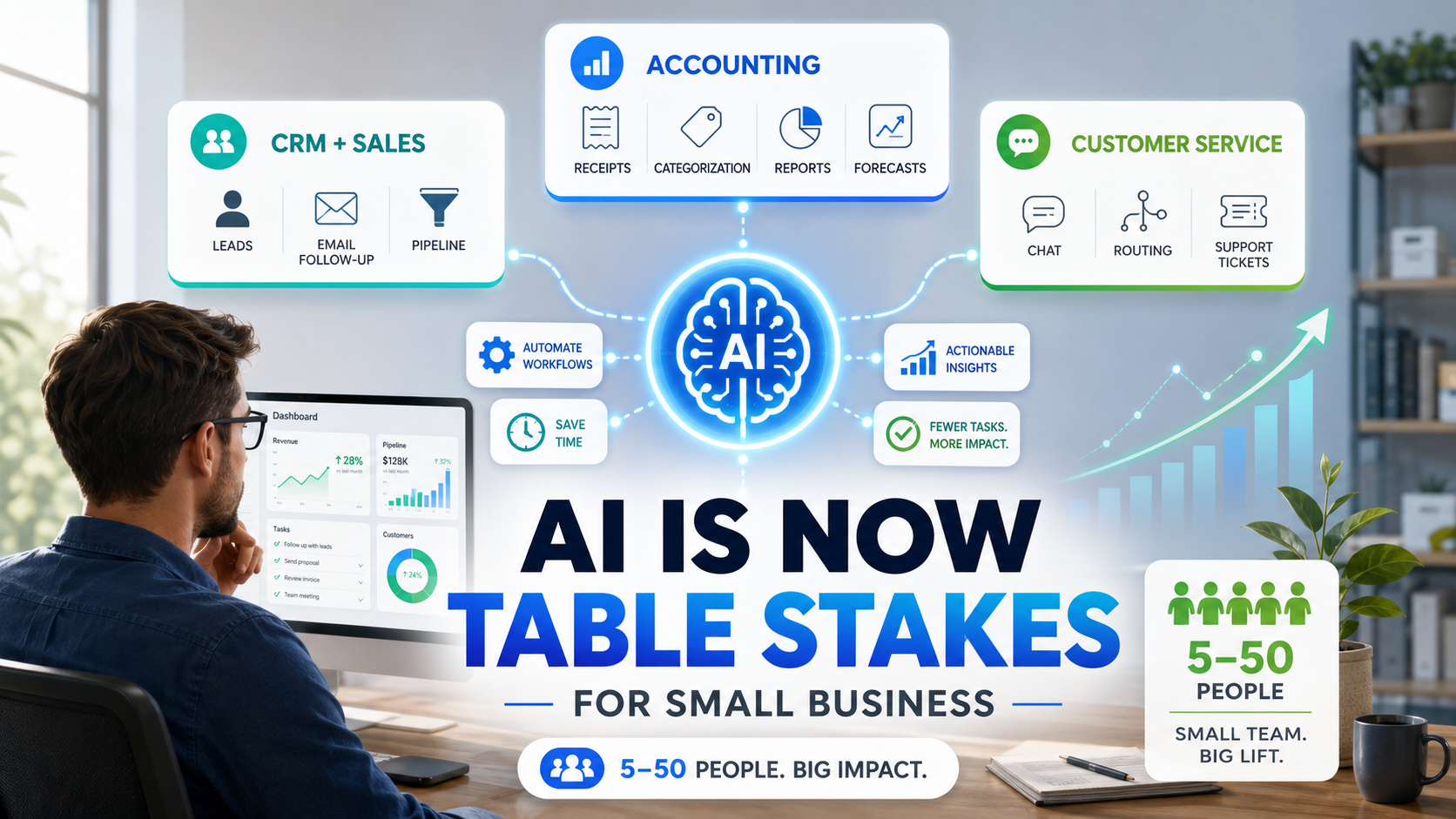
By 2026, AI adoption isn't a competitive advantage for small businesses—it's table stakes. The barrier to entry has collapsed. Tools that once required enterprise budgets are now accessible to teams of five or fifty. The question isn't whether to use AI; it's which tools to integrate into your existing workflow without burning cash or losing your mind.
Here's what's changed: AI platforms are consolidating around proven workflows. Instead of cobbling together ten different tools, you can now get CRM, accounting, customer service, and automation from a single integrated platform. The efficiency gain is real. Small businesses using AI-powered CRM and automation report 20-30% faster task completion and measurable improvements in customer response times.
The Core Three: Where to Start
1. CRM + AI Automation (HubSpot or Zoho CRM)
Your CRM is your nerve center. In 2026, it's not just a contact manager—it's an AI agent that qualifies leads, schedules follow-ups, and flags at-risk accounts. HubSpot's AI assistant writes emails and predicts deal closures. Zoho CRM does the same at lower cost for teams under 10 people.
So what? Your sales team spends less time on admin, more time closing. A founder managing 200 prospects can now automate 60% of qualification work. That's one employee's worth of capacity freed up without hiring.
Action: Map your current sales workflow. Identify the three most time-consuming repetitive tasks (lead scoring, follow-up emails, meeting notes). Test either tool's AI features for 30 days against those three tasks only.
2. Accounting + Compliance (QuickBooks + AI)
QuickBooks integrated AI features that automatically categorize expenses, flag tax deductions you're missing, and generate financial forecasts. For a 10-person team, this removes the need for a part-time bookkeeper in many cases.
So what? You get real-time financial clarity instead of scrambling three months after quarter-end. AI-powered categorization catches errors immediately. One solopreneur using this setup reduced accounting time from 8 hours/week to 2 hours/week.
Action: Export your last three months of transactions. Run them through QuickBooks' AI categorization. Compare accuracy to your current process. The ROI conversation becomes simple: hours saved × your hourly rate = payback period.
3. Customer Service + Intelligent Routing (Google Gemini or HubSpot Service Hub)
AI agents now handle 60-70% of common customer questions without human intervention. Google's Gemini Enterprise Agent Platform integrates with your existing helpdesk. It reads past interactions, understands context, and routes complex issues to humans only when needed.
So what? Your support team stops drowning in repetitive questions. A small business with 500 monthly customer inquiries sees 300+ handled automatically, freeing your support person to focus on retention and upsell conversations.
Action: List your top 10 customer questions. Feed them into a test AI agent. Measure first-response accuracy. If it's above 75%, you've found your tool.
The Platforms Doing This Better Than Single Tools
The real 2026 shift is platform consolidation. Instead of maintaining five different subscriptions, founders are moving to all-in-one systems:
- HubSpot: CRM + email + AI writing assistant + forms + basic accounting. $50-100/month. Best for: service businesses, agencies.
- Zoho Suite: CRM + books + forms + automation + 40+ apps. $20-80/month depending on modules. Best for: cost-conscious teams, non-US businesses.
- Google Cloud for SMBs: Gemini Agent Platform + BigQuery analytics + Cloud Storage. Pay-as-you-go. Best for: data-heavy operations, analytics-first founders.
The cost difference between these platforms is negligible. The difference is in integration depth. If your business already uses Google Workspace, Gemini agents integrate seamlessly. If you're on Microsoft, HubSpot's AI works better.
Three Operational Shifts You Must Make
Shift 1: Treat AI as a Team Member, Not a Tool
AI agents are now agentic—they act autonomously within guardrails you set. This requires governance. You can't just deploy a customer service bot and walk away. You need to review its outputs weekly for the first month. Check decision quality. Set escalation rules for when it should ask for help.
One founder who implemented this structure: weekly 30-minute audits of AI agent decisions, monthly retraining based on edge cases. After 90 days, escalation rate dropped from 40% to 15%. The AI got smarter because the founder treated it like an employee in onboarding.
Shift 2: Data Quality Becomes Your Bottleneck
AI tools are only as good as your input data. If your CRM has duplicate contacts, typos in email fields, or inconsistent deal stages, AI agents inherit those problems. Before deploying AI, audit your data. This is unglamorous work, but it determines whether your AI saves 10 hours/week or wastes 10 hours/week.
Action: Spend one week cleaning your three core systems: contacts, transactions, customer records. Use AI to help (ironically, AI is good at spotting data quality issues). Then deploy agents.
Shift 3: Monitor AI ROI Weekly
You're already tracking revenue, churn, and customer acquisition cost. Add AI metrics: hours saved per week per tool, error rates on automated decisions, escalation frequency. Most small businesses deploy AI and assume it's working. Track it. If a CRM automation isn't saving time after 60 days, kill it.
The Budget That Actually Works
For a 5-person team: $300-500/month gets you a full platform (CRM + accounting + service desk with AI). For 20 people: $1,500-2,500/month. That's roughly $100-125 per employee per month—less than you pay for a single freelancer.
The real question isn't "Can we afford this?" It's "Can we afford not to?" A business with 3 employees spending 15 hours/week on manual tasks that could be automated is leaving $50k+ on the table annually.
Start Here Next Week
Monday: Audit your three biggest time-sinks. Is it admin work? Follow-ups? Data entry?
Tuesday: Pick one platform that fits your existing tech stack. Request a trial.
Wednesday: Test its AI features against your #1 bottleneck for one week.
Friday: Measure time saved. Decide: keep, modify, or move on.
Don't try to boil the ocean. One small automation that saves 5 hours/week is a win. Scale from there.