The Cost-Cutting Trap Most Small Businesses Fall Into
You've heard the pitch a thousand times: AI will cut your operational costs. Deploy a chatbot here, automate a workflow there, and watch your bottom line improve. But here's what most small business owners discover too late—traditional cost-cutting through AI rarely works the way vendors promise.
The reason? You're optimizing the wrong thing. Companies treat AI implementation as a technology project when it should be a business transformation. That distinction matters because it determines whether you see a 10% efficiency gain or unlock entirely new revenue streams.
Waste Isn't the Same as Costs
Before deploying AI, you need to understand what you're actually trying to eliminate. Waste is using more resources than necessary to accomplish a task without being able to repurpose the excess. That's different from cutting costs, which tends to be reactive, siloed, and often painful (hello, layoffs).
Consider this: 77% of CEOs are pursuing cost-efficiency measures according to Gartner's 2025 business priorities. But only 48% are actually deploying fully automated AI systems. That gap reveals the real problem—most businesses are cutting blindly rather than strategically removing inefficiencies.
Waste elimination through AI works differently. Instead of asking "How can we do this cheaper?" you ask "Why are we doing this at all? And could AI help us reimagine the entire process?" That reframing transforms AI from a cost-reduction tool into a business model innovator.
Where Small Teams Actually Save Money With AI
Order-to-cash cycles, inside sales processes, and product workflows are natural AI candidates because they involve multiple teams, handoffs, and repetitive decision-making. These cross-functional processes typically have significant waste baked in—approval delays, data re-entry, redundant communications.
Here's the concrete opportunity: When you map these workflows, you often discover that 30-40% of activity doesn't create value. An order sitting in a queue waiting for approval. A sales rep manually pulling customer data from three different systems. A product manager recreating specifications that already exist elsewhere.
AI agents and automation can eliminate that waste. But here's the critical insight from industry research—the real savings come from reimagining the process entirely, not just automating the existing one. If your order-to-cash process takes 10 steps, don't just automate steps 3 and 7. Ask whether you actually need all 10 steps.
The Math on AI Investment vs. Status Quo
Initial AI implementation costs money. Infrastructure setup, tool subscriptions (ChatGPT Pro at $20/month, Claude API usage, automation platforms like Make or Zapier), training time, and likely some consulting fees if you're building custom workflows.
For a 10-person team, expect to spend $500-$2,000 monthly on AI tools depending on your use case. That's $6,000-$24,000 annually. That sounds expensive until you calculate the alternative.
According to Capgemini research, agentic AI has the potential to generate $450 billion in economic value globally by 2028 through revenue uplift and cost savings. At enterprise scale, that translates to companies saving 15-25% on process costs once AI agents are fully operational. For a small business with $2 million in annual operating costs, that's $300,000-$500,000 in savings.
More importantly, the cost of not adapting is rising faster. Technologically sophisticated competitors are already deploying AI to handle routine work. If you're not, your team is manually doing what their AI agents do automatically—and doing it slower.
How to Actually Calculate ROI on AI
Don't just count hours saved. Track these metrics instead:
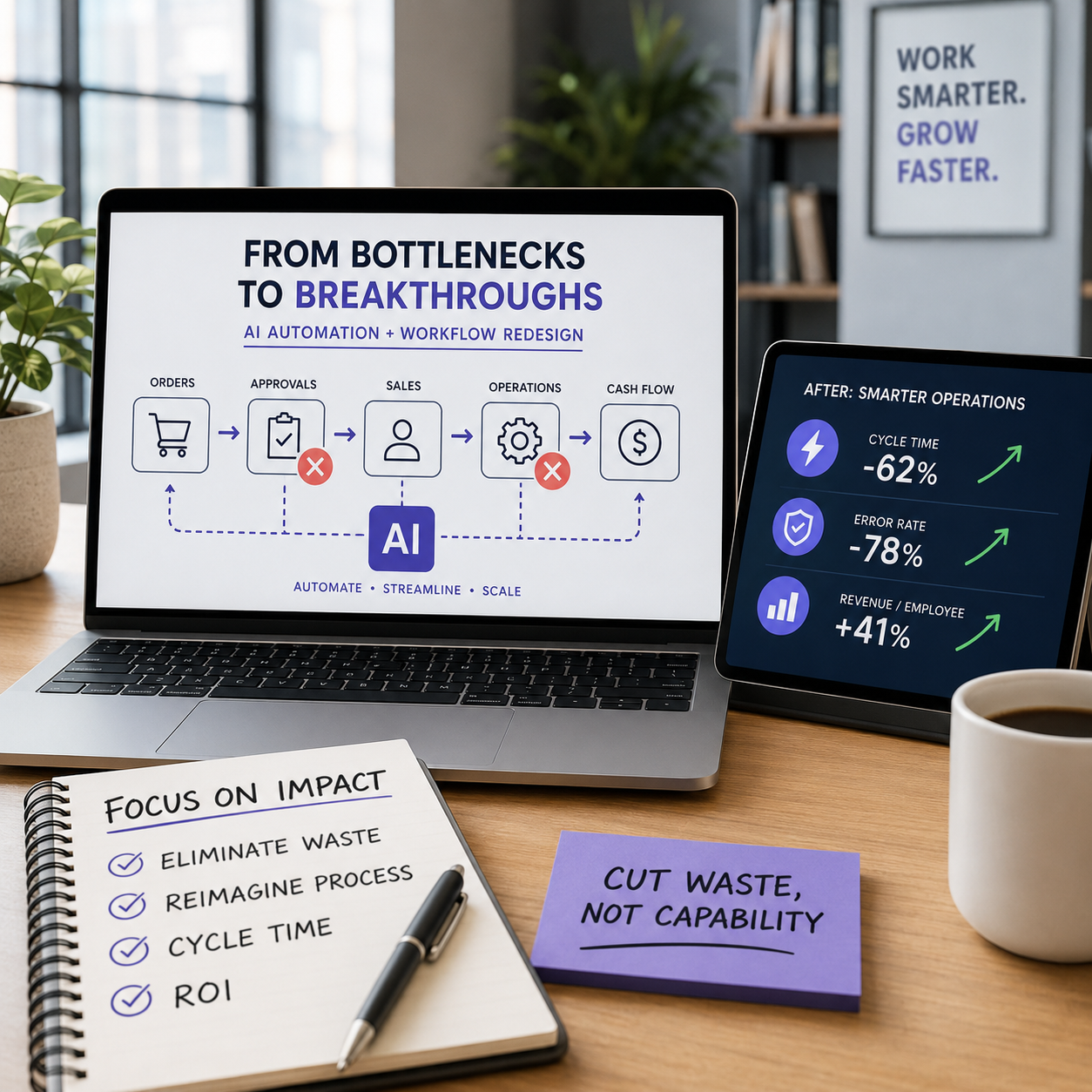
- Process cycle time reduction: Measure how long your bottleneck workflows take before and after. If order approval drops from 48 hours to 4 hours, that's not just efficiency—it's faster cash flow.
- Error rate decrease: AI handling customer data entry eliminates typos that create downstream rework. Quantify how many hours per month your team spends fixing data mistakes.
- Team capacity reallocation: When your 10-person team isn't spending 20% of their time on administrative tasks, that capacity goes toward revenue-generating work. Calculate what that team member could do instead.
- Revenue per employee: After AI deployment, track whether revenue per headcount increases. That's your signal that you've actually unlocked new value, not just cut costs.
Most small business owners see positive ROI within 3-6 months when focused on waste elimination rather than headcount reduction.
The Mindset Shift Required
This is the part vendors won't tell you: AI success requires rethinking your organization's approach to work itself. EY Consulting calls this the "AI Value Blueprints" framework, which prioritizes mindset and skill set over toolsets.
What does that mean practically? Your team needs to understand AI's capabilities and limitations. Your processes need to be documented clearly (if you can't describe how something works, AI can't reimagine it). Your decision-making needs to shift from "How do we protect existing jobs?" to "How do we create more valuable work?"
That sounds soft and abstract, but it's essential. Companies that treat AI as a technology implementation fail. Companies that treat it as a business transformation succeed.
The Real Opportunity for Small Teams
You have an advantage over enterprise companies here. You don't have legacy systems, entrenched processes, or 500 people doing things "the way we've always done it." You can reimagine your workflows from scratch.
Start with one cross-functional process that involves multiple people and repeated handoffs. Map every step. Identify where waste occurs. Pilot an AI solution—even a simple one like a custom ChatGPT trained on your internal documentation or a Zapier automation connecting your tools.
Measure cycle time, error rates, and team capacity. If you see 20-30% improvement in 30 days, expand. If not, diagnose why and adjust the workflow, not just the AI tool.
That's how you move from "AI cost savings" to actual business transformation—and actually hit those ROI targets while your competition is still trying to figure out which tool to buy.