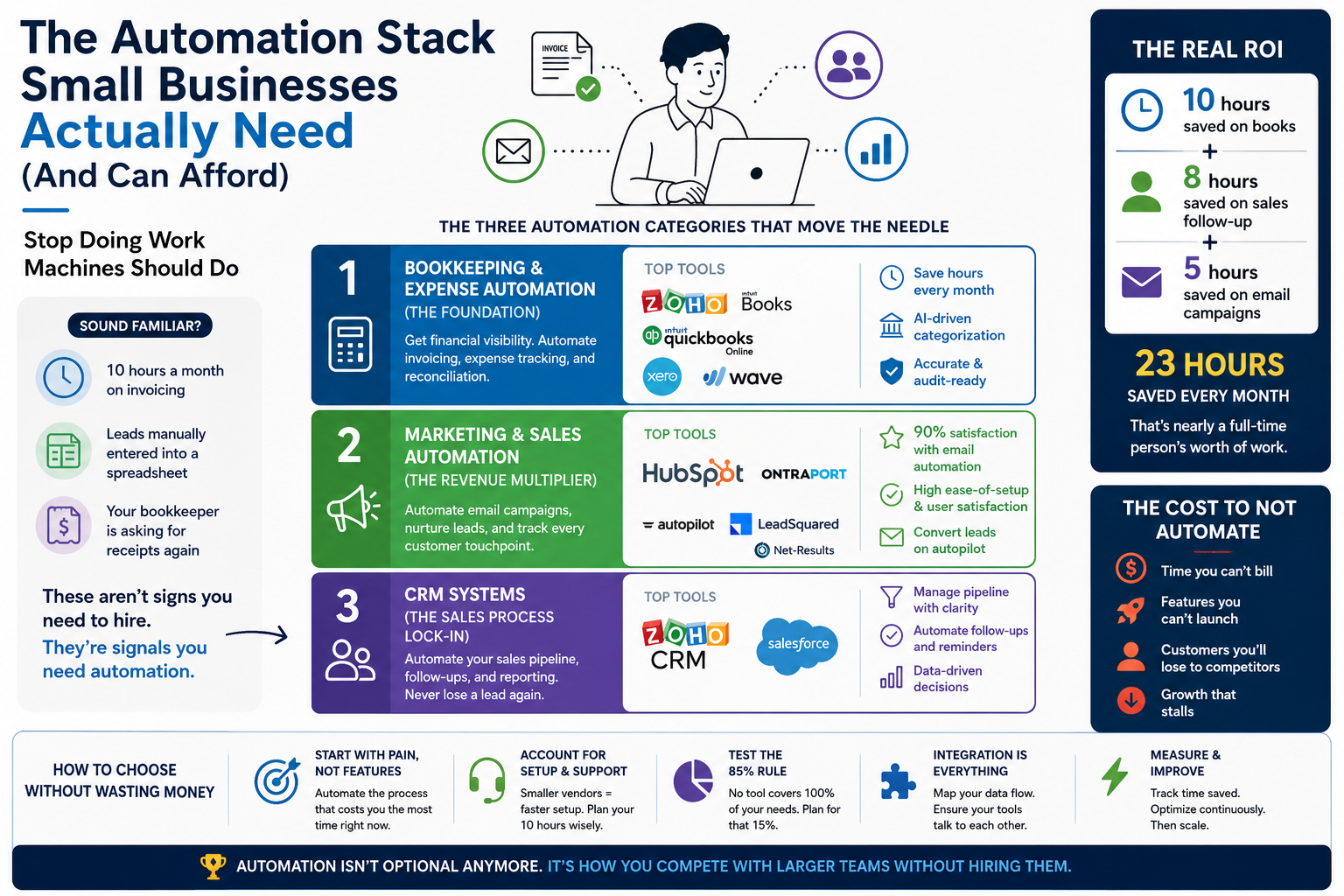
Stop Doing Work Machines Should Do
You're spending 10 hours a month on invoicing. Your sales team manually enters leads into a spreadsheet. Your bookkeeper is asking for receipts again. These aren't signs you need to hire—they're signals you need automation.
The problem isn't that automation tools don't exist. It's that most founders treat them like nice-to-haves instead of survival infrastructure. When you're running 1-50 people, every hour spent on repetitive work is an hour not spent selling, building, or thinking strategically. Automation is how you break that cycle.
Here's what actually works for small businesses, based on what's proven in the market.
The Three Automation Categories That Move the Needle
1. Bookkeeping & Expense Automation (The Foundation)
Start here. Every small business needs financial visibility, and manual expense tracking is where time goes to die.
Zoho Books is the most pragmatic choice for lean operations. At $20/month, it handles invoicing, expense tracking, and AI-driven categorization that saves hours monthly. The company's founder of 123 Baby Box put it directly: "Their AI-driven categorization saves hours every month." That matters when you're bootstrapped or early-stage.
QuickBooks Online and Xero are the enterprise cousins—powerful but potentially bloated if you're staying intentionally small. Xero wins for complex finances: it has "all the capabilities you could want, a lot of helpful automations," according to an IRS Enrolled Agent, plus reliable bank feed connections that prevent manual reconciliation errors.
Wave exists for truly simple bookkeeping—free or low-cost, minimal setup. Use it if your finances are straightforward and you're not ready to invest yet.
The decision: Choose based on financial complexity, not aspirational growth. A solopreneur with four income streams needs different software than a 20-person team with multiple vendors.
2. Marketing & Sales Automation (The Revenue Multiplier)
Email marketing campaigns are the highest-rated automation feature across all platforms—90% satisfaction. This tells you something: most businesses are still manually sending emails or using manual workflows. That's opportunity.
HubSpot and Pardot rank as leaders for small and mid-market businesses in G2 Crowd's analysis. HubSpot is particularly strong because it handles CRM, email automation, and lead tracking in one place. The integration alone saves you from data entry hell.
For smaller budgets, ONTRAPORT, LeadSquared, Autopilot, and Net-Results are "High Performers" in customer satisfaction—meaning smaller companies building products specifically for smaller customers. These had notably higher ease-of-setup scores, which matters if you don't have a dedicated marketing ops person."
Hatchbuck and ONTRAPORT showed the highest satisfaction rates for email functionality (98% and 97% respectively). If email campaigns are your primary outreach, these platforms will execute them reliably.
Reality check: Reviewers report marketing automation tools meet about 85% of their needs. The missing 15% is almost always custom integrations or workflows unique to your business. Plan for that gap.
3. CRM Systems (The Sales Process Lock-In)
Salesforce and Zoho CRM automate the entire sales pipeline—lead capture, follow-up sequencing, deal tracking, and reporting. The automation here isn't about emails; it's about making sure leads don't fall through cracks and your team knows exactly what to do next.
Zoho CRM is significantly cheaper than Salesforce and designed for teams under 50 people. Salesforce is the choice if you're already in the Salesforce ecosystem or have complex enterprise integrations.
For most small businesses, a CRM solves a specific problem: How do I know if we're actually following up with prospects? Automation here is non-negotiable if you have a sales team larger than one person.
How to Choose Without Wasting Money
Start with pain, not features. Which process costs you the most time right now? That's where you automate first. It's tempting to build the "complete stack" at once. Don't. Pick one category, implement it fully, and measure the time saved. Then move to the next.
Account for setup and support. Smaller vendors with high satisfaction scores (Autopilot, LeadSquared, Net-Results) typically have better onboarding. Larger vendors (Xero, QuickBooks) have slower customer support in some cases, though support quality is solid. If you have 10 hours to set this up, smaller vendors are safer bets.
Test the 85% rule. No automation tool will cover 100% of your workflows. Accept that 15% will require workarounds, manual steps, or integrations. Build that into your implementation timeline.
Integration is everything. Your bookkeeping tool needs to talk to your CRM. Your CRM needs to export data to your email platform. Before buying, map your data flow. ActiveCampaign, HubSpot, and Zoho products play nicely because they're designed to integrate. Smaller tools may require Zapier or other connectors—that's fine, but it's extra cost and potential slowdowns.
The Real ROI
A founder saving 10 hours per month on expense categorization (Zoho Books), 8 hours on sales follow-up (Salesforce or Zoho CRM), and 5 hours on email campaigns (HubSpot or ONTRAPORT) has just freed up 23 hours monthly. That's nearly a full-time person's worth of work, at the cost of $50-200/month.
The math is brutal on the other side: not automating costs you time you can't bill, features you can't launch, and customers you'll lose to competitors who move faster.
Automation isn't optional for small businesses anymore. It's how you compete with larger teams without hiring them.