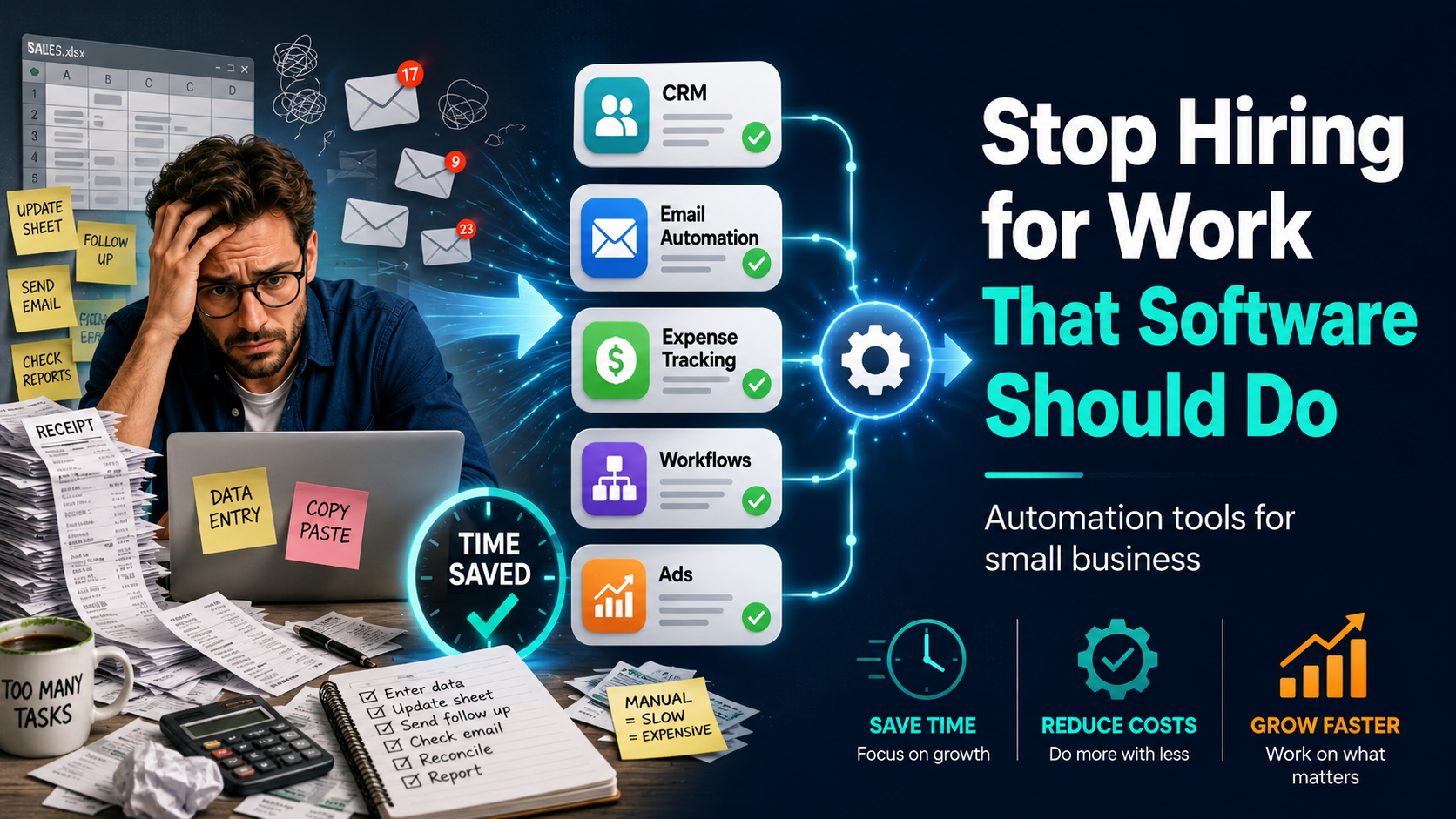
Stop Hiring for Work That Software Should Do
You're drowning in repetitive tasks. Your sales team manually logs every customer interaction. You're copy-pasting ad performance data across three platforms. Your accountant still asks for email receipts. This is what small business looks like without automation—and it's costing you money every single day.
The good news: automation tools have gotten cheap enough and simple enough that solopreneurs and 10-person teams can actually implement them without hiring a developer. The bad news: there are 47 options out there, and most of them solve problems you don't have yet.
This guide cuts through the noise. We've analyzed what actually works for small businesses—companies spending under $10K per month on tools, not enterprises—and built a framework for deciding what you need first.
Your Starting Point: CRM Systems (The Foundation)
Before you automate anything, you need a single source of truth for customer data. That's a CRM. And here's the thing: most small businesses skip this step and regret it immediately.
Why this matters: Without a CRM, your customer information lives in email inboxes, phone notes, and someone's brain. When that person leaves, knowledge walks out the door with them. When you get busy, leads fall through cracks. A CRM solves both problems.
The practical options for small teams:
- Pipedrive ($10/user/month) — Best for sales-first teams. Dead simple interface, integrates with Google apps and MailChimp. You'll be live in a day.
- Zoho CRM ($12/user/month, or free to start) — Best for budget-conscious founders. Deeply integrated with Google Workspace. The redesigned interface is actually usable.
- Salesforce ($25/user/month) — Only if you need to scale fast. Over-engineered for most small businesses. Their new Einstein AI platform automates lead scoring and next-step recommendations, but you're paying for enterprise capability you don't yet need.
The decision rule: Pick Pipedrive if sales is your growth engine. Pick Zoho if you're bootstrapped and use Google Workspace. Skip Salesforce for now.
Implementation time: 1–2 weeks to get your first 100 contacts in. Expect another month to build real habits around logging activity. Budget $20–30/month per sales person or founder wearing the sales hat.
Second Layer: Marketing Automation (For Lead Nurturing)
Once you have leads moving through your CRM, you need a system that touches them when you're sleeping. This is marketing automation.
What it actually does: You set triggers ("customer opened email 3 times in one week") and actions ("send them a call-to-action to book a demo"). You run behavioral campaigns based on real customer actions, not guesses. For small businesses, this fills the gap between "too expensive to hire someone" and "we can't manually nurture 200 leads."
The options that actually work at small scale:
- ActiveCampaign — Built specifically for lead nurturing at the small-business price point. You get email, CRM basics, and automation in one platform. Most reviewers say it covers 85% of what they need out of the box.
- HubSpot — G2's leader for small business marketing automation. Free tier gets you email + basic workflows. Paid plans ($50–150/month) add more sophisticated triggers and multi-touch campaigns.
- Hatchbuck or ONTRAPORT — Both hit 97–98% satisfaction ratings on email functionality specifically. If your entire business runs on email (coaching, consulting, info products), these are underrated.
The trigger question: Are you manually sending the same email to similar customer segments? If yes, automation pays for itself in two weeks.
Budget: $50–150/month for a tool. Setup time: 2–3 weeks to build your first 5 workflows. Ongoing: 2–3 hours per month to refine based on open rates and click-throughs.
Third Layer: Expense & Workflow Automation (The Unglamorous Layer)
Nobody talks about this part, but it's where small businesses leak money.
Expense tracking: Tools like Expensify eliminate the "please send me those receipts" email chains. Your team snaps photos of receipts with their phones. The system auto-categorizes them. You approve with one click. This saves your accountant 3–5 hours per month and eliminates reimbursement disputes.
Workflow automation platforms: Zapier is the most famous. You connect tools you already use (Google Forms → Slack → Spreadsheet → Email) without writing code. Average small business finds 5–10 automations that save 4–6 hours per week collectively.
Examples that actually move the needle:
- New customer inquiry form submission → Automatically creates contact in CRM + Sends welcome email + Posts notification to Slack
- Invoice marked "paid" in accounting software → Triggers customer success email → Creates follow-up task in project manager
- Weekly inventory count falls below threshold → Sends purchase order email to supplier + Slack alert to operations team
Cost: Zapier runs $19–99/month depending on automation volume. Expensify is $5–8/user/month. Combined: $50–100/month for a 5-person team.
Advanced Layer: Advertising Automation (When You're Ready)
Don't start here. But once you're getting 20+ leads per week from ads, this becomes relevant.
The problem it solves: You're running campaigns on Facebook, Google, and Instagram separately. Your ads manager spends 4 hours per week logging into three platforms, checking performance, and adjusting bids. Tools like Adriel centralize this.
Adriel's average customer spends $1,000/month on digital ads across platforms. The tool manages all three from one dashboard, handles bid optimization, and provides human support (not just automation). They've launched 7,200 campaigns across 20,000 small business accounts, so the data is real.
Alternative: AdEspresso (acquired by HootSuite) works if you're primarily a Facebook + Instagram advertiser.
When to implement: Only after you've validated that paid ads work for your business. Don't automate a channel you don't understand yet.
Cost: $99–299/month depending on ad spend and platform count.
The Implementation Priority Matrix
Month 1: Pick a CRM (Pipedrive or Zoho). Get your team trained. Use it for 30 days before adding anything else.
Month 2–3: Add one marketing automation platform (ActiveCampaign or HubSpot). Build 3–5 core workflows. Measure open rates and click-throughs.
Month 4: Implement Zapier for 2–3 high-impact workflows (form-to-CRM is the easiest win).
Month 5+: Only add advertising automation or other specialized tools if you've hit a clear bottleneck.
The principle: Automate the work that's stealing time from strategy. Not the work that's stealing time because you picked bad tools.
The Real Math on Automation ROI
Let's be concrete. You're spending $200/month on tools. You're saving:
- 5 hours per week on manual data entry (CRM + Zapier) = 20 hours/month at your hourly rate
- 3 hours per week on marketing campaign setup and monitoring (marketing automation) = 12 hours/month
- 2 hours per week on expense reports and reimbursement chasing (Expensify) = 8 hours/month
- Total: 40 hours per month
If you bill at $100/hour, that's $4,000 of your time freed up. If you value your time at $50/hour, it's $2,000. Either way, $200/month becomes a no-brainer.
And that's before you factor in the revenue impact: better lead follow-up, fewer dropped contacts, faster decision-making on what's working. Most small businesses see a 15–25% improvement in conversion rate once they actually track what's happening.
Don't automate for automation's sake. Automate the specific work that's preventing you from doing the strategic work only you can do. That's the difference between tools that sit unused and tools that become indispensable.