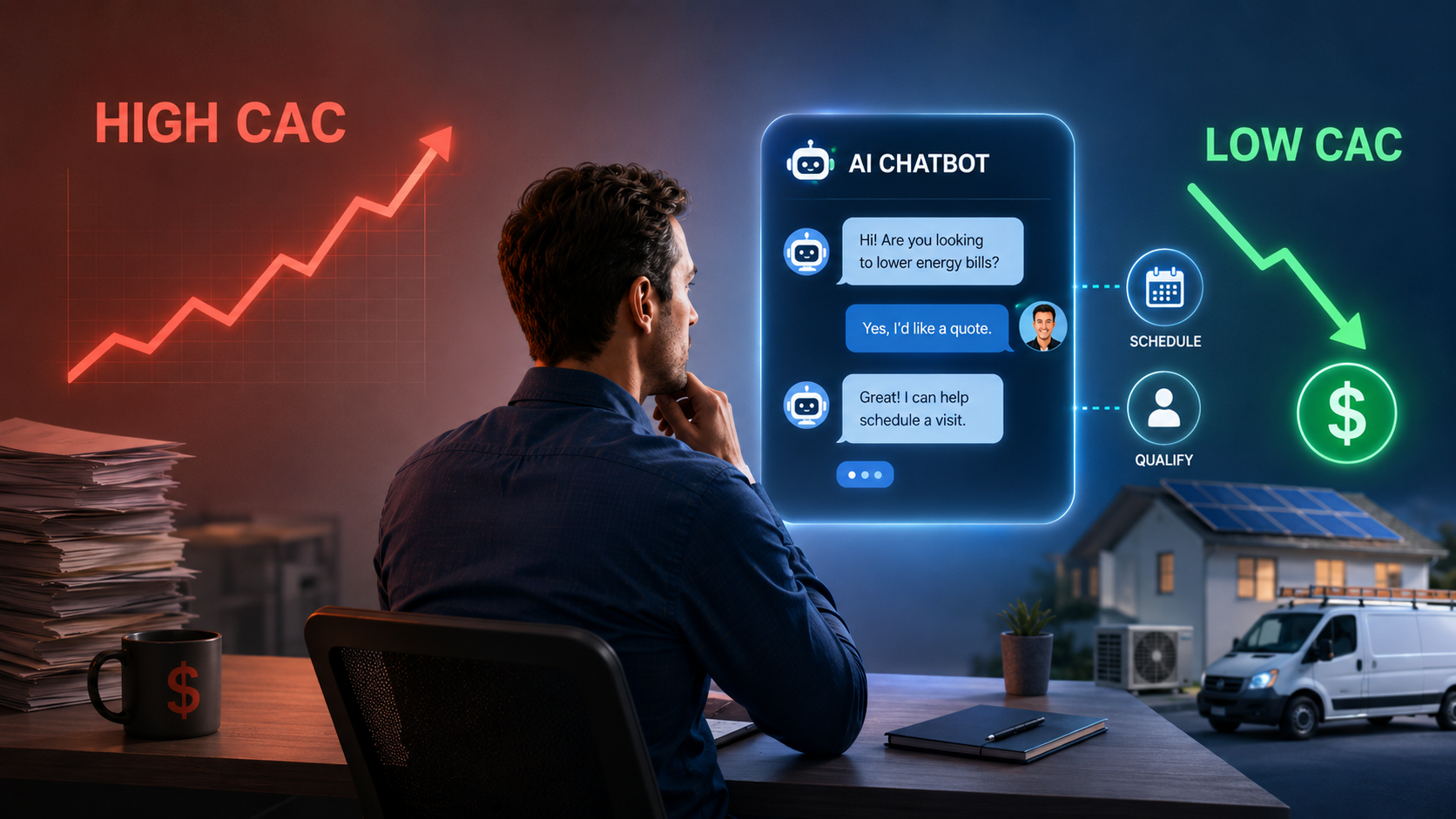
The Problem: Customer Acquisition Is Bleeding Your Budget
Customer acquisition costs (CAC) are crushing small businesses. In industries like solar installation, companies spend thousands of dollars to close a single customer—and that cost gets passed directly to your pricing power. If you're competing on margins, this kills you.
Here's the brutal math: your sales team spends 30-40% of their time on initial prospect conversations. Answering the same questions repeatedly. Qualifying leads manually. Scheduling calls. None of this adds revenue immediately. It's necessary friction, but friction nonetheless.
The opportunity: AI chatbots can handle 80% of those initial interactions automatically, reducing labor costs and accelerating your sales cycle simultaneously.
How AI Chatbots Actually Reduce CAC
This isn't theoretical. AI chatbots work on customer acquisition by doing three specific things your team is currently doing manually:
1. Being Your Always-On First Point of Contact
A prospect lands on your site at 11 PM on a Friday. With traditional sales: they bounce. With an AI chatbot: they get immediate answers about pricing, timelines, eligibility, and next steps. No form. No wait time. Real-time qualification.
According to industry analysis, AI chatbots can be a customer's first point of contact, allowing prospects to ask questions and gather critical information before ever speaking to a human. This alone optimizes sales efficiency by removing the scheduling friction that loses 30-40% of leads.
So what? You recapture leads you're currently losing to friction. Your sales team only talks to warm, pre-qualified prospects instead of tire-kickers. CAC drops immediately.
2. Gathering Discovery Information Automatically
Before your sales rep can move forward, they need to know: What's the prospect's timeline? Budget? Current pain point? Integration needs? Right now, your rep asks these questions in a call (30 mins) or email chain (3-5 days).
AI chatbots can ask these questions in real-time, contextually, as part of the conversation flow. The bot gathers structured data—roof type, current energy usage, budget range, decision timeline—without the prospect feeling interrogated. By the time your human rep jumps in, 70% of discovery work is done.
So what? Your rep's time-to-close drops by 40-60%. You close more deals with the same headcount. CAC per close decreases proportionally.
3. Reducing Design and Engineering Errors That Kill Deals
In service industries (solar, HVAC, construction), inaccurate initial designs kill deals. A prospect gets a quote based on incomplete data, then discovery happens, then the quote changes. Trust erodes. The deal stalls.
AI can model real-time design options and gather precise information about customer specifications before quoting. More accurate initial estimates mean fewer rework cycles and faster closes. One industry example: AI design assistance reduces engineering errors and accelerates the entire sales-to-installation timeline, directly lowering customer acquisition friction.
So what? Fewer dead deals. Better first-quote conversion. Lower CAC because you're not cycling prospects through multiple rounds of design revision.
Real-World Numbers: What You Can Actually Expect
The research points to thousands of dollars spent per customer acquisition in service industries. Here's what changes with AI:
- Response time: From 24-48 hours (email) or 7-14 days (call back) to 30 seconds (AI chatbot). Faster response = higher conversion rates.
- Sales rep time per lead: From 2-3 hours (calls, emails, manual discovery) to 30 minutes (rep only handles warm handoff). 75% time savings per qualified lead.
- Quote accuracy: Fewer revision cycles = fewer stalled deals. Industry data shows design automation reduces costly errors and rework.
- Lead-to-close cycle: From 30-60 days to 14-21 days. Faster close = less follow-up cost.
Combine these: if you're spending $2,000 per customer acquisition, AI-driven chatbots can cut that to $800-$1,000. That's 50-60% reduction in your biggest marketing expense.
The Implementation Path (Step by Step)
Step 1: Map Your Current Customer Acquisition Conversation
Document the 10-15 questions your sales team asks every prospect. These are your chatbot's first training data. Include pricing questions, eligibility questions, timeline questions, and objection handling.
Step 2: Deploy on Your Most Common Channel
Website visitor? Deploy chatbot on your homepage. Inbound leads via email? Use email AI. Phone calls? Use voice-based AI (still emerging, but available). Start where volume is highest.
Step 3: Train the Bot to Qualify, Not Close
The bot's job is to qualify and schedule, not sell. Ask: "Are you ready to buy in the next 60 days?" "What's your budget range?" "Who else needs to approve this?" Route qualified leads to sales. Nurture unqualified leads automatically.
Step 4: Measure Handoff Quality
Track: leads routed to sales team, lead quality score, time-to-first-call, and close rate on bot-qualified leads vs. other sources. AI chatbots should have 60%+ close rates on warm handoffs because your team is only talking to people ready to buy.
The Catch: This Only Works If You Do It Right
Bad AI chatbot implementation actually increases CAC by frustrating prospects. Here's what doesn't work:
- Generic chatbots that don't understand your specific offer or industry.
- Bots that interrupt with low-intent offers. (You'll tank conversion.)
- Bots that can't escalate to humans when needed. (You'll lose deals.)
- Bots that don't integrate with your CRM, so handoffs are messy.
The best results come from industry-specific or custom-trained AI that understands your specific sales qualification criteria and business logic.
What This Means for Your Bottom Line
If you're acquiring 50 customers per month at $2,000 CAC, you're spending $100,000/month on acquisition alone. A 50% reduction via AI chatbots = $50,000/month freed up for product, team expansion, or profit.
Even if deployment and training cost $2,000-$5,000 upfront, you break even in one month and compound savings every month after.
The conversation isn't whether to implement AI chatbots for customer acquisition anymore. It's whether you can afford not to while your competitors do.