The Real Stakes of Business Process AI
Your team spends roughly 40% of their time on repetitive, low-value work. That's not a guess—it's what happens when processes lack intelligent automation. Now imagine if AI handled the routine stuff: data entry, invoice processing, approval chains, customer routing. You'd recover weeks of productivity per month.
But here's the catch: not every decision should be automated. And that distinction matters more than you think.
What Intelligent Automation Actually Does
Intelligent Process Automation (IPA) isn't just RPA (Robotic Process Automation) with a marketing refresh. It's a deliberate integration of four core technologies working together:
- Robotic Process Automation (RPA) — handles repetitive digital tasks
- Machine Learning (ML) — provides probabilistic decision logic based on patterns in your data
- Natural Language Processing (NLP) — reads and understands unstructured text like emails and documents
- Optical Character Recognition (OCR) — extracts data from scans and PDFs
When you combine these—what Cognizant calls a "digital Swiss army knife"—you get systems that don't just automate tasks. They make smart, contextual decisions in real-time without requiring constant human intervention.
The practical upside: A small business running a fulfillment operation can now automate order triage. The system reads incoming orders (OCR + NLP), scores urgency and profitability (ML), and routes to the right warehouse bay or team (RPA). No humans in the loop until something breaks the rules.
The Decision Boundary: Your Most Important Framework
Here's where most businesses stumble. Not all decisions are created equal, and automating the wrong ones can tank your credibility or bottom line.
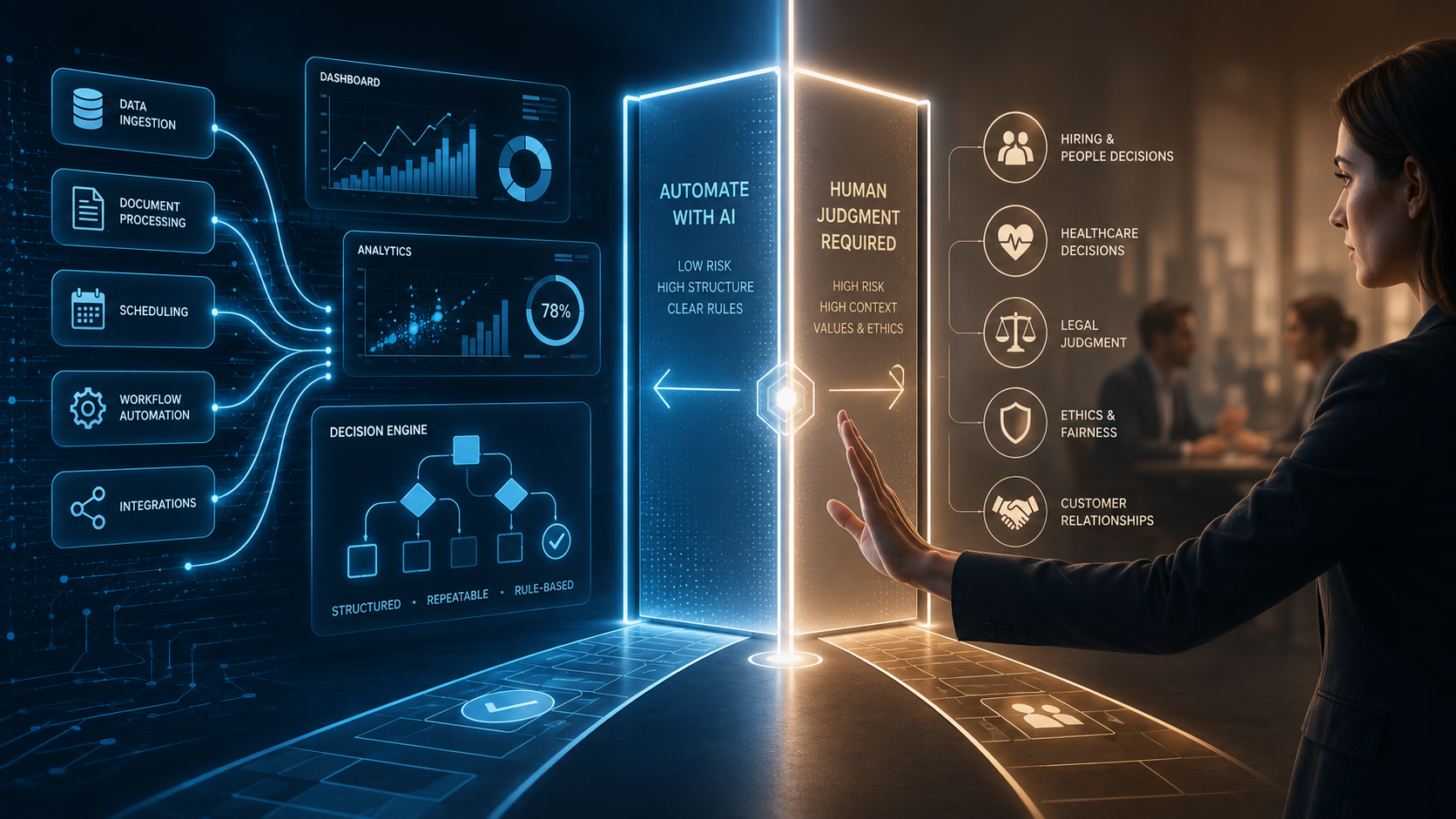
Safe zones for full automation:
- Routine operational decisions with clear, measurable outcomes (invoice approval under $500, order routing, employee shift scheduling)
- Tasks where errors are reversible and low-cost (duplicate record merging, spam filtering, basic customer segmentation)
- Processes where speed matters more than perfection (real-time inventory reordering, lead scoring, chatbot initial responses)
Danger zones requiring human oversight:
- Financial decisions involving significant capital (stock trades, major vendor contracts, loan approvals)
- Healthcare or safety-related choices (medical recommendations, workplace incident responses)
- Customer-facing decisions affecting trust (refund eligibility, account suspension, dispute resolution)
- Any decision that could set legal or brand precedent
The rule of thumb from InRule Technology's research: if the decision affects money, health, or relationships at scale, keep humans in the loop. Let AI recommend. Let humans decide.
How to Add the "Human Touch" to Your AI
The researchers identified three baseline techniques for keeping AI decisions accountable:
1. Rules-Based Governance
AI doesn't just predict; it operates within explicit boundaries you've set. Example: Your ML model scores customer churn risk, but it can only recommend retention offers within your predefined budget band. The system knows the guardrails.
2. Decision Transparency (Explainability)
Your team needs to understand *why* the system made a choice. Modern tools should show the weights: "This customer got flagged for churn because login frequency dropped 65%, but sentiment in support tickets remained neutral." That's actionable; a black-box score isn't.
3. Escalation Triggers
Define scenarios where the system automatically escalates to a human instead of deciding. Example: If confidence on an automated approval drops below 70%, or if the request is an outlier, route it to your team.
Real Cost Impact for Small Operations
Let's quantify this for a 15-person team:
- Invoice processing: Automate 80-90% of incoming invoices using OCR + ML validation. You recover 6-8 hours per week previously spent on data entry and error correction.
- Customer inquiry routing: AI triages support emails by urgency and category, auto-assigns to specialists. Response time drops 40%; team handles 25% more volume without hiring.
- Approval workflows: Routine approvals (timesheets, small purchase orders, leave requests) now auto-process. Finance and ops staff shift from rubber-stamping to exception management.
The result: 4-6 FTE weeks recovered monthly. At $50/hour loaded cost, that's $40,000-$60,000 in annual productivity gain from one small deployment.
The Obstacle You'll Actually Face
Technology isn't the blocker. Workforce skillset gaps and cultural resistance are.
Your team might fear automation eliminates their roles. That's real. Counter it with clarity: AI eliminates tedious tasks, not jobs. It shifts people from "keeping the lights on" to "making decisions that matter."
Your legacy process owners might resist change because "we've always done it this way." They need to see pilots that work before they trust the new paradigm. Start with one high-pain, low-risk process. Show the numbers. Momentum builds from there.
Your 30-Day Starting Point
Week 1: Map your top 5 recurring tasks your team hates. Calculate the hours spent weekly on each.
Week 2: For each task, determine if it fits the "safe automation" or "needs human oversight" category. Be honest.
Week 3: Pick the safest one (low-complexity, high-volume, low-risk if it fails). Research IPA platforms that fit your budget and tech stack. InRule, Automaton, or cloud-native options like Microsoft Power Automate or UiPath Community offer free trials.
Week 4: Run a two-week pilot. Measure the gap between old and new. Document what worked and what didn't.
The goal isn't to automate everything. It's to automate what frees your people to do what AI can't: think strategically, build relationships, and catch the edge cases that matter.