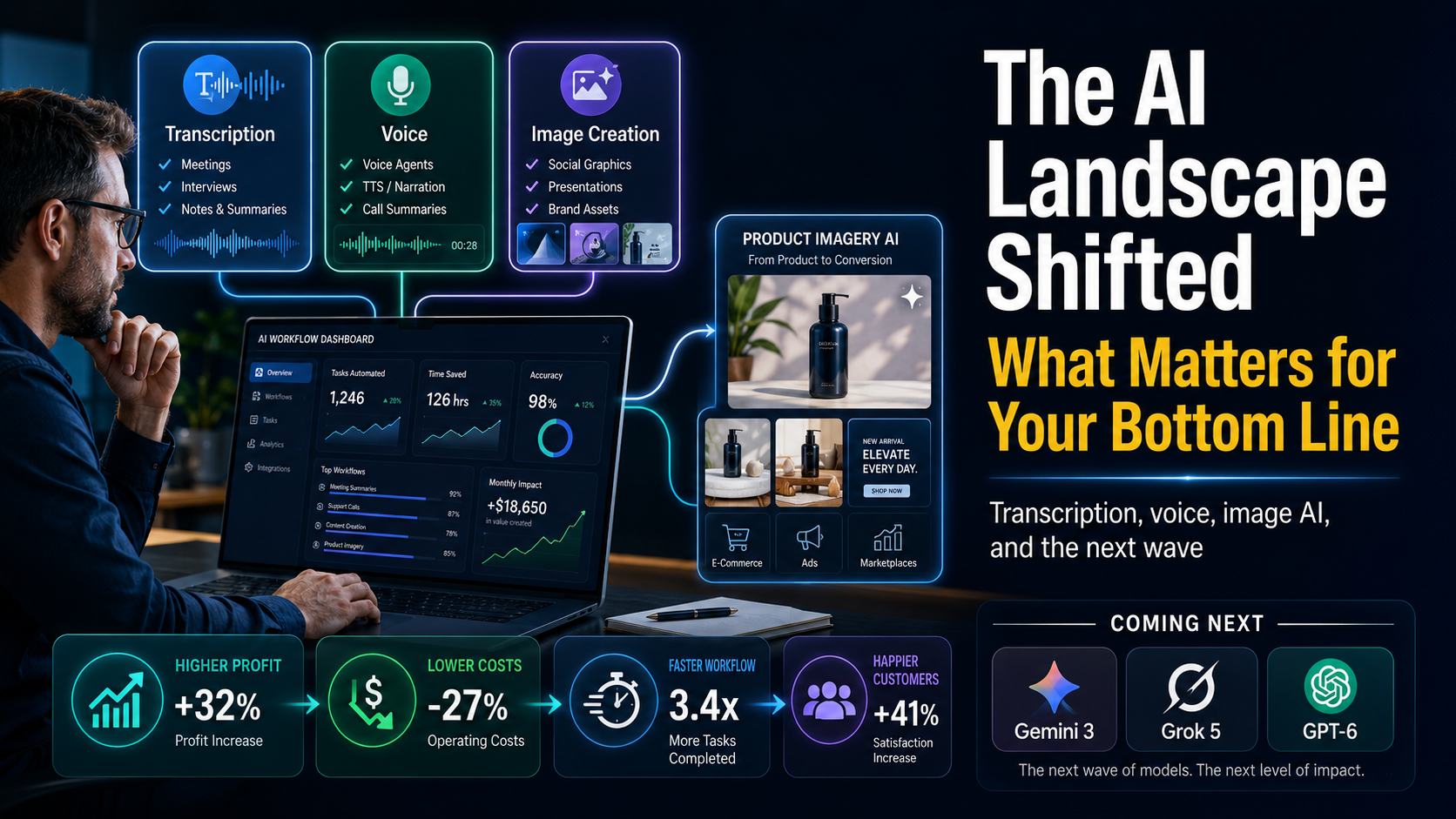
The AI Landscape Just Shifted — Here's What Actually Matters for Your Bottom Line
Microsoft and Google released new AI models targeting transcription, voice generation, and image creation. On the surface, that sounds like tech news. But here's the operational reality: if you're managing customer communications, product imagery, or content at scale—even as a team of five—these tools directly impact your workflow efficiency and monthly software spend.
The gap between "new AI exists" and "AI that improves my margins" is where most founders stumble. This article closes that gap.
Microsoft's New AI Models: Three Tools Worth Evaluating
Microsoft rolled out three specialized AI models that address specific business bottlenecks:
- Transcription improvements — Faster, more accurate audio-to-text conversion. If you're handling customer calls, webinars, or internal meetings, this reduces manual transcription time (and cost).
- Voice generation — Text-to-speech that sounds more natural. Use case: automated customer support, voiceovers for videos, or accessibility features without hiring voice talent.
- Image creation — Generative imagery for marketing assets, product mockups, and internal documentation.
The practical play: Transcription is the immediate priority. If your business logs 10 hours of recorded content weekly, manual transcription costs roughly $200-400/month. AI-powered transcription through Microsoft's tools or integration with Copilot Pro drops that to near-zero operational cost after the initial software subscription.
Google's Product Imagery AI: A Specific Win for E-Commerce and Ads
Google launched generative AI tools for product imagery, now available to US advertisers. This is laser-focused: generate product photos without a studio shoot or expensive photography retakes.
Numbers matter here: A single product photoshoot costs $500-2000. If you have 50 SKUs and need seasonal variations, you're looking at $10k-50k annually. Google's tool lets you generate lifestyle shots, angle variations, and background swaps in minutes.
For small e-commerce operations, this is a margin expander. Your COGS stays flat, but your marketing asset production cost collapses.
Tactical step: If you run Google Shopping campaigns, test this with 10-15 products first. Measure click-through rate and conversion rate against your control group (real photos). Roll out to full catalog only if performance is within 5% of live photography.
The Upstream Question: Are You Ready for These Tools?
New models only matter if you have the infrastructure to use them. Before adopting Microsoft's transcription API or Google's imagery tools, audit:
- Data quality — Transcription AI performs poorly on low-quality audio. Voice generation needs coherent source copy. Image generation works best with clear product descriptions.
- Integration complexity — Can your current stack (CRM, email platform, ad account) connect to these tools? Or will you spend 40 hours on integration work that erodes the time savings?
- Output review cycle — AI-generated content requires human review. Budget 15-20% of the time you'd spend creating the asset from scratch as your QA overhead.
If you're a solopreneur or two-person operation, these tools are ROI-positive immediately. If you're at 30+ employees with established workflows, integration friction increases. Plan accordingly.
What's Coming Next: Gemini 3, Grok 5, and GPT-6
The research indicates three major model releases are incoming. Here's what founders should expect:
- Gemini 3 — Google's next-generation model. Likely improvements in reasoning, code generation, and multimodal tasks. Impact: Better AI assistants for business automation and decision-support tools.
- Grok 5 — Elon's Grok model iteration. Positioned as faster and cheaper than competitors. Impact: If pricing undercuts OpenAI/Google, expect commoditization pressure on AI labor costs.
- GPT-6 — OpenAI's flagship model upgrade. History suggests 2-3x performance improvements over GPT-4. Impact: Complex tasks (strategy consulting, advanced coding, multimodal analysis) become feasible at lower cost.
For your roadmap: Don't wait. Gemini 3 and GPT-6 will likely launch within 12 months. But the value gap between today's tools and next-generation models is marginal for most small businesses. Implement Microsoft's transcription or Google's imagery tools now. You'll absorb the learning curve and integrate these into standard workflows before the next wave arrives.
The Action Framework: 30-Day Implementation Plan
Week 1: Identify your highest-friction operational task. Is it transcribing sales calls? Creating product photos? Generating customer support responses? Pick one.
Week 2: Pilot the relevant AI tool (Microsoft for transcription, Google for imagery, or a general LLM for other workflows). Process 5-10 real outputs.
Week 3: Measure time saved and cost reduction. Calculate ROI on the subscription or API usage.
Week 4: Scale to full workflow or kill the experiment. Don't get stuck in the evaluation phase.
The businesses winning right now aren't waiting for GPT-6. They're compounding small efficiency gains across three or four workflows. That compounds to 10-15% operational cost reduction annually—real money for margins.
The Bottom Line
Microsoft's transcription and voice generation, combined with Google's product imagery AI, solve specific, quantifiable problems. Together, they can reduce your content production and customer communication overhead by 30-50%. Upcoming models (Gemini 3, Grok 5, GPT-6) will improve over time, but waiting is expensive.
Start today. Pick your highest-friction workflow. Move fast. Measure. Scale what works.