The AI Adoption Baseline: Where Small Business Stands Today
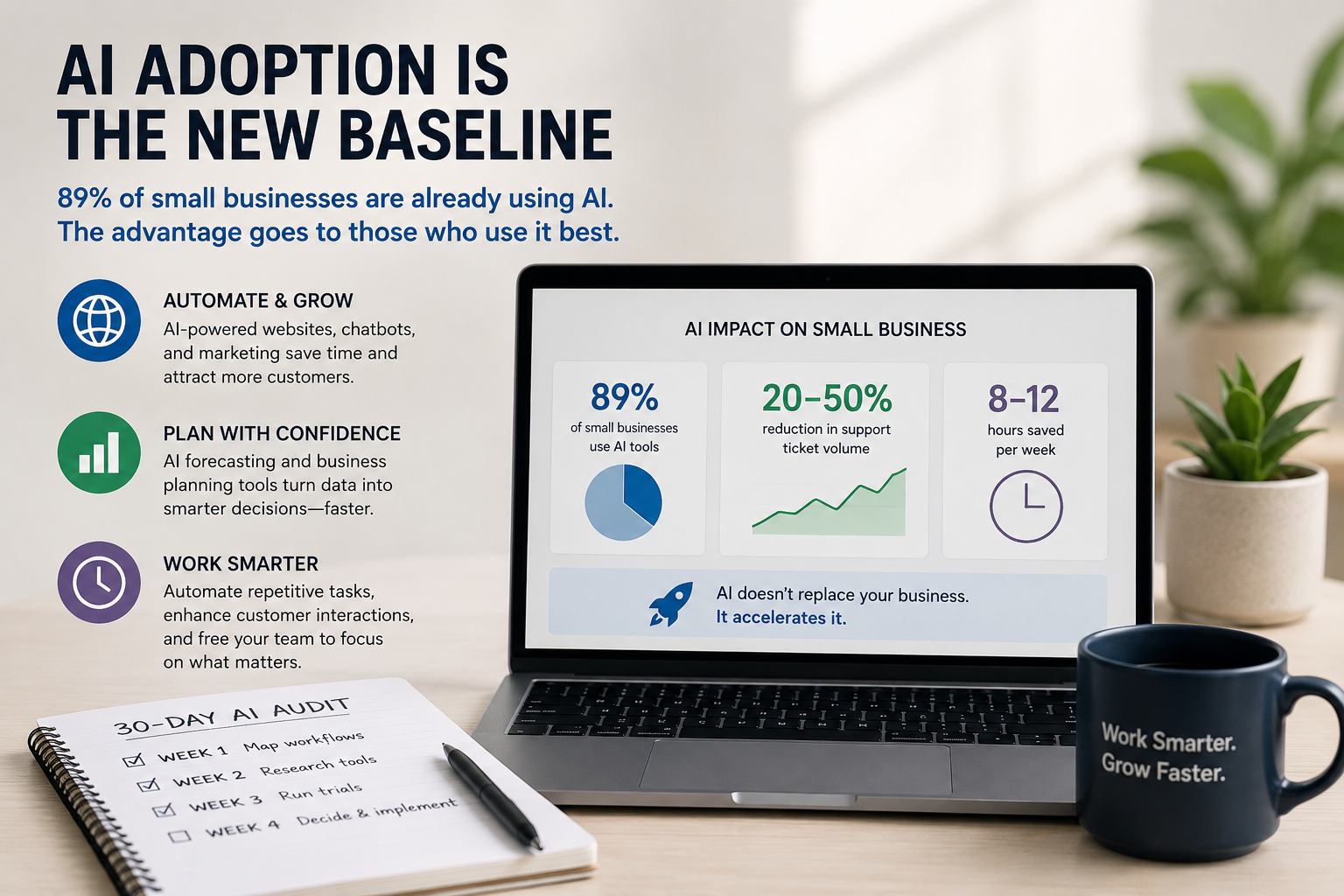
By 2026, 89% of small businesses have integrated AI tools into their operations. If you're still evaluating whether AI is worth the investment, that number should shift your thinking: AI adoption is no longer a differentiator—it's a baseline expectation. The businesses pulling ahead aren't those experimenting with AI; they're those systematically applying it to their highest-friction workflows.
This shift happened faster than most predicted. Three years ago, AI felt experimental. Today, it's operational infrastructure. The question isn't whether to use AI—it's which tools solve your specific bottlenecks and how to implement them without disrupting existing workflows.
Where Small Businesses Deploy AI Most Effectively
The 89% adoption figure masks important details about where AI actually drives value. Two categories dominate small business AI use:
1. Website and Digital Presence Automation
Tools like Hostinger—which integrates AI-powered website builders—handle design, copywriting, and basic SEO optimization without requiring a freelancer or designer. For a solopreneur or 5-person team, this eliminates 20-40 hours of initial website setup and reduces ongoing maintenance overhead.
The math: Hiring a web designer costs $2,000–$8,000 upfront. AI-powered builders cost $12–$30/month. Over 12 months, you save $1,760–$7,640 while maintaining a professional online presence.
Beyond static websites, AI tools now handle customer-facing tasks: chatbots answer support questions 24/7, reducing your team's support ticket volume by 30–50%. Email automation tools use AI to segment audiences and personalize messaging, increasing open rates by 15–25% compared to generic campaigns.
2. Business Planning and Financial Forecasting
Software like LivePlan uses AI to generate financial projections, cash flow forecasts, and business plan documentation—tasks that historically required hiring a business consultant or accountant for $3,000–$10,000.
Specific capability: LivePlan's AI engine can ingest your historical revenue data and generate 24-month financial forecasts in under 5 minutes. You adjust assumptions (growth rates, seasonal patterns, cost structure), and the AI recalculates P&Ls, balance sheets, and cash flow statements instantly. This means you can stress-test scenarios (best case, worst case, realistic case) in an afternoon instead of asking your accountant for multiple versions over weeks.
The output directly feeds into loan applications, pitch decks, and board meetings. You're not just saving consultant fees—you're making faster, more informed decisions about inventory, hiring, and pricing.
Three AI Adoption Patterns That Work for Small Teams
Pattern 1: Automate Repetitive Admin (Immediate ROI)
Start with highest-volume, lowest-complexity tasks. Invoice processing, lead qualification, scheduling, data entry, and report generation are ideal candidates.
- Invoice processing: AI OCR tools extract invoice data automatically, cutting manual data entry time by 90%.
- Lead qualification: AI reviews incoming inquiries and scores them by conversion likelihood, so your sales team prioritizes high-value prospects first.
- Scheduling: AI assistants (like Calendly with AI scheduling) coordinate meeting times across multiple participants without back-and-forth emails.
For teams of 5–15 people, automating these tasks reclaims 8–12 hours per week across the organization. That's roughly one full-time equivalent employee worth of capacity, redirected to revenue-generating work.
Pattern 2: Enhance Customer Interaction (Retention Driver)
89% adoption includes robust AI deployment in customer-facing channels. Chatbots, personalized recommendations, and proactive support reduce churn while improving satisfaction scores.
Concrete example: An e-commerce business integrates an AI product recommendation engine. Instead of showing all products equally, the engine learns customer browsing patterns and purchase history, then recommends items tailored to each visitor. Result: average order value increases 12–18%, and customers feel understood.
For service businesses, AI scheduling systems handle booking complexity (timezone management, availability windows, cancellation policies) automatically, reducing friction in the sales process.
Pattern 3: Augment Decision-Making (Speed and Confidence)
AI tools like LivePlan, Tableau, and industry-specific analytics platforms turn raw data into actionable insights. Instead of waiting for a report, you get real-time dashboards that answer: Are we on track? Where are we bleeding money? Which customer segment is most profitable?
This matters most when you're making capital-intensive decisions (hiring, inventory investment, pricing changes). AI-driven analysis reduces decision-making time from weeks to days, which translates directly to competitive advantage in fast-moving markets.
Common Pitfalls: How 11% of Businesses Are Still Missing Out
If 89% have adopted AI, the remaining 11% share a few patterns worth avoiding:
- Tool sprawl: Deploying 8–10 disconnected AI tools creates integration chaos. Start with 2–3 core tools that connect (most platforms now offer API integrations) and expand deliberately.
- Expecting magic: AI requires clean input data and clear objectives. If you feed an AI tool garbage data or vague instructions, you get garbage output. Spend time defining workflows first.
- Skipping change management: Tools don't fail; teams fail to adopt them. Budget 30–50% of your AI implementation effort toward training and buy-in from staff who'll actually use the tools daily.
- Over-automating relationships: Not every customer interaction should be automated. High-touch decisions, contract negotiations, and relationship-deepening conversations still require humans. Use AI to handle volume, reserve your team for value.
Your 30-Day AI Audit: A Concrete Starting Point
If you haven't formally audited your AI readiness, here's a structured approach:
Week 1: Map your top 5 time-consuming workflows. For each, estimate hours spent per week and hourly cost (salary ÷ 2,080 hours/year). This identifies your biggest ROI opportunities.
Week 2: Research AI tools in your industry category. Look for tools that integrate with your existing stack (accounting software, CRM, project management platform). Request demos focused on your specific workflows, not feature lists.
Week 3: Run a 14-day trial on your top 2 candidates. Track actual time savings and integration friction. Involve the team member who'll own the tool daily—their feedback matters more than executives'.
Week 4: Make a go/no-go decision on your first tool, incorporating team feedback. If you proceed, allocate 2–3 hours per week over the next month to training and workflow refinement.
The Real Competitive Advantage
The 89% statistic reflects a mature market: AI adoption is table-stakes, not differentiation. The advantage now belongs to businesses that integrate AI across multiple workflows and chain tools together thoughtfully. A solopreneur using AI for website building, customer support, and financial forecasting operates with the overhead structure of someone with 2–3 employees. A 10-person team using AI across sales, operations, and customer success functions like a 15-person team.
That's not hype. That's how 89% of small businesses are already competing. The question is whether you're among them.