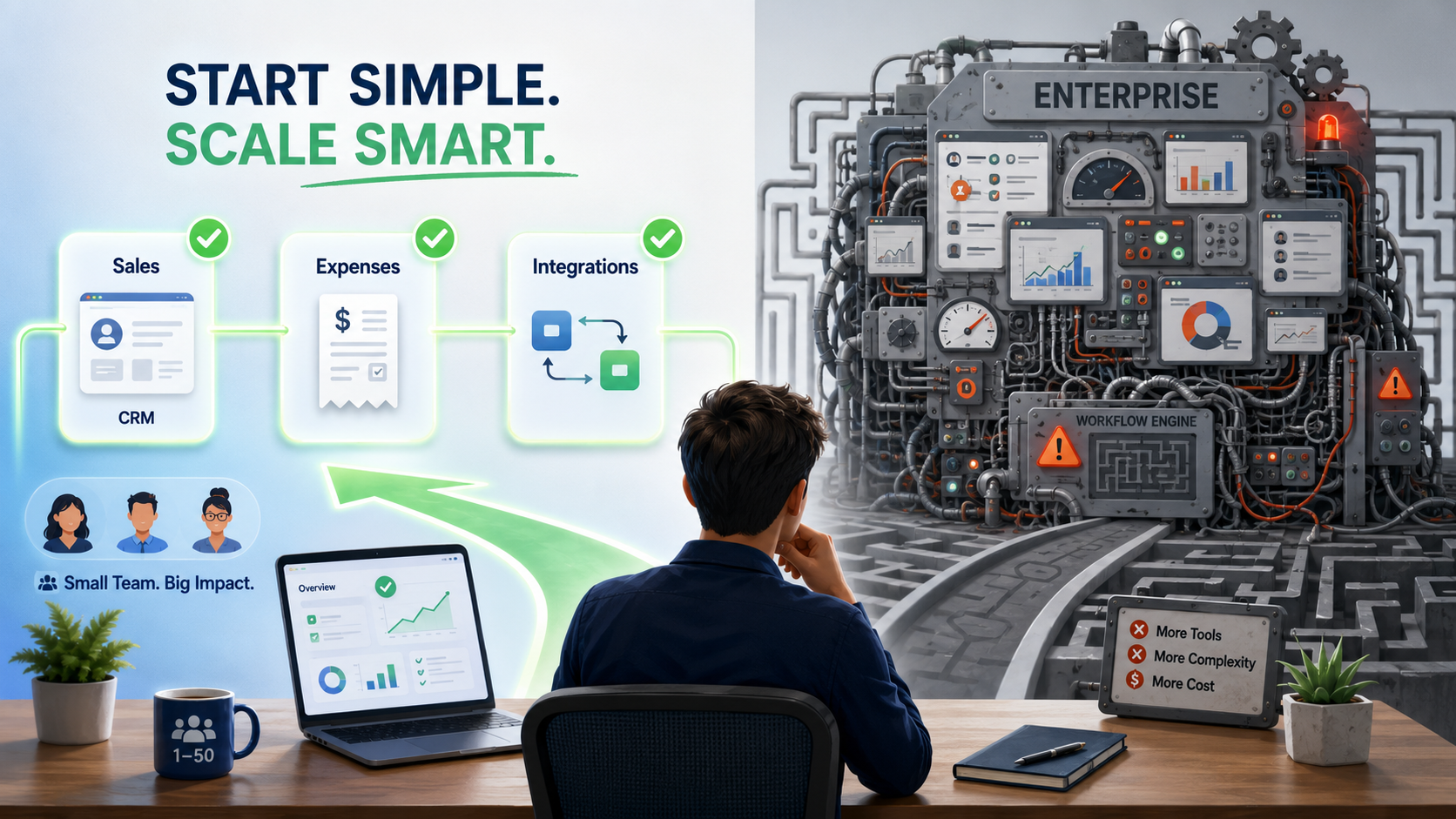
The Automation Trap Most Small Businesses Fall Into
You've heard it before: automation saves time and money. But here's what nobody tells you—buying enterprise-grade automation software when you have 5 employees is like leasing a warehouse to store office supplies. The result? You're paying for features you'll never use while drowning in setup complexity.
The real insight from analyzing small business automation trends is this: scale matters more than feature count. Companies with 1-50 employees need different automation strategies than those with 200+ employees. Your constraint isn't capability—it's bandwidth and budget.
What Actually Gets Automated at Small Companies
When small business owners implement automation successfully, they focus on three specific areas:
- Sales pipeline management (ActiveCampaign, Zoho CRM)
- Expense tracking and approval (Expensify)
- App-to-app data flow (Zapier)
Notice what's absent? Inventory management systems. Network administration tools. Software distribution platforms. Those are enterprise problems. You don't have them yet—and you shouldn't be paying for them.
The companies winning at automation right now aren't trying to automate everything. They're automating the specific repetitive task that costs them the most time. That's the differentiator.
Sales Automation: Where Most Small Businesses Start
Sales automation is the gateway drug for small business operations. Here's why it works:
A typical founder spends 10-15 hours per week on sales admin: follow-ups, pipeline updates, email sorting, proposal tracking. That's 500-750 hours annually doing work that machines can do.
ActiveCampaign and Zoho CRM both solve this at the small business price point ($15-50/user/month). The difference: ActiveCampaign specializes in email automation and lead scoring. Zoho integrates better if you're already using Google Workspace or want to add invoicing and support tools later.
The implementation isn't complex for a 10-person team. You spend 2-3 days mapping your sales process, connecting your email, and setting up basic automation rules. Then you stop losing leads because someone forgot to follow up.
Expense Management: The Unglamorous Killer of Cash Flow
Small teams waste staggering amounts of time on expense reports. Employees submit handwritten notes. Finance asks for receipts. Weeks pass before reimbursement. Money meant for operations sits in a buffer account.
Expensify solves this with a simple rule: photograph a receipt, the tool reads it, and it's submitted. No manual data entry. No lost receipts. No ambiguity.
For a 10-person team, this means eliminating 3-5 hours per month of administrative work. At fully loaded salary costs (~$50/hour for admin work), that's $150-250 saved monthly. Over a year, that's $1,800-3,000—far more than Expensify costs ($5-25/month per user).
Integration Automation: Connecting Tools Without Engineering
Your small team uses multiple tools: email, spreadsheets, project management, CRM, invoicing. The friction point is moving data between them. Someone manually copies information from one system to another. That's data entry. That's error-prone. That's a job for automation.
Zapier connects these tools without requiring custom code. You set a trigger ("new lead in CRM") and an action ("create row in spreadsheet"). The data flows automatically.
A realistic use case: When a customer signs up on your website, automatically add them to your email list, create a contact in your CRM, and send them a Slack notification. This used to require a developer or manual work. Now it takes 15 minutes to set up and runs forever.
For solopreneurs and tiny teams, Zapier Premium ($20/month) is often the difference between sustainable operations and constant manual busywork.
The Cost-Benefit Rule for Small Teams
Here's the framework for deciding what to automate:
- Identify a task you (or your team) do weekly. Track how long it takes.
- Calculate the annual time cost. (Hours per week × 52 weeks × your hourly rate)
- Find a tool that costs less than half that annual savings. Implement it.
If a task takes 5 hours per week and costs you $50/hour in time, that's $13,000 annually. A tool that costs $200/year is a no-brainer. A tool that costs $5,000/year isn't.
This is why small-scale automation projects work better than company-wide system overhauls. You're not betting the company on a massive software implementation. You're solving one concrete problem at a time.
The Mistake Teams Make: Over-Engineering Early
The trap is buying software meant for 500-person companies when you have 5 people. Salesforce has incredible functionality—and a 6-month implementation timeline and $120/user/month price tag. You don't need it yet.
The better path: Start with tools designed for your actual size. Zoho's suite, ActiveCampaign, Expensify, and Zapier all top out at reasonable cost even for 20-30 person teams. When you grow past that and have the budget and processes in place, then you upgrade to enterprise software.
Most small businesses never reach the point where they need Salesforce-level complexity. They get good at the basics, optimize their three core automation areas, and move on to higher-leverage problems.
Implementation Reality Check
Automation doesn't deploy itself. Here's the honest timeline for a small team:
- Week 1: Choose tool, sign up for trial, explore features (5 hours)
- Week 2: Map your current process, identify what to automate (3 hours)
- Week 3-4: Set up automation rules, test, tweak (8-10 hours)
- Week 5: Roll out to team, monitor for issues (2 hours)
Total: 18-20 hours over a month. For a 5-person team, that's less than half a week's worth of one person's time. For a 50-person team, it's invisible in the budget.
The payoff starts immediately and compounds. After three months, you're operating at a fundamentally different efficiency level.
What's Worth Automating vs. What Isn't
Automate: Repetitive data entry. Routine notifications. Email follow-ups. Invoice tracking. Expense processing. Routine reporting.
Don't automate (yet): Complex decisions. Customer judgment calls. Custom problem-solving. Relationship-building.
The rule: Automate the decisions you'd make the same way every time. Everything else still needs human judgment.
The Bottom Line
Small business automation isn't about buying the biggest toolset. It's about identifying the concrete, repetitive problem that costs your team the most time, then deploying a focused tool to solve it.
Start with one domain: sales, expenses, or integration. Get good at it. Then move to the next problem. Over six months, you'll have systematically eliminated hundreds of hours of busywork—and your team will have more energy for the work that actually moves the business forward.