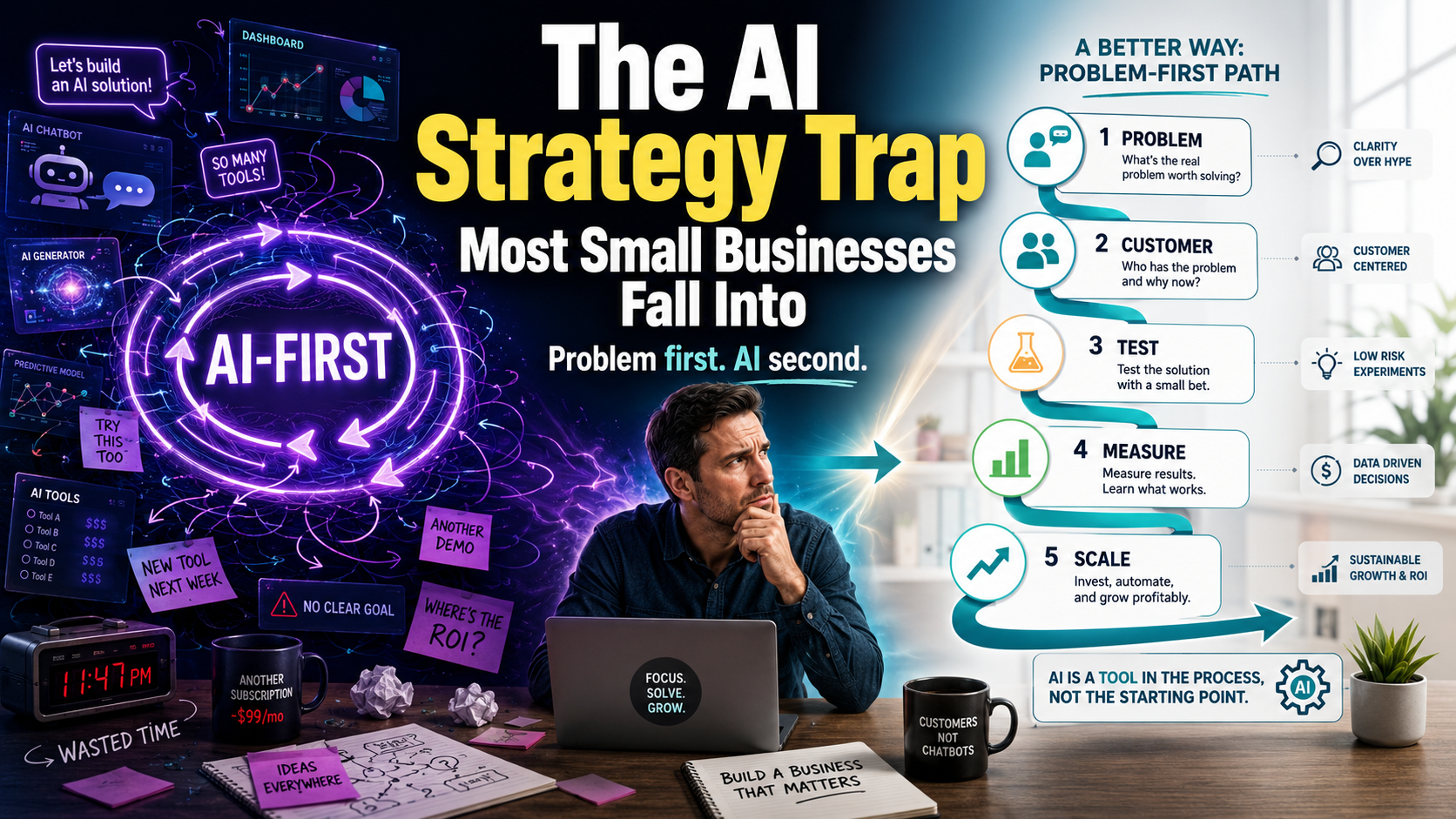
The AI Strategy Trap Most Small Businesses Fall Into
You've heard the pitch a hundred times: "Go AI-first." It's seductive advice, especially when 95% of enterprises attempting generative AI aren't seeing measurable revenue gains. But here's what most small business owners miss—"AI-first" isn't a strategy. It's an ego trip that starts with a solution instead of a problem.
According to recent analysis, AI strategies built on buzzwords rather than business fundamentals fail because they ignore three critical starting points: your actual problem, your customer's needs, and your market context. When you reverse-engineer from "AI" instead of "What does my business need?", your team wastes resources building features nobody asked for.
For solopreneurs and small teams with 1-50 employees, this is especially dangerous. You don't have the budget to experiment endlessly.
The Real Problem With "AI-First" Thinking
"AI-first is an oxymoron," according to strategy experts. Here's why: you cannot implement a solution before understanding why you need it.
When companies lack clear problem definition, customer research, and market-specific information, teams fill the void by working on whatever they think AI should do. The result? You end up building abstract solutions in search of customers instead of solving concrete business problems for real people.
- Circular strategy trap: The solution (AI) defines the goal, and the goal defines the solution. This collapses under the weight of ROI expectations.
- Too broad: "AI strategy" that includes "everything AI can do" loses focus and dilutes resources.
- Too narrow: Strategies that skip mentioning actual customer problems or market conditions miss the point entirely.
For small business owners, this matters because your competitive advantage isn't being the most AI-enabled company in your market. It's solving a specific customer problem better and faster than anyone else.
Three Steps to Build a Legitimate AI Strategy (Not Just Hype)
1. Start With a Clear, Company-Wide Vision
Before you touch a single AI tool, your entire team needs to understand why AI matters to your business and what opportunity it unlocks.
This doesn't mean writing a 40-page strategic plan. It means: Can your team of 5, 15, or 50 people articulate in one sentence what problem AI will solve for your customers?
Example: "We're using AI to reduce customer support response time from 24 hours to 2 hours, freeing our team to handle complex issues." That's clear. That's actionable. That's measurable.
Without this clarity, your team will fragment. Some will chase chatbots. Others will experiment with image generation. You'll waste months and budget on disconnected experiments.
2. Create a Controlled Testing Platform Before Full Integration
Thomson Reuters—a Fortune 500 company—didn't immediately deploy AI across all systems. Instead, they built Open Arena, an internal platform where employees could safely experiment with major LLMs (ChatGPT, Claude, Gemini, etc.) against internal company data.
You don't need an enterprise solution, but the principle applies to small teams:
- Pick one or two tools to start: ChatGPT, Claude, or Perplexity (depending on your use case). Avoid the temptation to subscribe to every AI platform.
- Set clear guardrails: Which internal data can employees use? How do they maintain confidentiality? Who owns the outputs?
- Make it human-in-the-loop: Teach your team that AI outputs are suggestions, not gospel. A founder or manager always verifies before customer-facing work ships.
- Track what works: Document which experiments reduce costs, save time, or improve quality. These become your case studies for broader rollout.
This approach reduces the risk of an expensive AI failure. You learn what actually works for your business before betting the farm on it.
3. Reimagine Core Processes, Not Just Incrementally Improve Them
The easiest (and usually most disappointing) AI move is bolting AI onto existing workflows. "Let's add a chatbot to our website." "Let's use AI to sort emails." These are Band-Aids, not breakthroughs.
Instead, ask: Given AI's capabilities today, how would I completely redesign this process from scratch?
Examples for small businesses:
- Proposal generation: Instead of manually writing proposals from templates, feed your AI platform customer details, past wins, and pricing rules. It generates a first draft in minutes instead of hours.
- Content production: Rather than having one person write all social copy, brief an AI tool on brand voice and let it generate 10 options weekly. Your team selects and refines instead of starting from zero.
- Customer onboarding: Instead of sending new customers a PDF handbook, create an AI-powered chatbot trained on your processes. It answers questions in real-time, reducing support tickets by 30-40%.
These aren't minor improvements. They're process reimagination—the kind that actually moves revenue needles.
What Gets Measured Gets Done: Build Accountability Into Your AI Strategy
Here's the uncomfortable truth: 95% of enterprises see no measurable revenue or growth from generative AI. The gap between what they thought would happen and what actually happened reveals a critical failure: no clear success metrics.
Before you deploy AI, define what winning looks like in numbers your board cares about:
- Cost reduction: "We'll cut proposal writing time by 60%, saving $X per year."
- Revenue growth: "AI-powered personalization will increase email conversion by 15%."
- Quality improvement: "Customer issue resolution time drops from 48 hours to 12 hours."
- Team capacity: "We'll handle 2x customer volume with the same headcount."
Track these metrics monthly. If they're not moving after 90 days, pause and investigate. This discipline separates AI leaders from AI hype-chasers.
The Bottom Line: Problem First, AI Second
Your small business doesn't need an "AI-first" strategy. You need a problem-first strategy with AI as one tool in the toolkit.
Here's your playbook:
- Define the specific business problem you're solving (not the technology).
- Identify which customer segment cares most about solving it.
- Test one or two AI tools against that problem in a controlled environment.
- Measure results. If ROI is positive after 90 days, scale. If not, pivot.
- Reimagine the entire process, not just patch the old one.
This takes discipline and clarity. But for small teams with limited resources, it's the only strategy worth pursuing. Everything else is just expensive experimentation.